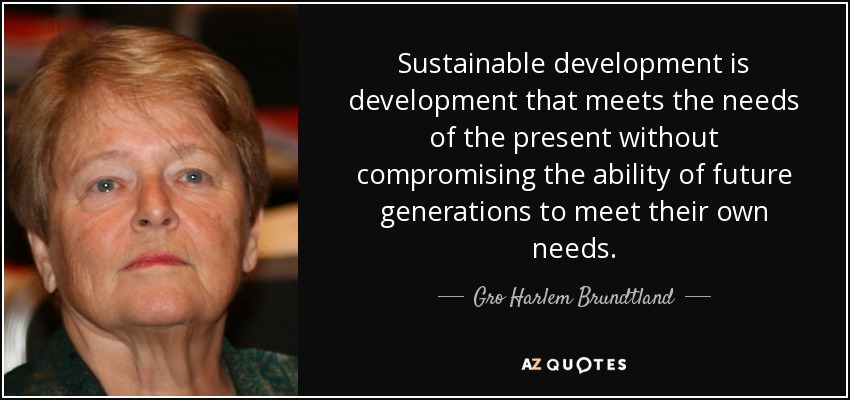
Sustainable development is development that meets the needs of the present without compromising the ability of future generations to meet their own needs.
We are taught to reinvent ourselves all the time. And nature is teaching us. What is necessary for us to do to create sustainability? There's a shift that has to take hold in our thinking, and it's hard to know when it's going to click for the larger percentage of us.
If the life-supporting ecosystems of the planet are to survive for future generations, the consumer society will have to dramatically curtail its use of resources - partly by shifting to high-quality, low-input durable goods and partly by seeking fulfillment through leisure, human relationships, and other nonmaterial avenues. We in the consumer society will have to live a technologically sophisticated version of the life-style currently practiced lower on the economic ladder.
Genuine leadership is inherently moral. So the values chosen matter tremendously, and they must be values aligned with society (including the most universal statement of human values in history, the Universal Declaration of Human Rights, as well as clear values of sustainability evidenced in global declarations like the Stockholm and Rio Declarations.
Real security, in other words, is inseparable from issues of energy policy; education; public health; preservation of soils, forests, and waters; and broadly based, sustainable prosperity.
It is much easier to make intellectual messes than it is to clarify complicated issues, especially when real solutions would challenge the status quo and require much careful thought across many fields of knowledge. Problems of climatic change, biotic impoverishment, population growth, and the choices to be made by various technologies and the transition to a sustainable and decent society with an economy that works over the long-term are difficult, complex, and intertwined problems with many possible answers.
...there's no such thing as sustainability. There are just levels of it. It's a process, not a real goal. All you can do is work toward it. There's no such thing as any sustainable economy. The only thing I know that's even close to sustainable economic activity would be organic farming on a very small scale or hunting and gathering on a very small scale. And manufacturing, you end up with way more waste than you end up with finished product. It's totally unsustainable. It's just the way it is.
It is so important not to let ourselves off the hook or to become apathetic or cynical by telling ourselves that nothing works or makes a difference. Every day, light your small candle.... The inaction and actions of many human beings over a long time contributed to the crises our children face, and it is the action and struggle of many human beings over time that will solve them-with God's help. So every day, light your small candle.
Japan's experience suggests the importance of assessing the sustainability of price stability over a fairly long period, which many central banks have emphasized in recent years.
Many years ago, I started a foundation [Wayuu Taya Foundation] to help improve the life of Latin American indigenous people, providing them with food, medical attention, education, and also focusing on sustainability.
I'm afraid what we are building today will not have the same impact and sustainability of the architecture of a 100, 500 or 1,000 years ago. The buildings of those days were miracles. We don't perform such miracles today. So we should be a little more modest. For my part, I'll be glad to show one of my buildings one day to my grandchildren and say: I'm proud of that.
I wish my artwork could persuade millions of people to join a global conversation about sustainability.
Equity, dignity, happiness, sustainability - these are all fundamental to our lives but absent in the GDP.
Sustainability is now a big baggy sack in which people throw all kinds of old ideas, hot air and dodgy activities in order to be able to greenwash their products and feel good.
From a business perspective, the question related to cities and sustainability is clear and compelling: can you have a healthy company in an unhealthy city? Arguably, no. Companies need healthy cities to provide reliable infrastructure, an educated and vital workforce, a vibrant economy, and a safe and secure environment to survive and thrive. Business executives have a lot to learn from cities, and a lot to contribute, and this book shows the way, chronicling the successes and the lessons learned about what it takes to make a city healthy, in every sense of the word.
Now comes the threat of climate crisis - a threat that is real, rising, imminent, and universal. Once again, it is the 11th hour. The penalties for ignoring this challenge are immense and growing, and at some near point would be unsustainable and unrecoverable. For now we still have the power to choose our fate, and the remaining question is only this: Have we the will to act vigorously and in time, or will we remain imprisoned by a dangerous illusion?
So long as we are under the illusion that we know best what is good for the earth and for ourselves, then we will continue our present course, with its devastating consequences on the entire Earth community... We need only listen to what the Earth is telling us... the time has come when we will listen, or we will die.
I think we have powerful role-models among us in the American West. Certainly the Hopis, a timeless civilization that understands sustainability and what that means about living in harmony, in tandem with the natural world. We have much to learn from them, and they will survive us, I feel certain about that.
We can just as easily have an economy that is based on healing the future instead of stealing it. We can either create assets for the future or take the assets of the future. One is called restoration and the other exploitation. And whenever we exploit the earth we exploit people and cause untold suffering. Working for the earth is not a way to get rich, it is a way to be rich.
It angers me when sustainability gets used as a buzz word. For 90 percent of the world, sustainability is a matter of survival.
I always make the business case for sustainability. It's so compelling. Our costs are down, not up. Our products are the best they have ever been. Our people are motivated by a shared higher purpose - esprit de corps to die for. And the goodwill in the marketplace - it's just been astonishing.
If you don't try to generate more revenues through tax reform, if you don't ask, you know, the most fortunate Americans to bear a slightly larger burden of the privilege of being an American, then you have to - the only way to achieve fiscal sustainability is through unacceptably deep cuts in benefits for middle class seniors, or unacceptably deep cuts in national security.
I used to think that my job didn't have anything to do with the environment. Then I realized that my job, as well as everyone else's job, impacts the environment in some way. And now advocating for sustainability has become my No. 1 responsibility.
If nations join together now, before the big collapse and share their resources, they can maintain a level of sustainability. Sustain the people that is, and not banks and businesses.
Every candidate running for president has got to answer the following very simple question: At a time when we need to address the planetary crisis of climate change, and transform our energy system away from fossil fuels and into energy efficiency and sustainability, should we continue to give $135 billion in tax breaks and subsidies over the next decade to fossil fuel companies?
Follow AzQuotes on Facebook, Twitter and Google+. Every day we present the best quotes! Improve yourself, find your inspiration, share with friends
or simply: