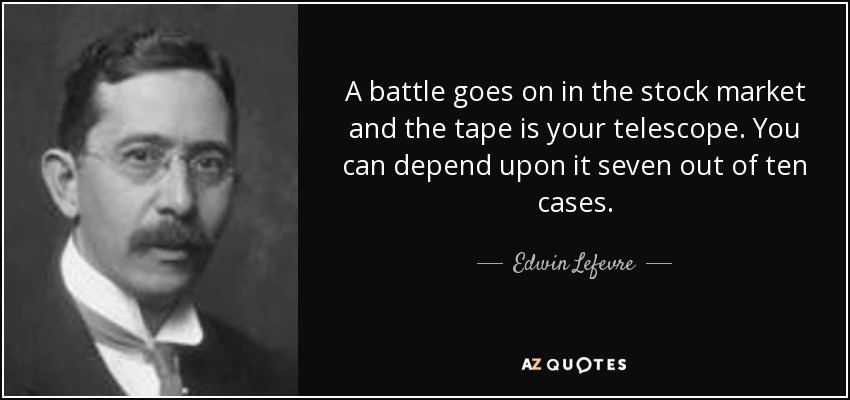
A battle goes on in the stock market and the tape is your telescope. You can depend upon it seven out of ten cases.
I read not so long ago about the construction of a large telescope in Chile's Atacama Desert, where rainfall can average a millimetre a year and the air is fifty times as dry as the air in Death Valley. Needless to say, skies over the Atacama are pristine. The pilgrim astronomer ventures to the earth's ravaged reaches in order to peer more keenly at other worlds, and I suppose the novelist is up to something similar.
I'm such a long-term investor, I've never really let go and celebrated what I did with the Hubble telescope.
No sign of purpose can be detected in any part of the vast universe disclosed by our most powerful telescopes.
What intelligent being, what being capable of responding emotionally to a beautiful sight, can look at the jagged, silvery lunar crescent trembling in the azure sky, even through the weakest of telescopes, and not be struck by it in an intensely pleasurable way, not feel cut off from everyday life here on Earth and transported toward that first step on celestial journeys?
Age and youth look upon life from the opposite ends of the telescope; it is exceedingly long,--it is exceedingly short.
there is practically no difference at all between a family and a nation, except the difference in size. A family is a nation seen through the wrong end of a telescope; a nation is a family seen through the right end of a telescope, and I don't believe it is possible to achieve a happy and successful family life, or a happy and successful national life, unless we bear this simple fact in mind and behave accordingly.
Vast objects of remote altitude must be looked at a long while before they are ascertained. Ages are the telescope tubes that must be lengthened out for Shakespeare; and generations of men serve but a single witness to his claims.
Poetry is an act of distillation. It takes contingency samples, is selective. It telescopes time. It focuses what most often floods past us in a polite blur.
Man is the highest product of his own history. The discoverer finds nothing so grand or tall as himself, nothing so valuable to him. The greatest star is at the small end, of the telescope,--the star that is looking, not looked after nor looked at.
One function of the income gap is that the people at the top of the heap have a hard time even seeing those at the bottom. They practically need a telescope. The pharaohs of ancient Egypt probably didn't was a lot of time thinking about the people who build their pyramids, either.
When asked, "How do you write?" I invariably answer, "One word at a time," and the answer is invariably dismissed. But that is all it is. It sounds too simple to be true, but consider the Great Wall of China, if you will: one stone at a time, man. That's all. One stone at a time. But I've read you can see that motherfucker from space without a telescope.
He was a physicist, more precisely an astrophysicist, diligent and eager but without illusions: the Truth lay beyond, inaccessible to our telescopes, accessible to the initiates. This was a long road which he was traveling with effort, wonderment, and profound joy. Physics was prose: elegant gymnastics for the mind, mirror of Creation, the key to man's dominion over the planet; but what is the stature of Creation, of man and the planet? His road was long and he had barely started up it, but I was his disciple: did I want to follow him?
In this way, Edwin Hubble worked out the distances to nine different galaxies. We now know that our galaxy is only one of some hundred thousand million that can be seen using modern telescopes, each galaxy itself containing some hundred thousand million stars.
Justice based purely on laws is about as accurate as a portrait created out of large low-resolution color pixels. If you stand back far enough it looks good. Come any closer and the glaring approximations overtake all semblance of the original. Justice should be viewable under the microscope, not from a telescope. And for that it needs to be based not on law but on truth.
Most people, looking back at their childhood, see it as a misty country half-forgotten or only to be remembered through an evocative sound or scent, but some episodes of those short years remain clear and brightly coloured like a landscape seen through the wrong end of a telescope.
At one point consciousness-altering devices like the microscope and telescope were criminalized for exactly the same reasons that psychedelic plants were banned in later years. They allow us to peer into bits and zones of Chaos.
I never really understood that massive collaboration involving hundreds of people is what makes movies possible, and it's also why I would agree that curiosity is not the most important human trait; the urge to collaborate is. Heck . . . only we have the ability to cooperate to make like online communities and space telescopes and imaginariums and movies. So the great thrill of this whole experience [my novel being made into a movie] for me was . .. .seeing humanity do what it's best at, which ultimately is not competing but cooperating.
If there is no solace in the fruits of our research, there is at least some consolation in the research itself. Men and women are not content to comfort themselves with tales of gods and giants, or to confine their thoughts to the daily affairs of life; they also build telescopes and satellites and accelerators and sit at their desks for endless hours working out the meaning of the data they gather.
We know there are billions of stars and planets literally out there, and the universe is getting bigger. We know from our fancy telescopes that just in the last two years more than 20 planets have been identified outside our solar system that seem to be far enough away from their suns - - and dense enough - - that they might be able to support some form of life. So it makes it increasing less likely that we're alone. But if we were visited someday, I wouldn't be surprised.
'As a fraction of your tax dollar today, what is the total cost of all spaceborne telescopes, planetary probes, the rovers on Mars, the International Space Station, the space shuttle, telescopes yet to orbit, and missions yet to fly?' Answer: one-half of one percent of each tax dollar. Half a penny. I'd prefer it were more: perhaps two cents on the dollar. Even during the storied Apollo era, peak NASA spending amounted to little more than four cents on the tax dollar.
Countless women are alive today because of ideas stimulated by a design flaw in the Hubble Space Telescope.
Students using astrophysical textbooks remain essentially ignorant of even the existence of plasma concepts, despite the fact that some of them have been known for half a century. The conclusion is that astrophysics is too important to be left in the hands of astrophysicists who have gotten their main knowledge from these textbooks. Earthbound and space telescope data must be treated by scientists who are familiar with laboratory and magnetospheric physics and circuit theory, and of course with modern plasma theory.
I wanted to understand things and then be free of them. I needed to learn how to telescope things, ideas. Things were too big to see all at once, like all the books in the library-everything laying around on all the tables. You might be able to put it all into one paragraph or into one verse of a song if you could get it right.
My dear Kepler, what would you say of the learned here, who, replete with the pertinacity of the asp, have steadfastly refused to cast a glance through the telescope? What shall we make of this? Shall we laugh, or shall we cry?
Follow AzQuotes on Facebook, Twitter and Google+. Every day we present the best quotes! Improve yourself, find your inspiration, share with friends
or simply: