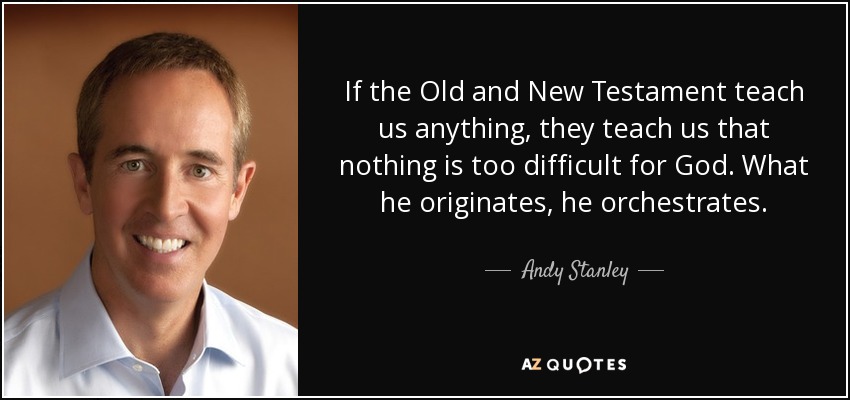
If the Old and New Testament teach us anything, they teach us that nothing is too difficult for God. What he originates, he orchestrates.
The city of Hiroshima stands as more than a monument to massive death and destruction. It stands as a living testament to the necessity for progress toward nuclear disarmament.
My biography of Jesus is probably the first popular biography that does not use the New Testament as its primary source material.
Lukewarm people feel secure because they attend church, made a profession of faith at age twelve, were baptized, come from a Christian family, vote Republican, or live in America. Just as the prophets in the Old Testament warned Israel that they were not safe just because they lived in the land of Israel, so we are not safe just because we wear the label 'Christian' or because some people persist in calling us a 'Christian nation.
When you read the New Testament, you see the Holy Spirit was supposed to change everything so that this gathering of people who call themselves Christians had this supernatural element about them.
There is heat in freezing...be a testament!
First, it is not unimportant that the legislative texts of the Old Testament are placed in the mouth of Moses and within the narrative framework of the sojourn at Sinai.
Nordie's at Noon is an honest and inspiring testament to [these authors'] experiences which, I am completely confident... will inspire thousands of women as it inspired me.
We call on all members of America's religious communities, as a testament of our common faith, to join Faithful Security, and to take action immediately to break faith with nuclear weapons.
Some, in their curiosity, will say, "But you Mormons have another Bible! Do you believe in the Old and New Testaments?" I answer we do believe in the Old and New Testaments, and we have also another book, called the Book of Mormon. What are the doctrines of the Book of Mormon? The same as those of the Bible.
Contemporary Christian proclamation is faced with the question whether, when it demands faith from men and women, it expects them to acknowledge this mythical world picture from the past. If this is impossible, it has to face the question whether the New Testament proclamation has a truth that is independent of the mythical world picture, in which case it would be the task of theology to demythologize the Christian proclamation.
It is impossible to repristinate a past world picture by sheer resolve, especially a mythical world picture, now that all of our thinking is irrevocably formed by science. A blind acceptance of New Testament mythology would be simply arbitrariness; to make such acceptance a demand of faith would be to reduce faith to a work.
We cannot use electric lights and radios and, in the event of illness, avail ourselves of modern medical and clinical means and at the same time believe in the spirit and wonder world of the New Testament.
Would you say that any one sacred book is superior to all others in the world? ... I say the New Testament, after that, I should place the Koran, which in its moral teachings, is hardly more than a later edition of the New Testament. Then would follow according to my opinion the Old Testament, the Southern Buddhist Tripitaka, the Tao-te-king of Laotze, the Kings of Confucius, the Veda and the Avesta.
Everything that happens in the Old Testament is a "type" or adumbration of something that happens in the New Testament, and the whole subject is therefore called typology, though it is a typology in a special sense.
The Book of Revelation, difficult as it may be for "literalists," becomes much simpler when we read it typologically, as a mosiac of allusions to Old Testament prophecy.
Philo of Alexandria introduced in the first century what has been described as the 'Hellenizing of the Old Testament,' or the allegorical method of exegesis. By this, as Erdmann observes, the Bible narrative was found to contain a deeper, and particularly an allegorical interpretation, in addition to its literal interpretation; this was not conscious disingenuousness but a natural mode of amalgamating the Greek philosophic with the Hebraic doctrines.
I regard Abraham as my ancestor. Some of the greatest inspiration I have got has come from what we call the Old Testament prophets and what Jews would say "our prophets."
It is a testament to our naïveté about culture that we think that we can change it by simply declaring new values. Such declarations usually produce only cynicism.
Richard [Carrier] takes the extremist position that Jesus of Nazareth never even existed, that there was no such person in history. This is a position that is so extreme that to call it marginal would be an understatement; it doesn't even appear on the map of contemporary New Testament scholarship.
Towards orthodox religion, father's own attitude remained one of tolerance. He looked upon the New Testament as the noble story of a human being which, because of ignorance and the lack of printing presses, had become exaggerated. He maintained that religions served their purpose; some people depended on them all their lives to make them honest. Others did not need to be so held in line. But subjection to any church was a reflection on strength and character. You should be able to get from yourself what you had to go go church for.
The Jews emerge into history, not a nation of keen spiritual aspirations and altruistic ethics, but that pagan people, worshipping rocks, sheep and cattle, and spirits of caves and wells, of whom the Old Testament, tending towards its higher ideal, gives fragmentary but convincing evidence.
The two Testaments are interesting, each in its own way. The Old one gives us a picture of these people's Deity as he was before he got religion, the other one gives us a picture of him as he appeared afterward.
The Christians think I am making a mistake by not trying the New Testament and meeting Jesus. The Jews tend to think I am making a mistake by reading without support from educated people. After all, there is 2,000 years of scholarship about the book, they say, so it's perverse of me to ignore it.
People are weird. We do live on all levels at the same time and you can be fighting and flirting, and there can be fury and sexual tension. All that stuff can co-exist so it's just a testament to how complex we are. Or maybe it's a testament to how boringly we try and simplify everything.
Follow AzQuotes on Facebook, Twitter and Google+. Every day we present the best quotes! Improve yourself, find your inspiration, share with friends
or simply: