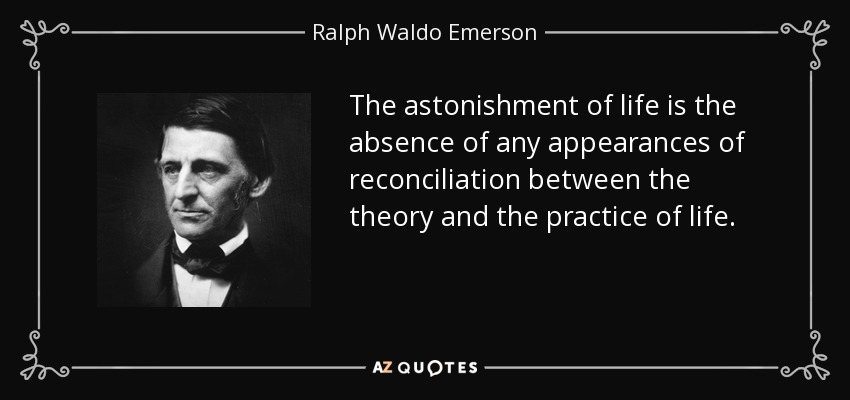
The astonishment of life is the absence of any appearances of reconciliation between the theory and the practice of life.
[Referring to Fourier's mathematical theory of the conduction of heat] ... Fourier's great mathematical poem.
The history of acceptance of new theories frequently shows the following steps: At first the new idea is treated as pure nonsense, not worth looking at. Then comes a time when a multitude of contradictory objections are raised, such as: the new theory is too fancy, or merely a new terminology; it is not fruitful, or simply wrong. Finally a state is reached when everyone seems to claim that he had always followed this theory. This usually marks the last state before general acceptance.
[Gauss calculated the elements of the planet Ceres] and his analysis proved him to be the first of theoretical astronomers no less than the greatest of 'arithmeticians.'
It took Einstein ten years of groping through the fog to get the theory of special relativity, and he was a bright guy.
Indeed, nothing more beautifully simplifying has ever happened in the history of science than the whole series of discoveries culminating about 1914 which finally brought practically universal acceptance to the theory that the material world contains but two fundamental entities, namely, positive and negative electrons, exactly alike in charge, but differing widely in mass, the positive electron-now usually called a proton-being 1850 times heavier than the negative, now usually called simply the electron.
Dissections daily convince us of our ignorance of the seats of diseases, and cause us to blush at our prescriptions. How often are we disappointed in our expectation from the most certain and powerful of our remedies, by the negligence or obstinacy of our patients! What mischief have we done under the belief of false facts and false theories! We have assisted in multiplying diseases. We have done more — we have increased their mortality.
Without theory, practice is but routine born of habit. Theory alone can bring forth and develop the spirit of invention. ... [Do not] share the opinion of those narrow minds who disdain everything in science which has not an immediate application. ... A theoretical discovery has but the merit of its existence: it awakens hope, and that is all. But let it be cultivated, let it grow, and you will see what it will become.
I worked on true Baconian principles, and without any theory collected facts.
What I remember most clearly was that when I put down a suggestion that seemed to me cogent and reasonable, Einstein did not in the least contest this, but he only said, 'Oh, how ugly.' As soon as an equation seemed to him to be ugly, he really rather lost interest in it and could not understand why somebody else was willing to spend much time on it. He was quite convinced that beauty was a guiding principle in the search for important results in theoretical physics.
Men act like brutes in so far as the sequences of their perceptions arise through the principle of memory only, like those empirical physicians who have mere practice without theory.
A great part of its theories derives an additional charm from the peculiarity that important propositions, with the impress of simplicity on them, are often easily discovered by induction, and yet are of so profound a character that we cannot find the demonstrations till after many vain attempts; and even then, when we do succeed, it is often by some tedious and artificial process, while the simple methods may long remain concealed.
The field of experience is the whole universe in all directions. Theory remains shut up within the limits of human faculties.
The problem with intelligent-design theory, is not that it is false but that it is not falsifiable. Not being susceptible to contradicting evidence, it is not a testable hypothesis. Hence it is not a scientific but a creedal tenet - a matter of faith, unsuited to a public school's science curriculum.
In fact, nothing in science as a whole has been more firmly established by interwoven factual information, or more illuminating than the universal occurrence of biological evolution. Further, few natural processes have been more convincingly explained than evolution by the theory of natural selection, or as it has been popularly called, Darwinism.
We may as well cut out group theory. That is a subject that will never be of any use in physics.
What good does the theory [of economics] do if it is not working for people?
Difficulties arise when reported observations seem to conflict with 'facts' that the majority of scientists accept as established and immutable. Scientists tend to reject conflicting observations.....Nevertheless, the history of science shows that new observations and theories can eventually prevail.
The great revelation of the quantum theory was that features of discreteness were discovered in the Book of Nature, in a context in which anything other than continuity seemed to be absurd according to the views held until then.
We must alter theory to adapt it to nature, but not nature to adapt it to theory.
We may affirm of Mr. Buffon, that which has been said of the chemists of old; though he may have failed in attaining his principal aim, of establishing a theory, yet he has brought together such a multitude of facts relative to the history of the earth, and the nature of its fossil productions, that curiosity finds ample compensation, even while it feels the want of conviction.
It is going to be necessary that everything that happens in a finite volume of space and time would have to be analyzable with a finite number of logical operations. The present theory of physics is not that way, apparently. It allows space to go down into infinitesimal distances, wavelengths to get infinitely great, terms to be summed in infinite order, and so forth; and therefore, if this proposition [that physics is computer-simulatable] is right, physical law is wrong.
My theory is, strong people don't need strong leaders.
It is a capital mistake to theorize before you have all the evidence. It biases the judgment.
There's a theory, one I find persuasive, that the quest for knowledge is, at bottom, the search for the answer to the question: Where was I before I was born. In the beginning was what? Perhaps, in the beginning, there was a curious room, a room like this one, crammed with wonders; and now the room and all it contains are forbidden you, although it was made just for you, had been prepared for you since time began, and you will spend all your life trying to remember it.
Follow AzQuotes on Facebook, Twitter and Google+. Every day we present the best quotes! Improve yourself, find your inspiration, share with friends
or simply: