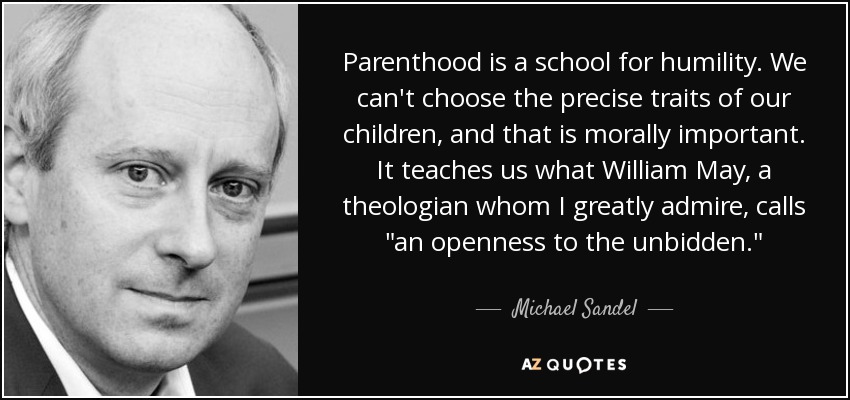
Parenthood is a school for humility. We can't choose the precise traits of our children, and that is morally important. It teaches us what William May, a theologian whom I greatly admire, calls "an openness to the unbidden."
The norm of unconditional parental love, I think, depends on the fact that we don't pick and choose the traits of our children in the way that we pick and choose the features of a car we might order, or a consumer good.
For me parks are good when first of all, they're not impeccable, and when solitude has appropriated them in such a way that solitude itself becomes an emblem, a defining trait for walkers, sporadic at best, who in my opinion should be irrevocably lost or absorbed in thought, and a bit confused, too, as when one walks through a space that's at once alien and familiar.
If we go too far down the road of choosing the genetic traits of children, my worry is that parenting will be less a kind of school for humility than it should be, and we will become too accustomed to regarding children as instruments of our ambition and of our desires.
No one's supposed to be the president. This is not England. And it's not just the Bush family, all families designate each child as having some particular trait.
I made the rules I figured I could be the one to break them. I thought I would write about xenophobia, a hatred of foreigners. After I stated writing the story there was not a foreigner to be had. I did not want to just stick one in there so I could get a title out of it since it seemed like cheating. I never figured out how I could get out of this dilemma so I just called it X and weaved X traits into the story.
I never left my roots. You can identify me as someone that didn't become high and mighty. Humility is a defining [trait] all of us can forever learn, and I try to be as humble as anyone can be.
One trait stands out in nearly all meteorites: metal; they've got it. So, the best way to find a meteorite is to hear it first.
If only I had discipline, but alas, it is only an obsessive-compulsive trait and the beauty of habit that causes me to return again and again to my work.
Showing the addiction and unusual sexual practices are ways of just outlining a much bigger character trait.
I believe deeply that every one of us has an individual talent or trait that can be used to make a difference in some way.
An inquiring, analytical mind; an unquenchable thirst for new knowledge; and a heartfelt compassion for the ailing - these are prominent traits among the committed clinicians who have preserved the passion for medicine.
It is a common trait of primates to become submissive and even worshipful toward one who has the power to kill them.
Through this experience [of makimg movies], I recognized what an extraordinary set of personality traits it takes to be able to succeed in that world, and I was really drawn to the character work we could build with actors as a result.
I would hesitate to say the characters [ in Bink & Gollie] are too related to either to us [me and Alison McGhee], but they certainly draw on our physical traits and personality traits and then exaggerate them to the nth degree.
There are things about us that make us who we are, personality traits, or capacities that we have, or knowledge we possess or that we don't possess, habits we have that are good or bad.
There are personality traits, or baggage from their backgrounds, goals that they have and the first thing I need to do is understand and then acknowledge and then accept those properties. That's kind of the baseline requirement to have a productive relationship.
Evolutionary biologists often appeal to parsimony when they seek to explain why organisms "match" with respect to a given trait. For example, why do almost all the organisms that are alive today on our planet use the same genetic code? If they share a common ancestor, the code could have evolved just once and then been inherited from the most recent common ancestor that present organisms share. On the other hand, if organisms in different species share no common ancestors, the code must have evolved repeatedly.
If the organisms in a species now have trait T, and this trait now helps those organisms to survive and reproduce because the trait has effect E, a natural hypothesis to consider is that T evolved in the lineage leading to those current organisms because T had effect E. This hypothesis is "natural," but it often isn't true!
Darwin and his successors have railed against the fallacy of confusing the current utility of a trait with the reason the trait evolved. For example, Darwin argued that skull sutures in mammals did not evolve because they facilitate live birth; the sutures were in place well before live birth evolved. Checking the chronological order in which different traits evolved in a lineage is one way to test an adaptive hypothesis; the fact of common ancestry is what makes that checking possible.
Another way to test hypotheses about adaptation is to consider trait variation across a group of species instead of focusing on the trait of a single species. Rather than seeking to explain why polar bears have fur of a certain thickness, one tries to explain why bears in colder climates have thicker fur than bears in warmer climates. The former problem is hard to solve, since it is hard to say exactly what fur thickness polar bears should have if natural selection guided the evolution of that trait.
Who wins a... competition [between two traits] is massively context sensitive.
Trait X is fitter than trait Y in a population of organisms if those organisms have other biological traits T and live in an environment that has properties E. The theory of natural selection is filled with statements of this form.
One admirable trait in women is their lack of illusions about themselves. They never reason about their most blameworthy actions; their feelings carry them away. Even their dissimulation comes naturally to them, and in them crime is free of all baseness. Most of the time they simply do not know how it happened.
In the Negro countenance you will often meet with strong traits of benignity. I have felt yearnings of tenderness towards some of these faces.
Follow AzQuotes on Facebook, Twitter and Google+. Every day we present the best quotes! Improve yourself, find your inspiration, share with friends
or simply: