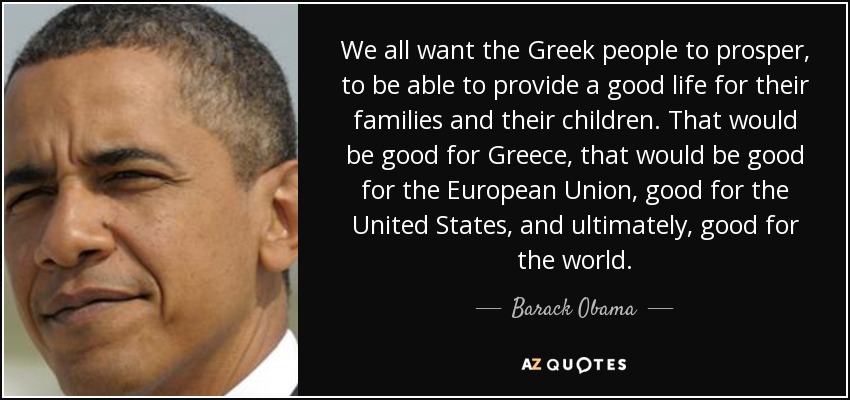
We all want the Greek people to prosper, to be able to provide a good life for their families and their children. That would be good for Greece, that would be good for the European Union, good for the United States, and ultimately, good for the world.
I am interested in making sure that the people of Cyprus will be able to live in a reunited Cyprus, where they are free, where there's a democracy, freedom and Cyprus is a member of the European Union.
I don't even know if I ever knew - some sweatshop in Baltimore. I knew with my other relatives - some of the women were in the International Ladies' Garment Workers' Union and men were shop boys and things like that. I happened to be in Philadelphia, but the family was in New York. I could see what the union was doing for them.It really saved their lives.
The community itself didn't support the union. Now that's kind of interesting about [Barack] Obama, because Obama was supposedly a community organizer in Chicago at that time. Now I'm sure he read the Chicago Tribune, so he knew about it, but when he went to show his solidarity with the workforce, the first place he went was Caterpillar. I don't think he's forgotten, and the labor movement didn't react. Even radical labor historians didn't remember. It was only 15 years ago, after all, but that's a real triumph of propaganda in many ways.
[Ronald] Reagan bitterly hated unions and wanted them destroyed. This began with the air controllers' strike and went on from there.
[Companies that specialized in how to destroy unions] don't make it a secret, and they have all sorts of techniques for management to destroy unions.
When [Bill] Clinton came along, it sort of moderated a little bit, but Clinton had a different device for breaking unions called NAFTA [North America Free Trade Agreement]. Because the government was entirely lawless, employers could exploit NAFTA to threaten union organizers with transfer. It's illegal, but when you've got a lawless government, it doesn't matter if it's illegal. I think the number of union drives blocked increased by about 50 percent.
They [unions] used straight Marxist rhetoric [in 1930s] - just the values were changed.
The Second World War ended with a radicalization of the population in the United States and everywhere else, and called for all kinds of things like popular takeovers, government intervention, and worker takeovers of factories. Business propagated a tremendous propaganda offensive. The scale surprised me when I read the scholarship - it's enormous, and it's been very effective. There were two major targets: one is unions, the other is democracy.
Very, very often in movie sex you see this fiction about unity. A union. That somehow these two thinking beings become one, and there's one action and they're sort of perfectly in sync, and the lighting's perfect, and they've got their eyes closed, and they're gone, you know? And then you cut to someone having a cigarette. And it's all so much Novocain. Meanwhile, those of us us watching it are going "I'm never going to tell anybody, but I never have sex like that".
When you have powerful unions, you have a working class that is politicized.
I should also say that apart from the negotiations that are taking place within the WTO, we are ourselves involved in all manner of bilateral negotiations, or, if they are not bilateral, with the South African Customs Union and the European Union. All the member countries of the European Union have now ratified the agreement that we have with the EU and that opens up the EU market in various ways.
There are established processes of consultation between the Government, the parastatals and the trade unions, which have worked in the past. And I don't see any particular reason why they shouldn't work.
The matters I am talking about regarding the ports. That matter has been discussed with the unions, and agreed, and therefore there is no particular reason why there should be a problem about it. We will continue to move like that. We need the engagement of the unions in these processes.
While the United States (US) can view the war as a success, Europe must see it as a failure for it and, in particular, for the institutions of the European Union (EU).
Back in the days of the Soviet Union, the countries of Eastern Europe, being under the control of the USSR, would call their states "people's republics." The sham that is currently going on in the states of the former Soviet Union is due to the fact that the politicians in power are eager to polish up their image abroad.
There are exceptions of course, like for instance the Baltic States, which are members of the European Union, together with Ukraine and Moldova, as well. In those countries, the governments have been reformed as a result of elections.
As for the eastern part of the former Soviet Union, the picture is rather uniform. Authoritarian structures prevail to differing extents. But we can still determine certain regularities, and the role of Russia is not to be underestimated. It is clear that we would have the same situation in Tajikistan and, let's say, Uzbekistan without the direct influence of Russia.
There's a whole range of areas that we'll be looking at, so I'm not at this very early stage going to specify any particular areas. As you will know, there will be a limit to how far we can go in terms of a formal free trade agreement until we've actually left the European Union. I think there is much that we [with Donald Trump] can do in the interim in terms of looking at how we can remove some of the barriers to trade in a number of areas.
I'm convinced that a trade deal between the U.S. and the U.K. is in the national interest of both countries and will cement the crucial relationship that exists between us, particularly as the U.K. leaves the European Union and reaches out to the world.
I've lived long enough to see the triumph of zealots and absolutists, to watch money swallow politics, to witness the rise of the corporate state. See the party of working and poor people become a sycophant of crony capitalism. Watch the union of church and state become fashionable again. Witness the coupling of news and entertainment. See everyday people cast overboard as the pirates and predators of Wall Street seized the ship of state. I didn't drift; I moved left just by standing still.
I don't think that the Soviet Union and China are accidents, aberrations; I think they follow from Marxism-Leninism. I think that Leninism comes out of Marx's basic convictions.
Since 9/11 the United States has been followed by countries with bad records, such as the former Soviet Union countries, into erosions of human rights. Because the United States has changed its standards it is undermining civil liberties elsewhere.
Finance ministers and central bank governors have the seats at the table, not labor unions or labor ministers. Finance ministers and central bank governors are linked to financial communities in their countries, so they push policies that reflect the viewpoints and interests of the financial community and barely hear the voices of those who are the first victims of dictated policies.
[Ho Chi Minh] was always conscious that conditions in China and Vietnam were not always the same. He "kowtowed" to the Chinese - as he had to the Soviet Union - in order to receive their assistance, but he quietly worked to limit those forms of influence of which he did not approve (such as the harsh forms of land reform and the Great Leap Forward). Unfortunately, he was not always successful in fending off those forms of external advice that he didn't agree with.
Follow AzQuotes on Facebook, Twitter and Google+. Every day we present the best quotes! Improve yourself, find your inspiration, share with friends
or simply: