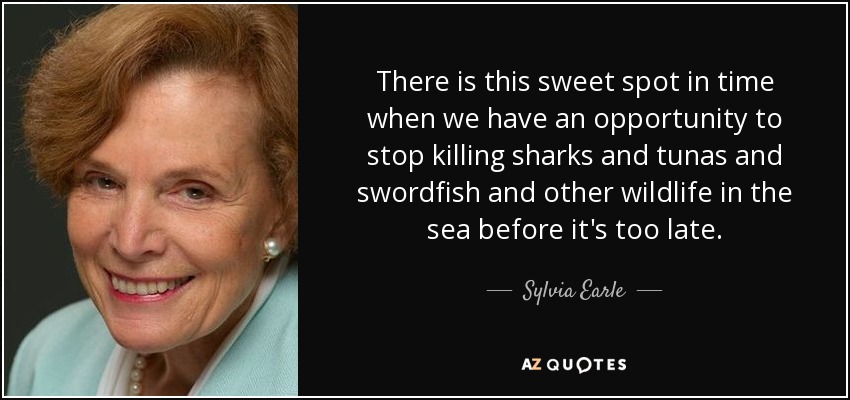
There is this sweet spot in time when we have an opportunity to stop killing sharks and tunas and swordfish and other wildlife in the sea before it's too late.
As I stood, I took in a last breath of spring-scented air, listened to the birdsong, and then saw a member of wildlife the conservationists hadn't planned on reviving in this place. A perv in a white shirt and polyester pants. A standard hide-in-the-bushes-and-whack-it perv. Fat and balding, it was as appealing as watching a giant marshmallow go at it.
We have found ways to capture, kill and market ocean wildlife on an unprecedented scale. It's an absolute catastrophe.
Good farmers, who take seriously their duties as stewards of Creation and of their land's inheritors, contribute to the welfare of society in more ways than society usually acknowledges, or even knows. These farmers produce valuable goods, of course; but they also conserve soil, they conserve water, they conserve wildlife, they conserve open space, they conserve scenery.
That's the trouble with the world we live in. It's full of people just doing their job and ignoring what's really going on. Care about the rainforest until they get a couple of kids and enough money for a gas guzzling car, or some hardwood dining furniture. Watch all those wildlife programmes and coo over the furry animals, but still eat meat and poultry that was raised in conditions of unbelievable cruelty.
I am passionate about making sure that we collectively and proactively preserve all of the world's most iconic coastal and oceanic wild places - those keystone ecosystems that are irreplaceable, breathtakingly beautiful refuges for fish and other marine wildlife.
We are all consumers of wildlife. We may not realize it but there's probably something in your home or something you own that came from wildlife.
The territorial body has been polluted by roads, elevators, etc. Similarly, our animal body starts being polluted. Ecology no longer deals with water, flora, wildlife and air only. It deals with the body itself as well. It is comparable with an invasion: technology is invading our body because of miniaturisation.
I live on a canyon at the edge of San Mateo. We are fortunate to have lots of suburban wildlife as our neighbors, though I kind of wish the rattlesnakes would stop curling up by our back door.
I'm driving down the freeway the other day, on my way to Knott's Scary Farm probably, and I hear this report on NPR that the whole lemmings thing was faked in the 1950s. They were shooting a wildlife documentary in the '50s, they found a group of lemmings, and the crew chased them all off a cliff. No lemming has ever jumped off a cliff, purposefully, ever. Isn't that unbelievable?
There is a lot of corruption all over the world and not only when it comes to illegal wildlife trade! There are a few ways to ensure this stops: If there are no customers, there will be no trade.
We are facing an enormous crisis in Africa right now in terms of illegal wildlife trafficking, which is decimating animal populations, destroying local economies, and funding armed insurgencies and terrorist syndicates. If we do not find solutions to this crisis now, there will be little habitat left beyond sparse areas of national parks that will serve as glorified zoos to small pockets of remaining animals.
For conservation to succeed, we must embrace conservation models where people use their natural resources to create jobs, to grow economies, and to feed their people while protecting wildlife and Africa's iconic species.
In addition to tourism, it is essential to employ other ways to benefit more from the use of natural resources than from their destruction - from wildlife breeding operations to - yes - hunting of abundant species where viable.
We conservatives bemoan the decline in values that has besieged our society. Why then should we not abhor the lack of morality involved in discharging untested chemicals into the air, ground, and water to alter and harm, to whatever degree, human life and wildlife? As a conservative, I do abhor it.
Looking around the world at these wildlife, it's abundantly clear that humans have benefited from nature in so many ways but have also brought many species to the brink of extinction...The American people that I interact with through my IS Foundation work do not want to allow this to happen; they do not want to let these species go without a fight; and they see the way in which nature provides for people around the world.
Eating wildlife is probably not the smartest thing that we can do in terms of maintaining the integrity of natural systems.
The city (regardless which one it is) does provide a certain degree of sophistication and intellectualism. It offers the challenge of professional matters. It throws new and interesting people in one's path. There is a dynamic and an energy in cities which is diametric to the life-forces of the forest. Still the cabin is the wellspring, the source, the hub of my existence. It gives me tranquility, a closeness of nature and wildlife, good health and fitness, a sense of security, the opportunity for resourcefulness, reflection and creative thinking.
I have often thought that my work with wildlife taught me the meaning of patience, and my work with the big trees taught me the meaning of humility, and my work with the ice has taught me the meaning of mortality.
If asked to sketch a picture of the typical archer I would be hard put. They seem to come in all shapes, sizes, colors and backgrounds. Inwardly they seem to have in common a love for the outdoors, a reverence for wildlife, and a close tie with history. There is nothing they seem to enjoy more than telling tall tales around a campfire or talking about archery to others. It would be difficult to find a more interesting group of people.
Go afield with a good attitude, with respect for the wildlife you hunt and for the forest and fields in which you walk. Immerse yourself in the outdoor experience. It will cleanse your soul and make you a better person.
I grew up in a home where animals were ever-present and often dominated our lives. There were always horses, dogs, and cats, as well as a revolving infirmary of injured wildlife being nursed by my sister the aspiring vet. Without any conscious intention on my part, animals come to play a significant role in my fiction: in Three Junes, a parrot and a pack of collies; in The Whole World Over, a bulldog named The Bruce. To dog lovers, by the way, I recommend My Dog Tulip by J. R. Ackerley -- by far the best 'animal book' I've ever read.
Our lifestyle, our wildlife, our land and our water remain critical to our definition of Wyoming and to our economic future.
We should start by allowing drilling in Alaska's National Wildlife Refuge. It can provide billions of barrels of recoverable oil and trillions of cubic feet of recoverable natural gas.
One researcher just determined that African and Indian elephants make each other sick. When a new animal or plant is introduced to a habitat bad things happen. The biggest danger to native wildlife is foreign wildlife.
Follow AzQuotes on Facebook, Twitter and Google+. Every day we present the best quotes! Improve yourself, find your inspiration, share with friends
or simply: