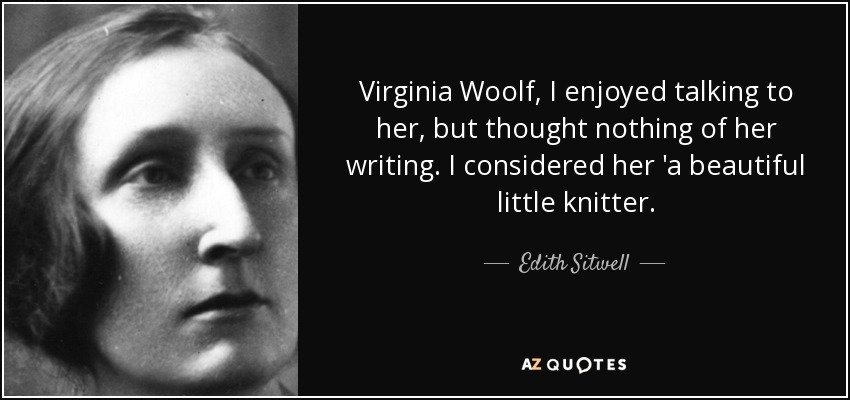
Virginia Woolf, I enjoyed talking to her, but thought nothing of her writing. I considered her 'a beautiful little knitter.
When I saw Virginia Woolf, somewhere between the first and second acts, someone I had known as my mother became somebody else.
Virginia Woolf wrote, "Across the broad continent of a woman's life falls the shadow of a sword." On one side of that sword, she said, there lies convention and tradition and order, where all is correct. But on the other side of that sword, if you're crazy enough to cross it and choose a life that does not follow convention, "all is confusion." Nothing follows a regular course. Her argument was that the crossing of the shadow of that sword may bring a more interesting existence to a woman, but you can bet it will be more perilous.
For pain words are lacking. There should be cries, cracks, fissures, whiteness passing over chintz covers, interference with the sense of time, of space ; the sense also of extreme fixity in passing objects ; and sounds very remote and then very close ; flesh being gashed and blood sparting, a joint suddenly twisted - beneath all of which appears something very important, yet remote, to be just held in solitude.” — Virginia Woolf, The Waves
Like all her friends, I miss her greatly...But...I am sure there is no case for lamentation...Virginia Woolf got through an immense amount of work, she gave acute pleasure in new ways, she pushed the light of the English language a little further against darkness. Those are facts.
I think one of the primary goals of a feminist landscape architecture would be to work toward a public landscape in which we can roam the streets at midnight, in which every square is available for Virginia Woolf to make up her novels
A middle-aged woman who looked like someone's cleaning lady, a shrieking adolescent lunatic and a talkshow host with an orange face... It didn't add up. Suicide wasn't invented for people like this. It was invented for people like Virginia Woolf and Nick Drake. And Me. Suicide was supposed to be cool.
Throughout much of history, women writers have capitulated to male standards, and have paid too much heed to what Virginia Woolf calls "the angel in the house." She is that little ghost who sits on one's shoulder while one writes and whispers, "Be nice, don't say anything that will embarrass the family, don't say anything your man will disapprove of ..." [ellipsis in original] The "angel in the house" castrates one's creativity because it deprives one of essential honesty, and many women writers have yet to win the freedom to be honest with themselves.
Insofar as I think about postmodernism at all, and it doesn't exactly keep me awake at nights, I think of it as something that happens to one, not a style one affects. We're postmoderns because we're not modernists. The modernist writersPound, Eliot, Joyce, Stevens, Yeats, Woolf, Williamsspoke with a kind of vatic authority: they were really the last of the Romantics, for whom authorship itself was like being a solitary prophet in the wasteland.
In the end I created a career of my own, concentrating on my writing and lecturing, reaching larger audiences than I would had I ended up with tenure and a full teaching load. It was Virginia Woolf who said that it is terrible to be frozen out of a sacred tradition - but even more terrible to be frozen into it.
I don't think there is a 'gay lifestyle.' I think that's superficial crap, all that talk about gay culture. A couple of restaurants on Castro Street and a couple of magazines do not constitute culture. Michelangelo is culture. Virginia Woolf is culture. So let's don't confuse our terms. Wearing earrings is not culture.
Virginia Woolf came along in the early part of the century and essentially said through her writing, yes, big books can be written about the traditional big subjects. There is war. There is the search for God. These are all very important things.
Virginia Woolf said that writers must be androgynous. I'll go a step further. You must be bisexual.
Who's Afraid of Virginia Woolf?
If you find yourself born in Barnsley and then set your sights on being Virginia Woolf it is not going to be roses all the way.
When you think about Broadway, you think broad and big, but the fact is there are so many plays that are very intimate, but fill a 1,500-seat house. Plays like 'Who's Afraid of Virginia Woolf?' have deep moments of silence and intimacy to them.
Like my hero Virginia Woolf, I do lack confidence. I always find that the novel I'm finishing, even if it's turned out fairly well, is not the novel I had in my mind. I think a lot of writers must negotiate this, and if they don't admit it, they're not being honest.
Virginia Woolf's great novel, 'Mrs. Dalloway,' is the first great book I ever read. I read it almost by accident when I was in high school, when I was 15 years old.
As an actor, to go and see those shows - great plays like 'Who's Afraid of Virginia Woolf?' and Clifford Odets's 'Golden Boy' - it's so exhilarating. I'd personally love to perform the role of Jerry in Edward Albee's 'The Zoo Story.' He's a transient, lost soul, and an example of humanity at its rawest.
I think the kind of unexpected I really love is when you open books and the actual way of writing is different and interesting. Like reading Virginia Woolf for the first time or Lawrence Durrell for the first time.
She pulled off Virginia Woolf's To the Lighthouse and settled down in a comfortable leather chair by the fire to read.
I've always loved my own little office spaces no matter what they were like. It's the Virginia Woolf, room of one's own concept, it's really important.
If you're writing an opinion piece, it's your job to write your opinion. If, on the other hand, you wrote a novel, as Virginia Woolf tells us, it would be inappropriate if you let your novel be influenced by your political opinions.
I woke up full of hate and fear the day before the most recent peace march in San Francisco. This was disappointing: I'd hoped to wake up feeling somewhere between Virginia Woolf and Wavy Gravy.
It's rather splendid to think of all those great men and women who appear to have presented symptoms that allow us to describe them as bipolar. Whether it's Hemingway, Van Gogh... Robert Schumann has been mentioned... Virginia Woolf, Sylvia Plath... some of them with rather grim ends.
Follow AzQuotes on Facebook, Twitter and Google+. Every day we present the best quotes! Improve yourself, find your inspiration, share with friends
or simply: