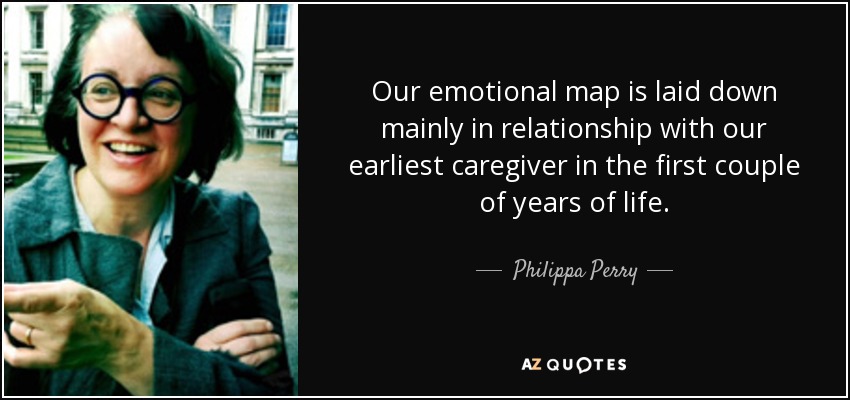
Our emotional map is laid down mainly in relationship with our earliest caregiver in the first couple of years of life.
We have good reason to believe that memories of early childhood do not persist in consciousness because of the absence or fragmentary character of language covering this period. Words serve as fixatives for mental images. . . . Even at the end of the second year of life when word tags exist for a number of objects in the child's life, these words are discrete and do not yet bind together the parts of an experience or organize them in a way that can produce a coherent memory.
Let us not live a life … that would bring regret. … It is not going to matter very much how much money you made, what kind of a house you lived in, what kind of a car you drove, the size of your bank account—any of those things. What is going to matter is that dear woman who has walked with you side by side as your companion through all of the years of life and those children and grandchildren and great-grandchildren and their faithfulness and their looking to you … with respect and love and deference and kindness.
One discovers a friend by chance, and cannot but feel regret that 20 or 30 years of life may have been spent without the least knowledge of him.
The closing years of life are like the end of a masquerade party, when the masks are dropped.
The first ten, twelve or fifteen years of life are excavated of inherent moral worth in order to accommodate a regimen of basic training for the adult years that many of the poorest children may not even live to know.
The first forty years of life give us the text; the next thirty supply the commentary on it.
I have lived eighty years of life and know nothing for it, but to be resigned and tell myself that flies are born to be eaten by spiders and man to be devoured by sorrow.
If the years of youth are experienced slowly, while the later years of life hurtle past at an ever-increasing speed, it must be habit that causes it. We know full well that the insertion of new habits or the changing of old ones is the only way to preserve life, to renew our sense of time, to rejuvenate, intensify, and retard our experience of time - and thereby renew our sense of life itself. That is the reason for every change of scenery and air.
Child psychologists have demonstrated that our minds are actually constructed by these thousands of tiny interactions during the first few years of life. We aren't just what we're taught. It's what we experience during those early years - a smile here, a jarring sound there - that creates the pathways and connections of the brain. We put our kids to fifteen years of quick-cut advertising, passive television watching, and sadistic video games, and we expect to see emerge a new generation of calm, compassionate, and engaged human beings?
I was 30 when 9/11 happened and I had lived exactly 15 years of life in America, so I was half American. I was a full-fledged New Yorker.
I see now how things even up, how they are squared away, and how they balance under the law of love and justice. No year of life is emotionally, spiritually or even materially, all drought or all rainfall; nor is it all sun. The road turns a little every day, and one day there's a sudden twist we didn't dream was there, and for every loss there is somewhere a gain, for every grief a happiness, for every deprivation a giving.
Sir Walter, with his 61 years of life, although he never wrote a novel until he was over 40, had, fortunately for the world, a longer working career than most of his brethren.
If the bee disappeared off the surface of the globe, then man would have only four years of life left. No more bees, no more pollination, no more plants, no more animals, no more man.
Man is not the most majestic of the creatures; long before the mammals even, the dinosaurs were far more splendid. But he has what no other animal possesses: a jigsaw of faculties, which alone, over three thousand million years of life, made him creative. Every animal leaves traces of what he was. Man alone leaves traces of what he created.
If you want to succeed in your life, remember this phrase: That past does not equal the future. Because you failed yesterday; or all day today; or a moment ago; or for the last six months; the last sixteen years; or the last fifty years of life, doesn't mean anything... All that matters is: What are you going to do, right now?
Learning to speak, therefore, and the power it brings of intelligent converse with others, is a most impressive further step along the path of independence ... Learning to walk is especially significant, not only because it is supremely complex, but because it is done in the first year of life.
After 13 years of life on the half shell in Hollywood, I have made a trip where I wasn't a tourist.
How so many absurd rules of conduct, as well as so many absurd religious beliefs, have originated, we do not know; nor how it is that they have become, in all quarters of the world, so deeply impressed on the minds of men; but it is worthy of remark that a belief constantly inculcated during the early years of life, while the brain is impressionable, appears to acquire almost the nature of an instinct; and the very essence of an instinct is that it is followed independently of reason.
If our society were truly to appreciate the significance of children's emotional ties throughout the first years of life, it would no longer tolerate children growing up or parents having to struggle in situations which could not possibly nourish healthy growth.
One of the best investments we can make is to give our kids the ingredients they need to develop in the first five years of life.
Each year of life brings us nearer to our decline, but I will continue to seek a listener until I'm dead in a ditch.
We belong to that order of mammals, the primates, distinguished by its propensity for repeated single litters, intense parental care, long life-spans, late sexual maturity, and a complex and extensive social existence... Our protracted biological and psychological helplessness, which extends well into the third year of life, intensifies the bond between infant and parents, making possible a sense of generational continuity. In contrast to other primates these bonds are not obliterated after sexual maturity.
As important as the father is in the life of a child, even he must take second place to mother during the first three years of life.... Consequently, mothers actually have more to do with producing a predisposition toward homosexuality than fathers. Two kinds of mothers are particularly harmful - smother mothers and dominating mothers.
Man is at his furthest remove from the animal as a child, his intellect most human. With his fifteenth year and puberty he comes astep closer to the animal; with the sense of possessions of his thirties (the median line between laziness and greediness), still another step. In his sixtieth year of life he frequently loses his modesty as well, then the septuagenarian steps up to us as a completely unmasked beast: one need only look at the eyes and the teeth.
Follow AzQuotes on Facebook, Twitter and Google+. Every day we present the best quotes! Improve yourself, find your inspiration, share with friends
or simply: