Competition is merely the absence of oppression.
There is only one difference between a bad economist and a good one: the bad economist confines himself to the visible effect; the good economist takes into account both the effect that can be seen and those effects that must be foreseen.
I find it hard to understand why those who demand Unitary Education by the State do not also demand a Unitary Press by the State... Either the State is infallible, in which case we could not do better than to submit to it the entire domain of intelligent thought, or it is not, in which case it is no more rational to hand over education to it than the press.
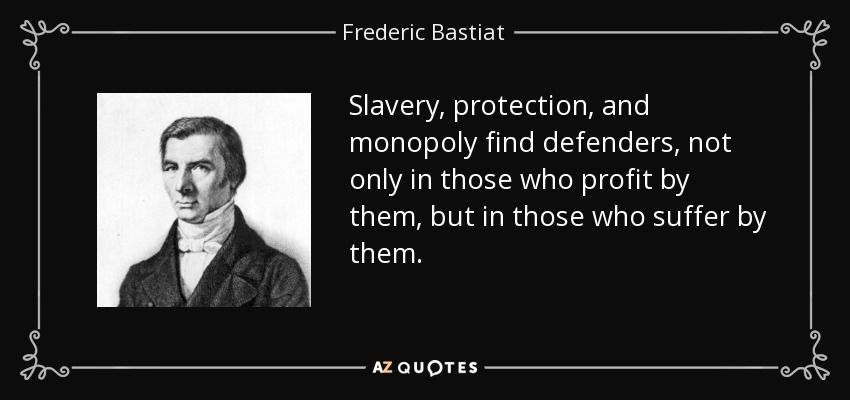
Slavery, protection, and monopoly find defenders, not only in those who profit by them, but in those who suffer by them.
All you have to do, is to see whether the law takes from some what belongs to them in order to give it to others to whom it does not belong. We must see whether the law performs, for the profit of one citizen and to the detriment of others, an act which that citizen could not perform himself without being guilty of a crime. Repeal such a law without delay. ... [I]f you don't take care, what begins by being an exception tends to become general, to multiply itself, and to develop into a veritable system.
They would be the shepherds over us, their sheep. Certainly such an arrangement presupposes that they are naturally superior to the rest of us. And certainly we are fully justified in demanding from the legislators and organizers proof of this natural superiority.
Is not liberty the destruction of all despotism - including, of course, legal despotism?
It is impossible to introduce into society a greater change and a greater evil than this: the conversion of the law into an instrument of plunder.
The mind never fully accepts any convictions that it does not owe to its own efforts.
Which countries contain the most peaceful, the most moral, and the happiest people? Those people are found in the countries where the law least interferes with private affairs; where the government is least felt; where the individual has the greatest scope, and free opinion the greatest influence; where the administrative powers are fewest and simplest; where taxes are lightest and most nearly equal
It is not true that the legislator has absolute power over our persons and property, since they pre-exist, and his work is only to secure them from injury. It is not true that the mission of the law is to regulate our consciences, our ideas, our will, our education, our sentiments, our works, our exchanges, our gifts, our enjoyments. Its mission is to prevent the rights of one from interfering with those of another, in any one of these things.
The people who, during the election, were so wise, so moral, so perfect, now have no tendencies whatever; or if they have any, they are tendencies that lead downward to degradation. . . . If people are as incapable, as immoral, and as ignorant as the politicians indicate, then why is the right of these same people to vote defended with such passionate insistence?
The mission of law is not to oppress persons and plunder them of their property, even thought the law may be acting in a philanthropic spirit. Its mission is to protect property.
I believe that my theory is correct; for whatever be the question upon which I am arguing, whether it be religious, philosophical, political, or economical; whether it affects well-being, morality, equality, right, justice, progress, responsibility, property, labor, exchange, capital, wages, taxes, population, credit, or Government; at whatever point of the scientific horizon I start from, I invariably come to the same thing—the solution of the social problem is in liberty.
Who then would not like to see these benefits flow upon the world from the law, as from an inexhaustible source? But is it possible? Whence does the State draw those resources that it is urged to dispense by way of benefits to individuals? Is it not from the individuals themselves? How, then, can these resources be increased by passing through the hands of a parasitic and voracious intermediary?
As long as it is admitted that the law may be diverted from its true purpose - that it may violate property instead of protecting it - then everyone will want to participate in making the law, either to protect himself against plunder or to use it for plunder.
Try to imagine a system of labor imposed by force that is not a violation of liberty; a transfer of wealth imposed by force that is not a violation of property rights. If you cannot do so, then you must agree that the law cannot organize labor and industry without organizing injustice.
Why don't you reform yourselves? That task would be sufficient enough.
Since no individual acting separately can lawfully use force to destroy the rights of others, does it not logically follow that the same principle also applies to the common force that is nothing more than the organized combination of the individual forces?
We cannot but be astonished at the ease with which men resign themselves to ignorance about what is most important for them to know; and we may be certain that they are determined to remain invincibly ignorant if they once come to consider it as axiomatic that there are no absolute principles.
Justice is achieved only when injustice is absent.
[Socialists claim] that we reject fraternity, solidarity, organization, and association; and they brand us with the name of individualists. We can assure them that what we repudiate is not natural organization, but forced organization. It is not free association, but the forms of association that they would impose upon us. It is not spontaneous fraternity, but legal fraternity. It is not providential solidarity, but artificial solidarity, which is only an unjust displacement of responsibility. Socialism . . . confounds Government and society.
If you wish to prosper, let your customer prosper. When people have learned this lesson, everyone will seek his individual welfare in the general welfare. Then jealousies between man and man, city and city, province and province, nation and nation, will no longer trouble the world.
When, then, does plunder stop? It stops when it becomes more painful and more dangerous than labor.
This question of legal plunder must be settled once and for all, and there are only three ways to settle it: (1) The few plunder the many. (2) Everybody plunders everybody. (3) Nobody plunders anybody.
Follow AzQuotes on Facebook, Twitter and Google+. Every day we present the best quotes! Improve yourself, find your inspiration, share with friends
or simply: