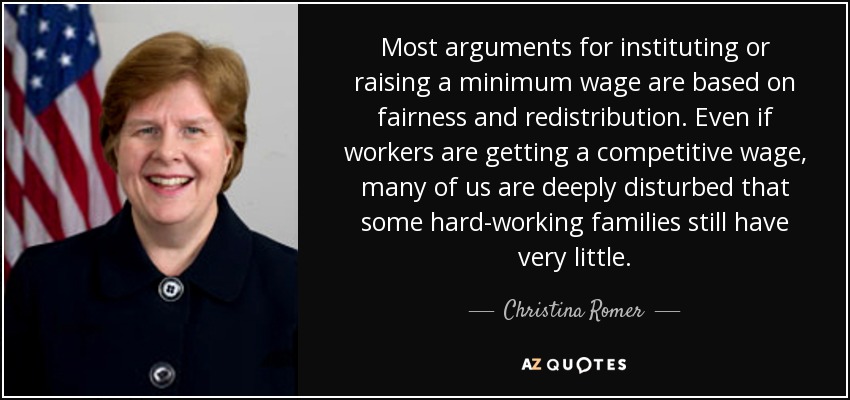
Most arguments for instituting or raising a minimum wage are based on fairness and redistribution. Even if workers are getting a competitive wage, many of us are deeply disturbed that some hard-working families still have very little.
Many of my students assume that government protection is the only thing ensuring decent wages for most American workers. But basic economics shows that competition between employers for workers can be very effective at preventing businesses from misbehaving.
Climate change and dependence on foreign oil are problems that won't go away on their own. Tabling plans to deal with them doesn't make it easier for companies to plan and invest; it makes it harder.
There's a joke in economics about the drunk who loses his keys in the street but only looks for them under the lightposts. When asked why, he says, 'because that's where the light is.' That's the problem with the deficit.
Tax increases appear to have a very large sustained and highly significant negative impact on output.
What I desire to point out is that I wish the law was not so, but that being the law, I must follow it.
Fewer people working means permanently lower tax revenues.
The goal of long-run economic growth without asset price bubbles is not only achievable, but is something we should expect if we put a sound regulatory framework in place and if policymakers remain vigilant.
A natural way that an economist approaches a problem is to say, here's where I think the economy is going; this is what we need to deal with the problem.
If every other store in town is paying workers $9 an hour, one offering $8 will find it hard to hire anyone - perhaps not when unemployment is high, but certainly in normal times. Robust competition is a powerful force helping to ensure that workers are paid what they contribute to their employers' bottom lines.
I think where I differ a little bit, we absolutely have to think about the deficit looking down the road. And certainly that's something the president has said that we need to, as the economy recovers, have a plan in place for getting it down.
A successful argument for a government manufacturing policy has to go beyond the feeling that it's better to produce 'real things' than services. American consumers value health care and haircuts as much as washing machines and hair dryers.
As a former member of President Obama's economic team, I have a soft spot for the fiscal stimulus legislation he signed just a month after his inauguration.
In the four decades after World War II, manufacturing jobs paid more than other jobs for given skills. But that is much less true today. Increased international competition has forced American manufacturers to reduce costs. As a result, the pay premium for low-skilled workers in manufacturing is smaller than it once was.
You care about the deficit because it allows you to do things you need to do to help people who are suffering.
I think something that forces financial institutions to write down underwater mortgages, I think, would be a sensible thing to do.
The very first email I got [was] from a women's group saying 'We don't want this stimulus package to just create jobs for burly men.'
Tax increases appear to have a very large sustained and highly significant negative impact on output. Since most of our exogenous tax changes are in fact reductions, the more intuitive way to express this result is that tax cuts have very large and persistent positive output effects
Our estimates suggest that a tax increase of 1 percent of GDP reduces output over the next three years by nearly 3 percent. The effect is highly significant.
You know, I think the, the crucial thing, you know, we have put in place what is, is just simply the biggest, boldest recovery package in history, right; the stimulus package, biggest ever; the financial rescue, absolutely comprehensive; a housing plan - that is incredible medicine for the economy. And we fully expect it to work.
Recent research suggests that New Deal programs may actually have had their primary impact on the economy by influencing consumer and business expectations of future growth and inflation.
Raising the minimum wage, as President Obama proposed in his State of the Union address, tends to be more popular with the general public than with economists.
President Obama has repeatedly urged Congress to let the Bush tax cuts expire for those earning more than $250,000 a year. Increasing rates on top earners is an obvious way to raise revenue from those who can afford it most.
If you look at the studies coming out of the Congressional Budget Office, the number one thing that's going to blow a hole in the deficit as we go forward 20, 30 years is government spending on healthcare.
If you think about it, candidate Obama, Sen. Obama, was running on sort of long-run economic issues, like restoring prosperity to the middle class, dealing with the perennial problem of health care in the United States. He talked a lot about the budget deficit, about the need to transition to clean energy.
Follow AzQuotes on Facebook, Twitter and Google+. Every day we present the best quotes! Improve yourself, find your inspiration, share with friends
or simply: