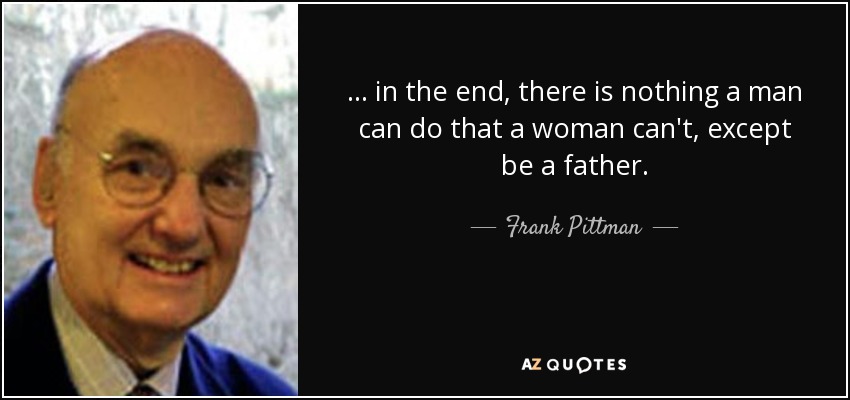




. . . in the end, there is nothing a man can do that a woman can't, except be a father.
In colonial America, the father was the primary parent. . . . Over the past two hundred years, each generation of fathers has hadless authority than the last. . . . Masculinity ceased to be defined in terms of domestic involvement, skills at fathering and husbanding, but began to be defined in terms of making money. Men had to leave home to work. They stopped doing all the things they used to do.
What we men share is the experience of having been raised by women in a culture that stopped our fathers from being close enough to teach us how to be men, in a world in which men were discouraged from talking about our masculinity and questioning its roots and its mystique, in a world that glorified masculinity and gave us impossibly unachievable myths of masculine heroics, but no domestic models to teach us how to do it.
As boys without bonds to their fathers grow older and more desperate about their masculinity, they are in danger of forming gangs in which they strut their masculinity for one another, often overdo it, and sometimes turn to displays of fierce, macho bravado and even violence.
Our father has an even more important function than modeling manhood for us. He is also the authority to let us relax the requirements of the masculine model: if our father accepts us, then that declares us masculine enough to join the company of men. We, in effect, have our diploma in masculinity and can go on to develop other skills.
The great passion in a man's life may not be for women or men or wealth or toys or fame, or even for his children, but for his masculinity, and at any point in his life he may be tempted to throw over the things for which he regularly lays down his life for the sake of that masculinity. He may keep this passion secret from women, and he may even deny it to himself, but the other boys know it about themselves and the wiser ones know it about the rest of us as well.
All those tough guys who want to scare the world into seeing them as men . . . who don't know how to be a man with a woman, only abrute or a boy, who fill up the divorce courts; all those corporate raiders and rain-forest burners and war starters who want more in hopes that will make them feel better; . . . are suffering from Father Hunger. They go through their puberty rituals day after day for a lifetime, waiting for a father to anoint them and say "Attaboy," to treat them as good enough to be considered a man.
The child who would be an adult must give up any lingering childlike sense of parental power, either the magical ability to solveyour problems for you or the dreaded ability to make you turn back into a child. When you are no longer hiding from your parents, or clinging to them, and can accept them as fellow human beings, then they may do the same for you.
Every boy was supposed to come into the world equipped with a father whose prime function was to be our father and show us how tobe men. He can escape us, but we can never escape him. Present or absent, dead or alive, real or imagined, our father is the main man in our masculinity.
The problem is simply this: no one can feel like CEO of his or her life in the presence of the people who toilet trained her and spanked him when he was naughty. We may have become Masters of the Universe, accustomed to giving life and taking it away, casually ordering people into battle or out of their jobs . . . and yet we may still dirty our diapers at the sound of our mommy's whimper or our daddy's growl.
Character, not passion keeps marriages together long enough to do their work of raising children into mature, responsible, productive citizens.
In considering the ledger equal, understand the greatest gift you have given your parents is the opportunity to raise you. The things a child gets from parents can't compare to the things a parent gets from raising a child. Only by experiencing this can you understand the degree to which children give meaning to parents' lives.
As a guy develops and practices his masculinity, he is accompanied by an invisible male chorus of all the other guys, who hiss orcheer as he attempts to approximate the masculine ideal, who push him to sacrifice more of his humanity for the sake of his masculinity, and who ridicule him when he holds back. The chorus is made up of all the guy's comrades and rivals, his buddies and bosses, his male ancestors and his male cultural heroes--and above all, his father, who may have been a real person in his life, or may have existed only as the myth of the man who got away.
We become male automatically because of the Y chromosome and the little magic peanut, but if we are to become men we need the helpof other men--we need our fathers to model for us and then to anoint us, we need our buddies to share the coming-of-age rituals with us and to let us join the team of men, and we need myths of heroes to inspire us and to show us the way.
Each generation's job is to question what parents accept on faith, to explore possibilities, and adapt the last generation's system of values for a new age.
Parents can fail to cheer your successes as wildly as you expected, pointing out that you are sharing your Nobel Prize with a couple of other people, or that your Oscar was for supporting actress, not really for a starring role. More subtly, they can cheer your successes too wildly, forcing you into the awkward realization that your achievement of merely graduating or getting the promotion did not warrant the fireworks and brass band.
There are great advantages to seeing yourself as an accident created by amateur parents as they practiced. You then have been left in an imperfect state and the rest is up to you. Only the most pitifully inept child requires perfection from parents.
Early on, girls begin to menstruate, which is dramatic but not obvious to their playmates. They grow taller and rounder, but underneath their makeup they are still recognizably themselves. For boys it is far more disorienting. Puberty comes later, sometimes much later, and its delay is humiliating. While the tall round girls are getting themselves up like grown women, the prepubertal boys, with their featureless, hairless bodies, are just dirty little kids who could pass for the children of the hypermature girls.
At the heart of male bonding is this experience of boys in early puberty: they know they must break free from their mothers and the civilized world of women, but they are not ready yet for the world of men, so they are only at home with other boys, equally outcast, equally frightened, and equally involved in posturing what they believe to be manhood.
Parents have to get over the idea that their children belong just to them; children are a family affair.
For most people, a life lived alone, with passing strangers or passing lovers, is incoherent and ultimately unbearable. Someone must be there to know what we have done for those we love.
Parents have subtle ways of humbling you, of reminding you of your origins, perhaps by showing up at the moment of your greatest glory and reminding you where you came from and demonstrating that you still have some of it between your toes.
However patriarchal the world, at home the child knows that his mother is the source of all power. The hand that rocks the cradlerules his world. . . . The son never forgets that he owes his life to his mother, not just the creation of it but the maintenance of it, and that he owes her a debt he cannot conceivably repay, but which she may call in at any time.
Family love can be a bore, but only when you are hearing it, never when you are relating it to the ones who will be carrying it out for you. A family without a storyteller or two has no way to make sense out of their past and no way to get a sense of themselves.
Nothing is quite so horrifying and paralyzing as to win the Oedipal struggle and to be awarded your mother as the prize.
Follow AzQuotes on Facebook, Twitter and Google+. Every day we present the best quotes! Improve yourself, find your inspiration, share with friends
or simply: