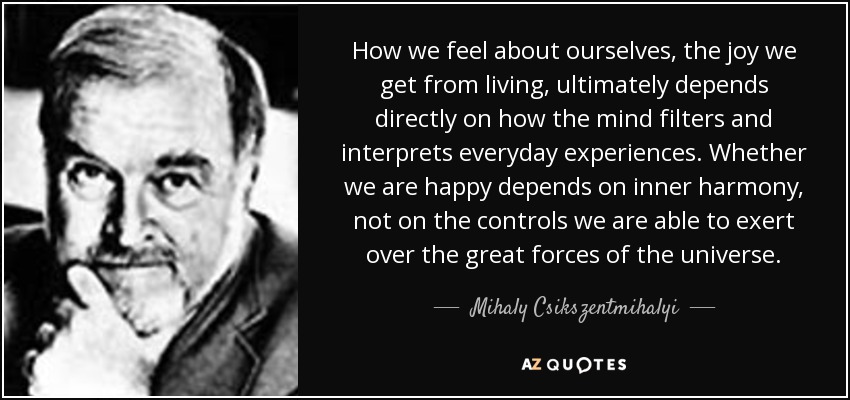
How we feel about ourselves, the joy we get from living, ultimately depends directly on how the mind filters and interprets everyday experiences. Whether we are happy depends on inner harmony, not on the controls we are able to exert over the great forces of the universe.
It is amazing how little effort most people make to improve control of their attention. If reading a book seems too difficult, instead of sharpening concentration we tend to set it aside and instead turn on the television, which not only requires minimal attention, but in fact tends to diffuse what little it commands with choppy editing, commercial interruptions, and generally inane content.
When people restrain themselves out of fear, their lives are by necessity diminished. They become rigid and defensive, and their self stops growing.
It is how we choose what we do, and how we approach it, that will determine whether the sum of our days adds up to a formless blur, or to something resembling a work of art.
For a person to become deeply involved in any activity it is essential that he knows precisely what tasks he must accomplish, moment by moment.
Flow is hard to achieve without effort. Flow is not 'wasting time.
Even without success, creative persons find joy in a job well done. Learning for its own sake is rewarding.
Few things are sadder than encountering a person who knows exactly what he should do, yet cannot muster enough energy to do it. "He who desires but acts not," wrote Blake with his accustomed vigor, "Breeds pestilence.
For original ideas to come about, you have to let them percolate under the level of consciousness in a place where we have no way to make them obey our own desires or our own direction. Their random combinations are driven by forces we don't know about.
For better or worse, our future is now closely tied to human creativity.
Some individuals have developed such strong internal standards that they no longer need the opinion of others to judge whether they have performed a task well or not. The ability to give objective feedback to oneself is in fact the mark of the expert.
Attention is like energy in that without it no work can be done, and in doing work is dissipated. We create ourselves by how we use this energy. Memories, thoughts and feelings are all shaped by how use it. And it is an energy under control, to do with as we please; hence attention is our most important tool in the task of improving the quality of experience.
Half a century ago, the Austrian psychiatrist Viktor Frankl wrote that happiness cannot be attained by wanting to be happy - it must come as the unintended consequence of working for a goal greater than oneself.
To know oneself is the first step toward making flow a part of one's entire life. But just as there is no free lunch in the material economy, nothing comes free in the psychic one. If one is not willing to invest psychic energy in the internal reality of consciousness, and instead squanders it in chasing external rewards, one loses mastery of one's life, and ends up becoming a puppet of circumstances.
Happiness is not something that happens ... It does not depend on outside events, but, rather, on how we interpret them.
Most of us become so rigidly fixed in the ruts carved out by genetic programming and social conditioning that we ignore the options of choosing any other course of action. Living exclusively by genetic and social instructions is fine as long as everything goes well. But the moment bioloical or social goals are frustrated- which in the long run is inevitable - a person must formulate new goals, and create a new flow activity for himself, or else he will always waste his energies in inner turmoil.
A person can make himself happy, or miserable, regardless of what is actually happening 'outside,' just by changing the contents of consciousness.
A paycheck is a sufficient impetus to motivate some employees to do the minimum amount to get by, and for others, the challenge of getting ahead in the organization provides a satisfactory focus for a while. But these incentives alone are rarely strong enough to inspire workers to give their best to their work. For this a vision is needed, an overarching goal that gives meaning to the job, so that an individual can forget himself in the task and experience flow without doubts or regrets. The most important component of such a vision is an ingredient we call soul.
It does not seem to be true that work necessarily needs to be unpleasant. It may always have to be hard, or at least harder than doing nothing at all. But there is ample evidence that work can be enjoyable, and that indeed, it is often the most enjoyable part of life.
Produce as many ideas as possible. Try to produce unlikely ideas.
Optimal experience is that rare occasion when we feel a sense of exhilaration, a deep sense of enjoyment that is long cherished and that becomes a landmark in memory for what life should be like.
Write down each day what surprised you and how you surprised others. When something strikes a spark of interest, follow it.
People who learn to control inner experience will be able to determine the quality of their lives, which is as close as any of us can come to being happy.
One cannot lead a life that is truly excellent without feeling that one belongs to something greater and more permanent than oneself.
Those periods of struggling to overcome challenges are what people find to be the most enjoyable times.
Follow AzQuotes on Facebook, Twitter and Google+. Every day we present the best quotes! Improve yourself, find your inspiration, share with friends
or simply: