

It is easy to see why a diversity of cultures should confront power with a problem. If culture is about plurality, power is about unity. How can it sell itself simultaneously to a whole range of life forms without being fatally diluted?
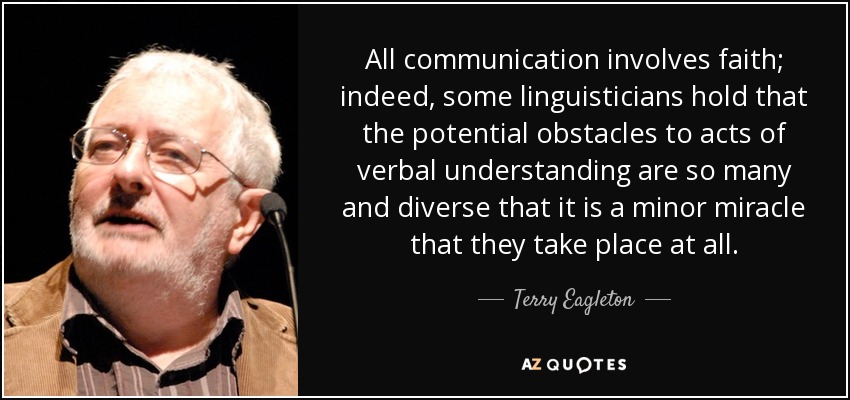
All communication involves faith; indeed, some linguisticians hold that the potential obstacles to acts of verbal understanding are so many and diverse that it is a minor miracle that they take place at all.
If the masses are not thrown a few novels , they may react by throwing up a few barricades.
All propaganda or popularization involves a putting of the complex into the simple, but such a move is instantly deconstructive. For if the complex can be put into the simple, then it cannot be as complex as it seemed in the first place; and if the simple can be an adequate medium of such complexity, then it cannot after all be as simple as all that.
It is important to see that, in the critique of ideology, only those interventions will work which make sense to the mystified subject itself.
It is true that some liberals and humanists, along with the laid-back Danes, deny the existence of evil. This is largely because they regard the word 'evil' as a device for demonising those who are really nothing more than socially unfortunate.
It is in Rousseau's writing above all that history begins to turn from upper-class honour to middle-class humanitarianism. Pity, sympathy and compassion lie at the centre of his moral vision. Values associated with the feminine begin to infiltrate social existence as a whole, rather than being confined to the domestic sphere.
Language always pre-exists us: it is always already 'in place', waiting to assign us our places within it.
In conscious life, we achieve some sense of ourselves as reasonably unified, coherent selves, and without this action would be impossible. But all this is merely at the 'imaginary' level of the ego, which is no more than the tip of the iceberg of the human subject known to psychoanalysis. The ego is function or effect of a subject which is always dispersed, never identical with itself, strung out along the chains of the discourses which constitute it.
For Aristotle, goodness is a kind of prospering in the precarious affair of being human.
Anyone can be tolerant of those who are tolerant.
Like the rest of us, Tom Paulin is a bundle of contradictions. At its finest, his work is brave, adventurous, original and wonderfully idiosyncratic.
Writing seems to rob me of my being: it is a second hand mode of communication, a pallid, mechanical transcript of speech, and so always at one remove from my consciousness.
The frontier between public and private shifts from time to time and culture to culture.
In the end, it is because the media are driven by the power and wealth of private individuals that they turn private lives into public spectacles. If every private life is now potentially public property, it is because private property has undermined public responsibility.
It is language which speaks in literature, in all its swarming 'polysemic' plurality, not the author himself.
Most students of literature can pick apart a metaphor or spot an ethnic stereotype, but not many of them can say things like: 'The poem's sardonic tone is curiously at odds with its plodding syntax.
The most compelling confirmation of Marx's theory of history is late capitalist society. There is a sense in which this case is becoming truer as time passes.
I liked early Amis a lot, but I stopped reading him some time ago. I admire Hitchens on literary topics - I think he is very astute. McEwan, I read a bit. But I suppose it's more the ideological phenomenon that they represent together that interests me.
What was needed was a literary theory which, while preserving the formalist bent of New Criticism, its dogged attention to literature as aesthetic object rather than social practice, would make something a good deal more systematic and 'scientific' out of all this. The answer arrived in 1957, in the shape of the Canadian Northrop Fryes mighty 'totalization' of all literary genres, Anatomy of Criticism .
You've got to have a sense of different audiences. I'm a kind of performer manque - I come from a long line of failed actors!
Those who sentimentally indulge humanity do it no favours.
Ideology... is a kind of contemporary mythology, a realm which has purged itself of ambiguity and alternative possibility.
Man eternally tries to get back to an organic past that has slipped just beyond his reach.
Irish fiction is full of secrets, guilty pasts, divided identities. It is no wonder that there is such a rich tradition of Gothic writing in a nation so haunted by history.
Follow AzQuotes on Facebook, Twitter and Google+. Every day we present the best quotes! Improve yourself, find your inspiration, share with friends
or simply: