


I do not know whether to be delighted or outraged by the fact that Literary Theory: An Introduction was the subject of a study by a well known U.S. business school, which was intrigued to discover how an academic text could become a best-seller.
Readers are less and less seen as mere non-writers, the subhuman "other" or flawed derivative of the author; the lack of a pen is no longer a shameful mark of secondary status but a positively enabling space, just as within every writer can be seen to lurk, as a repressed but contaminating antithesis, a reader.
What persuades men and women to mistake each other from time to time for gods or vermin is ideology. One can understand well enough how human beings may struggle and murder for good material reasons - reasons connected, for instance, with their physical survival. It is much harder to grasp how they may come to do so in the name of something as apparently abstract as ideas. Yet ideas are what men and women live by, and will occasionally die for.
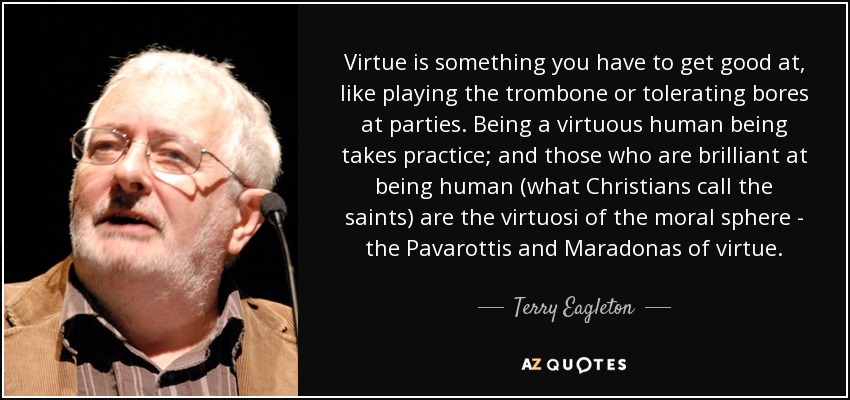
Virtue is something you have to get good at, like playing the trombone or tolerating bores at parties. Being a virtuous human being takes practice; and those who are brilliant at being human (what Christians call the saints) are the virtuosi of the moral sphere - the Pavarottis and Maradonas of virtue.
The conversion of agnostic High Tories to the Anglican church is always rather suspect. It seems too pat and predictable, too clearly a matter of politics rather than faith.
In the end, the humanities can only be defended by stressing how indispensable they are; and this means insisting on their vital role in the whole business of academic learning, rather than protesting that, like some poor relation, they don't cost much to be housed.
Follow AzQuotes on Facebook, Twitter and Google+. Every day we present the best quotes! Improve yourself, find your inspiration, share with friends
or simply: