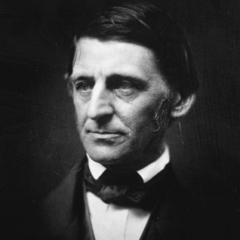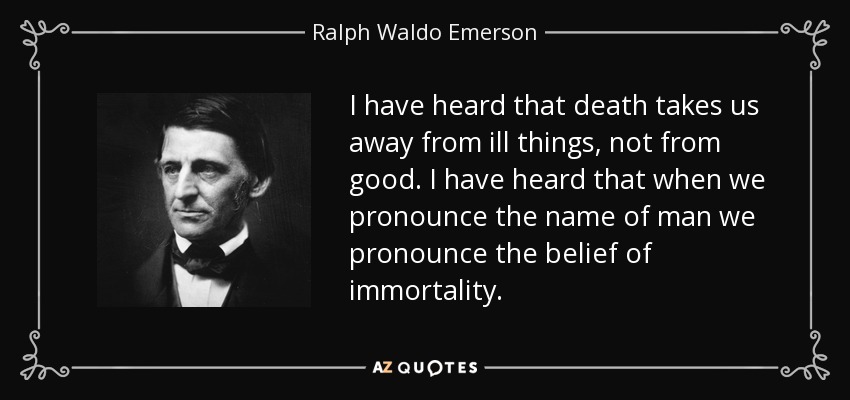


I have heard that death takes us away from ill things, not from good. I have heard that when we pronounce the name of man we pronounce the belief of immortality.
Men are what their mothers made them. You may as well ask a loom which weaves huckabuck why it does not make cashmere as to expect poetry from this engineer or a chemical discovery from that jobber.
As much wisdom may be expended on a private economy as on an empire, and as much wisdom may be drawn from it.
England, an old and exhausted island, must one day be contented, like other parents, to be strong only in her children.
Colleges, in like manner, have their indispensable office,--to teach elements. But they can only highly serve us, when they aim not to drill, but to create; when they gather from far every ray of various genius to their hospitable halls, and, by the concentrated fires, set the hearts of their youth on flame.
No man can quite emancipate himself from his age and country, or produce a model in which the education, the religion, the politics, usages, and arts, of his times shall have no share.
Since everything in nature answers to a moral power, if any phenomenon remains brute and dark, it is that the corresponding faculty in the observer is not yet active.
Man is timid and apologetic; he is no longer upright; he dares not say "I think," "I am," but quotes some saint or sage.
He is a good man, who can receive a gift well. We are either glad or sorry at a gift, and both emotions are unbecoming.
The idealism of Berkeley is only a crude statement of the idealism of Jesus, and that again is a crude statement of the fact thatall nature is the rapid efflux of goodness executing and organizing itself.
But the mark of American merit in painting, in sculpture, in poetry, in fiction, in eloquence, seems to be a certain grace withoutgrandeur, and itself not new but derivative; a vase of fair outline, but empty,--which whoso sees, may fill with what wit and character is in him, but which does not, like the charged cloud, overflow with terrible beauty, and emit lightnings on all beholders.
The Americans have many virtues, but they have not Faith and Hope. I know no two words whose meaning is more lost sight of.
We must trust infinitely to the beneficent necessity which shines through all laws. Human nature expresses itself in them as characteristically as in statues, or songs, or railroads, and an abstract of the codes of nations would be an abstract of the common conscience.
We legislate against forestalling and monopoly; we would have a common granary for the poor; but the selfishness which hoards thecorn for high prices, is the preventative of famine; and the law of self-preservation is surer policy than any legislation can be.
In old persons, when thus fully expressed, we often observe a fair, plump, perennial waxen complexion, which indicates that all the ferment of earlier days has subsided into serenity of thought and behavior.
The sentiment of virtue is a reverence and delight in the presence of certain divine laws. It perceives that this homely game of life we play, covers, under what seem foolish details, principles that astonish.
The right eloquence needs no bell to call the people together, and no constable to keep them.
The consciousness in each man is a sliding scale, which identifies him now with the First Cause, and now with the flesh of his body; life above life, in infinite degrees.
Logic is the procession or proportionate unfolding of the intuition; but its virtue is as silent method; the moment it would appear as propositions, and have a separate value, it is worthless.
Our reliance on the physician is a kind of despair of ourselves.
The stars awaken a certain reverence, because though always present, they are inaccessible.
The best conversation is rare. Society seems to have agreed to treat fictions as realities, and realities as fictions; and the simple lover of truth, especially if on very high grounds, as a religious or intellectual seeker, finds himself a stranger and alien.
In our large cities, the population is godless, materialized,--no bond, no fellow-feeling, no enthusiasm. These are not men, but hungers, thirsts, fevers, and appetites walking. How is it people manage to live on,--so aimless as they are? After their peppercorn aims are gained, it seems as if the lime in their bones alone held them together, and not any worthy purpose.
If the individuals who compose the purest circles of aristocracy in Europe, the guarded blood of centuries, should pass in review,in such manner as that we could, at leisure, and critically inspect their behavior, we might find no gentleman, and no lady; for, although excellent specimens of courtesy and high-breeding would gratify us in the assemblage, in the particulars, we should detect offence. Because, elegance comes of no breeding, but of birth.
Every man is not so much a workman in the world as he is a suggestion of that he should be. Men walk as prophecies of the next age.
Follow AzQuotes on Facebook, Twitter and Google+. Every day we present the best quotes! Improve yourself, find your inspiration, share with friends
or simply: