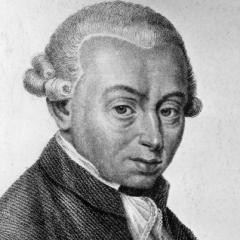
Life means to have something definite to do-a mission to fulfill-and in the measure in which we avoid setting our life to something, we make it empty. Human life, by its very nature, has to be dedicated to something.
Poetry has become the higher algebra of metaphors.
This leads us to note down in our psychological chart of the mass-man of today two fundamental traits: the free expansion of his vital desires, and, therefore, of his personality; and his radical ingratitude towards all that has made possible the ease of his existence. These traits together make up the well-known psychology of the spoilt child.
Thought is not a gift to man but a laborious, precarious and volatile acquisition.
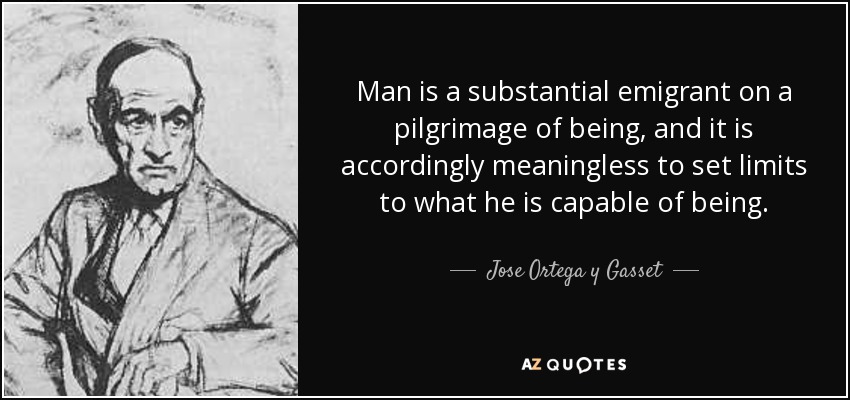
Man is a substantial emigrant on a pilgrimage of being, and it is accordingly meaningless to set limits to what he is capable of being.
The metaphor is perhaps one of man's most fruitful potentialities. Its efficacy verges on magic, and it seems a tool for creation which God forgot inside one of His creatures when He made him.
Barbarism is the absence of standards to which appeal can be made.
Nobility is defined by the demands it makes on us - by obligations, not by rights. Noblesse oblige. 'To live as one likes is plebeian; the noble man aspires to order and law.'
The metaphor is probably the most fertile power possessed by man
Man adapts himself to everything, to the best and the worst.
And this is the simple truth - that to live is to feel oneself lost. He who accepts it has already begun to find himself to be on firm ground.
Thinking is the desire to gain reality by means of ideas.
These are the only genuine ideas, the ideas of the shipwrecked. All the rest is rhetoric, posturing, farce.
The direction of society has been taken over by a type of man who is not interested in the principles of civilisation. Not of this or that civilisation but from what we can judge today of any civilisation. The type of man dominant today is a primitive one, a Naturmensch rising up in the midst of a civilised world.
Every life is, more or less, a ruin among whose debris we have to discover what the person ought to have been.
We distinguish the excellent man from the common man by saying that the former is the one who makes great demands on himself, and the latter who makes no demands on himself.
In these years we are witnessing the gigantic spectacle of innumerable human lives wandering about lost in their own labyrinths, through not having anything to which to give themselves.
The cynic, a parasite of civilization, lives by denying it, for the very reason that he is convinced that it will not fail.
Every intellectual effort sets us apart from the commonplace, and leads us by hidden and difficult paths to secluded spots where we find ourselves amid unaccustomed thoughts.
I am I plus my circumstances.
The choice of a point of view is the initial act of a culture.
The common man, finding himself in a world so excellent, technically and socially, believes it has been produced by nature, and never thinks of the personal efforts of highly endowed individuals which the creation of this new world presupposed. Still less will he admit the notion that all these facilities still require the support of certain difficult human virtues, the least failure of which would cause the rapid disappearance of the whole magnificent edifice.
There are people who so arrange their lives that they feed themselves only on side dishes.
We cannot put off living until we are ready.
An 'unemployed' existence is a worse negation of life than death itself.
Follow AzQuotes on Facebook, Twitter and Google+. Every day we present the best quotes! Improve yourself, find your inspiration, share with friends
or simply: