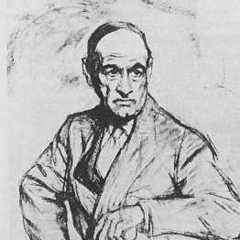
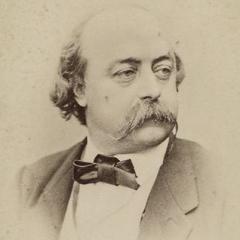
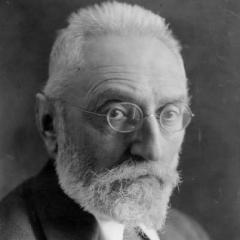
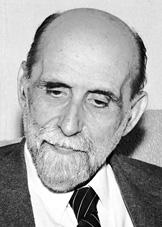
I have never said that human society ought to be aristocratic, but a great deal more than that. What I have said, and still believe with ever-increasing conviction, is that human society is always, whether it will or no, aristocratic by its very essence, to the extreme that it is a society in the measure that it is aristocratic, and ceases to be such when it ceases to be aristocratic. Of course I am speaking now of society and not of the State.
There is but one way left to save a classic; to give up revering him and use him for our own salvation.
When you are fed up with the troublesome present, you take your gun, whistle for your dog, go out to the mountain, and, without further ado, give yourself the pleasure during a few hours or a few days of being "Paleolithic."
He who wishes to teach us a truth should not tell it to us, but simply suggest it with a brief gesture, a gesture which starts an ideal trajectory in the air along which we glide until we find ourselves at the feet of the new truth.
The librarian's mission should be, not like up to now, a mere handling of the book as an object, but rather a know how (mise au point) of the book as a vital function.
Beliefs constitute the basic stratum, that which lies deepest, in the architecture of our life. By them we live, and by the same token we rarely think of them.... One may symbolize the individual life as a bank of issue. The bank lives on the credit of a gold reserve which is rarely seen, which lies at the bottom of metal coffers hidden in the vaults of the building. The most elementary caution will suggest that from time to time the effective condition of these guaranties--of these credences, one might say, that are the basis of credit--be passed in review.
Revolution is not the uprising against preexisting order, but the setting up of a new order contradictory to the traditional one
The characteristic of the hour is that the commonplace mind, knowing itself to be commonplace, has the assurance to proclaim the rights of the commonplace and to impose them wherever it will.
Were art to redeem man, it could do so only by saving him from the seriousness of life and restoring him to an unexpected boyishness. The symbol of art is seen again in the magic flute of the Great God Pan which makes the young goats frisk at the edge of the grove. All modern art begins to appear comprehensible and in a way great when it is interpreted as an attempt to instill youthfulness into an ancient world.
Poetry is adolescence fermented, and thus preserved.
Imagine for a moment that each one of us takes only a little more care for each hour of his days, that he demands in it a little more of elegance and intensity; then, multiplying all these minute pressures toward the perfecting and deepening of each life by all the others, calculate for yourselves the gigantic enrichment, the fabulous ennobling which this process would create for human society.
Man has to live with the body and soul which have fallen to him by chance.
It is not obligatory for a generation to have great men.
Life, individual or collective, personal or historic, is the one entity in the universe whose substance is compact of danger, of adventure. It is, in the strict sense of the word, drama. The primary, radical meaning of life appears when it is employed in the sense not of biology, but of biography. For the very strong reason that the whole of biology is quite definitely only a chapter in certain biographies, it is what biologists do in the portion of their lives open to biography.
One age cannot be completely understood if all the others are not understood. The song of history can only be sung as a whole.
tragedy in the theater opens our eyes so that we can discover and appreciate the heroic in reality.
Here, then, is the point at which I see the new mission of the librarian rise up incomparably higher than all those preceding. Up until the present, the librarian has been principally occupied with the book as a thing, as a material object. From now on he must give his attention to the book as a living function. He must become a policeman, master of the raging book.
To learn English you must begin by thrusting the jaw forward, almost clenching the teeth, and practically immbilizing the lips. In this way the English produce the series of unpleasant little mews of which their language consists.
The assurance that we have no means of answering [final] questions is no valid excuse for callousness towards them. The more deeply should we feel, down to the roots of our being, their pressure and their sting. Whose hunger has ever been [sated] with the knowledge that he could not eat?
Life is a struggle with things to maintain itself among them. Concepts are the strategic plan we form in answer to the attack.
The tapestry of history that seems so full of tragedy when viewed from the front has countless comic scenes woven into its reverse side. In truth, tragedy and comedy are the twin masks of history - its mass appeal.
[I]t is necessary to insist upon this extraordinary but undeniable fact: experimental science has progressed thanks in great part to the work of men astoundingly mediocre, and even less than mediocre. That is to say, modern science, the root and symbol of our actual civilization, finds a place for the intellectually commonplace man and allows him to work therein with success.
Towns are full of people, houses full of tenants, hotels full of guests, trains full of travelers, cafés full of customers, parks full of promenaders, consulting-rooms of famous doctors full of patients, theatres full of spectators, and beaches full of bathers. What previously was, in general, no problem, now begins to be an everyday one, namely, to find room.
The essence of man is, discontent, divine discontent; a sort of love without a beloved, the ache we feel in a member we no longer have.
Triumph cannot help being cruel.
Follow AzQuotes on Facebook, Twitter and Google+. Every day we present the best quotes! Improve yourself, find your inspiration, share with friends
or simply: