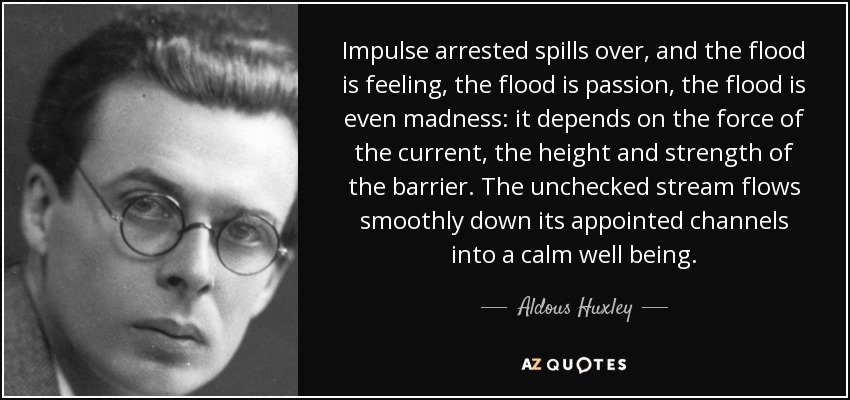



Impulse arrested spills over, and the flood is feeling, the flood is passion, the flood is even madness: it depends on the force of the current, the height and strength of the barrier. The unchecked stream flows smoothly down its appointed channels into a calm well being.
The history of any nation follows an undulatory course. In the trough of the wave we find more or less complete anarchy; but the crest is not more or less complete Utopia, but only, at best, a tolerably humane, partially free and fairly just society that invariably carries within itself the seeds of its own decadence.
Nobody can have the consolations of religion or philosophy unless he has first experienced their desolations.
A love of nature keeps no factories busy.
But then every man is ludicrous if you look at him from outside, without taking into account what’s going on in his heart and mind.
There are confessable agonies, sufferings of which one can positively be proud. Of bereavement, of parting, of the sense of sin and the fear of death the poets have eloquently spoken. They command the world's sympathy. But there are also discreditable anguishes, no less excruciating than the others, but of which the sufferer dare not, cannot speak. The anguish of thwarted desire, for example.
No Romeo-and-Juliet acts, no nonsense about Love with a large L, none of that popular song claptrap with its skies of blue, dreams come true, heaven with you. Just sensuality for its own sake.
Where beauty is worshipped for beauty's sake as a goddess, independent of and superior to morality and philosophy, the most horrible putrefaction is apt to set in. The lives of the aesthetes are the far from edifying commentary on the religion of beauty.
A life-worshipper's philosophy is comprehensive. He is at one moment a positivist and at another a mystic: now haunted by the thought of death and now a Dionysian child of nature; now a pessimist and now, with a change of lover or liver or even the weather, an exuberant believer that God's in his heaven and all's right with the world.
A gramme is better than a damn.
Industrial civilization is only possible when there's no self-denial. Self-indulgence up to the very limits imposed by hygiene and economics. Otherwise the wheels stop turning.
We now spend a good deal more on drink and smoke than we spend on education. This, of course, is not surprising. The urge to escape from selfhood and the environment is in almost everyone almost all the time.
Since Mozart's day composers have learned the art of making music throatily and palpitatingly sexual.
Most kings and priests have been despotic, and all religions have been riddled with superstition.
Procrustes in modern dress, the nuclear scientist will prepare the bed on which mankind must lie; and if mankind doesn’t fit—well, that will be just too bad for mankind. There will have to be some stretching and a bit of amputation—the same sort of stretching and amputations as have been going on ever since applied science really got going into its stride, only this time they will be a good deal more drastic than in the past. These far from painless operations will be directed by highly centralized totalitarian governments.
Art, I suppose, is only for beginners, who have made up in their minds to be content with symbols rather than with what they signify, with the elegantly composed recipe in lieu of actual dinner.
The artists who the world has always recognized as the greatest are those with the widest sympathy. The greatness of the great artist depends precisely on the width and the intensity of his sympathy.
De Sade is the one completely consistent and thoroughgoing revolutionary of history.
One of the principal functions of a friend is to suffer (in a milder and symbolic form) the punishments that we should like, but are unable, to inflict upon our enemies.
Now, a corpse, poor thing, is an untouchable and the process of decay is, of all pieces of bad manners, the vulgarest imaginable. For a corpse is, by definition, a person absolutely devoid of savoir vivre.
I'm pretty good at inventing phrases - you know, the sort of words that suddenly make you jump, almost as though you'd sat on a pin, they seem so new and exciting even though they're about something hypnopaedically* obvious. But that doesn't seem enough. It's not enough for the phrases to be good; what you make with them ought to be good too.
Perhaps dirt is the necessary condition of beauty.... Perhaps hygiene and art can never be bedfellows. No Verdi, after all, without spitting into trumpets. No Duse without a crowd of malodorous bourgeois giving one another their coryzas. And think of the inexpugnable retreats for microbes prepared by Michelangelo in the curls of Moses' beard!
Books have their destinies like men. And their fates, as made by generations of readers, are very different from the destinies foreseen for them by their authors. Gulliver's Travels, with a minimum of expurgation, has become a children's book; a new illustrated edition is produced every Christmas. That's what comes of saying profound things about humanity in terms of a fairy story.
Every notable advance in technique or organization has to be paid for, and in most cases the debit is more or less equivalent to the credit. Except of course when it's more than equivalent, as it has been with universal education, for example, or wireless, or these damned aeroplanes. In which case, of course, your progress is a step backwards and downwards.
No less than war or statecraft, the history of Economics has its heroic ages.
Follow AzQuotes on Facebook, Twitter and Google+. Every day we present the best quotes! Improve yourself, find your inspiration, share with friends
or simply: