When the final result is expected to be a compromise, it is often prudent to start from an extreme position.
When the accumulation of wealth is no longer of high social importance, there will be great changes in the code of morals. We shall be able to rid ourselves of many of the pseudo-moral principles which have hag-ridden us for two hundred years, by which we have exulted some of the most distasteful of human qualities into the highest virtues.
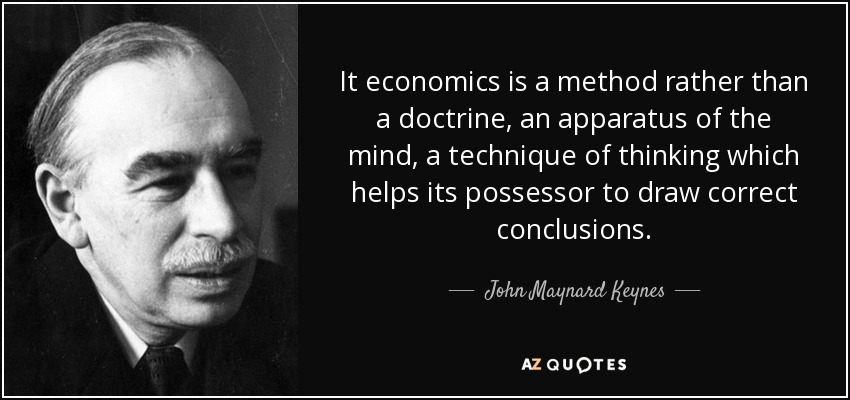
It economics is a method rather than a doctrine, an apparatus of the mind, a technique of thinking which helps its possessor to draw correct conclusions.
When my information changes, I alter my conclusions. What do you do, sir?
If, however, a government refrains from regulations and allows matters to take their course, essential commodities soon attain a level of price out of the reach of all but the rich, the worthlessness of the money becomes apparent, and the fraud upon the public can be concealed no longer.
If farming were to be organised like the stock market, a farmer would sell his farm in the morning when it was raining, only to buy it back in the afternoon when the sun came out.
Lenin is said to have declared that the best way to destroy the Capitalist System was to debauch the currency. By a continuing process of inflation, governments can confiscate, secretly and unobserved, an important part of the wealth of their citizens. By this method they not only confiscate, but they confiscate arbitrarily; and, while the process impoverishes many, it actually enriches some. The sight of this arbitrary rearrangement of riches strikes not only at security, but at confidence in the equity of the existing distribution of wealth.
All production is for the purpose of ultimately satisfying a consumer.
... a speculator is one who runs risks of which he is aware and an investor is one who runs risks of which he is unaware.
As time goes on, I get more and more convinced that the right method in investment is to put fairly large sums into enterprises which one thinks one knows something about and in the management of which one thoroughly believes. It is a mistake to think that one limits one's risk by spreading too much between enterprises about which one knows little and has no reason for special confidence. . . . One's knowledge and experience are definitely limited and there are seldom more than two or three enterprises at any given time in which I personally feel myself entitled to put full confidence.
The central principle of investment is to go contrary to the general opinion, on the grounds that if everyone agreed about its merits, the investment is inevitably too dear and therefore unattractive.
Experience shows that what happens is always the thing against which one has not made provision in advance.
If the Treasury were to fill old bottles with bank-notes, bury them at suitable depths in disused coal-mines which are then filled up to the surface with town rubbish, and leave it to private enterprise on well-tried principles of laissez-faire to dig the notes up again (the right to do so being obtained, of course, by tendering for leases of the note-bearing territory), there need be no more unemployment and, with the help of repercussions, the real income of the community, and its capital wealth, would probably become a good deal greater than it actually is.
Ideas shape the course of history.
The boom, not the slump, is the right time for austerity at the Treasury.
The power to become habituated to his surroundings is a marked characteristic of mankind.
Government machinery has been described as a marvelous labor saving device which enables ten men to do the work of one.
The key to selecting the winner isn't choosing the face you think is the most beautiful but rather the face other people will pick
There is no intrinsic reason for the scarcity of capital.
The love of money as a possession-as distinguished from the love of money as a means to the enjoyments and realities of life-will be recognized for what it is, a somewhat disgusting morbidity, one of those semi-criminal, semi-pathological propensities which one hands over with a shudder to the specialists in mental disease
Whenever you save five shillings you put a man out of work for a day.
It is the duty of the long-term investor to endure great losses with equanimity.
The difficulty lies, not in the new ideas, but in escaping the old ones, which ramify, for those brought up as most of us have been, into every corner of our minds.
It is a good thing to make mistakes so long as you're found out quickly.
Conservatism leads nowhere; it satisfies no ideal.
Follow AzQuotes on Facebook, Twitter and Google+. Every day we present the best quotes! Improve yourself, find your inspiration, share with friends
or simply: