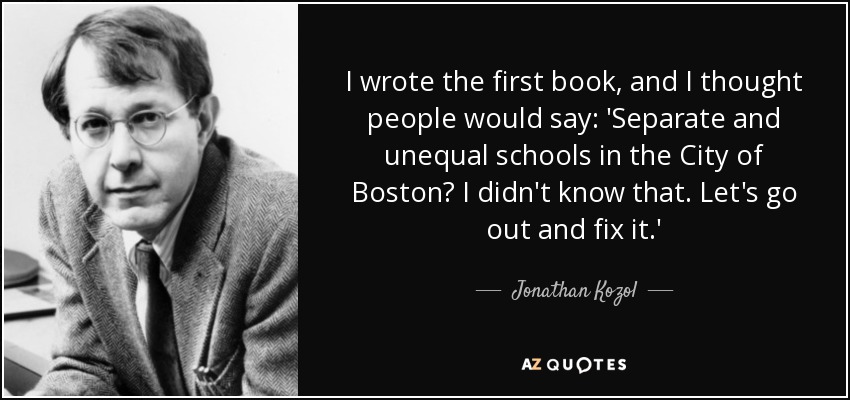
I wrote the first book, and I thought people would say: 'Separate and unequal schools in the City of Boston? I didn't know that. Let's go out and fix it.'
I once made a check of all books in my fourth-grade classroom. Of the slightly more than six hundred books, almost one quarter had been published prior to the bombing of Hiroshima; 60 percent were either ten years old or older.
But when I went to Harvard, it kind of got washed out of me, partly because people made fun of you in college. If you said you believed in God, they would look at you clinically, you know, suggest that you needed a referral.
There has been so much recent talk of progress in the areas of curriculum innovation and textbook revision that few people outside the field of teaching understand how bad most of our elementary school materials still are.
As a matter of record, New York City spends a higher portion of its budget on instruction and associated costs within the schools themselves than any of the other 100 largest districts in the nation.
When I was teaching in the 1960s in Boston, there was a great deal of hope in the air. Martin Luther King Jr. was alive, Malcolm X was alive; great, great leaders were emerging from the southern freedom movement.
What I tell these young people is, the world is not as dangerous as the older generation would like you to believe. Anyone I know who has ever taken a risk and lost a job has ended up getting a better one two years later.
Let's concede that we have decided to let our children grow up in two separate nations, and lead two separate kinds of lives. If, on the other hand, we have the courage to rise to this challenge to name what's happening within our inner-city schools, then we also need the courage to be activist and go out and fight like hell to change it.
As damaging as the obsessive emphasis on testing often proves to be for kids in general, I believe that the effects are still more harmful in those schools in which the resources available to help the children learn the skills that will be measured by these tests are fewest, the scores they get are predictably the lowest, and the strategies resorted to by principals in order to escape the odium attaching to a disappointing set of numbers tend to be the most severe.
Apartheid does not happen spontaneously, like bad weather conditions.
You need massive recruitment to tell the poorest of the poor what is possible.
The first ten, twelve or fifteen years of life are excavated of inherent moral worth in order to accommodate a regimen of basic training for the adult years that many of the poorest children may not even live to know.
Follow AzQuotes on Facebook, Twitter and Google+. Every day we present the best quotes! Improve yourself, find your inspiration, share with friends
or simply: