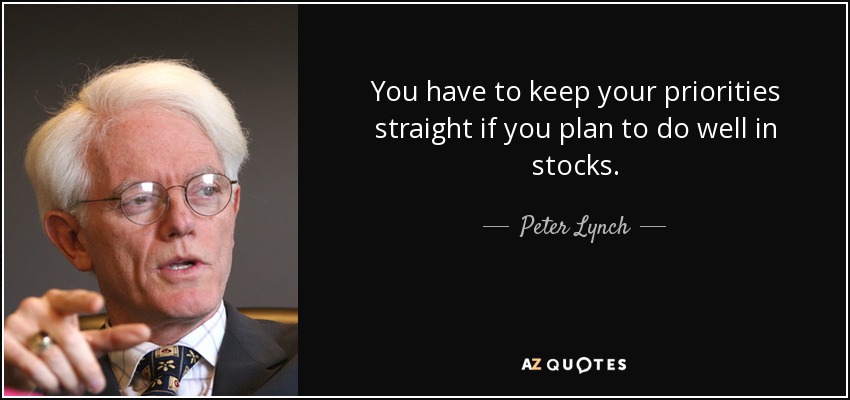







You have to keep your priorities straight if you plan to do well in stocks.
There's lots of stocks out there and all you need is a few of 'em. That's been my philosophy.
I talk to hundreds of companies a year and spend hour after hour in heady pow-wows with CEOs, financial analysts and my colleagues in the mutual-fund business, but I stumble onto the big winners in extracurricular situations, the same way you do.
The extravagance of any corporate office is directly proportional to management's reluctance to reward the shareholders.
Absent a lot of surprises, stocks are relatively predictable over twenty years. As to whether they're going to be higher or lower in two to three years, you might as well flip a coin to decide.
Most investors would be better off in an index fund.
The biggest winners are surprises to me, and takeovers are even more surprising. It takes years, not months, to produce big results.
In business, competition is never as healthy as total domination.
I don't know anyone who said on their deathbed: 'Gee, I wish I'd spent more time at the office.'
The basic story remains simple and never-ending. Stocks aren't lottery tickets. There's a company attached to every share.
Searching for companies is like looking for grubs under rocks: if you turn over 10 rocks you'll likely find one grub; if you turn over 20 rocks you'll find two.
In the long run, a portfolio of well chosen stocks and/or equity mutual funds will always outperform a portfolio of bonds or a money-market account. In the long run, a portfolio of poorly chosen stocks won't outperform the money left under the mattress.
All you need for a lifetime of successful investing is a few big winners, and the pluses from those will overwhelm the minuses from the stocks that don't work out.
If you're lucky enough to have been rewarded in life to the degree that I have, there comes a point at which you have to decide whether to become a slave to your net worth by devoting the rest of your life to increasing it or to let what you've accumulated begin to serve you.
In stocks as in romance, ease of divorce is not a sound basis for commitment.
Long-term investing has gotten so popular, it's easier to admit you're a crack addict than to admit you're a short-term investor.
Twenty years in this business convinces me that any normal person using the customary three percent of the brain can pick stocks just as well, if not better, than the average Wall Street expert.
More money is lost anticipating the changes in the overall stock market than any other way of investing.
The more cash that builds up in the treasury, the greater the pressure to piss it away.
Never buy anything that you can't illustrate on the back of a napkin.
In our society, it's been the men who've handled most of the finances, and the women who've stood by and watched men botch things up.
The worst thing you can do is invest in companies you know nothing about. Unfortunately, buying stocks on ignorance is still a popular American pastime.
When people discover they are no good at baseball or hockey, they put away their bats and their skates and they take up amateur golf or stamp collecting or gardening. But when people discover they are no good at picking stocks, they are likely to continue to do it anyway.
People who want to know how stocks fared on any given day ask, "Where did the Dow close?" I'm more interested in how many stocks went up versus how many went down. These so-called advance/decline numbers paint a more realistic picture.
Well, I think the secret is if you have a lot of stocks, some will do mediocre, some will do okay, and if one of two of 'em go up big time, you produce a fabulous result. And I think that's the promise to some people.
Follow AzQuotes on Facebook, Twitter and Google+. Every day we present the best quotes! Improve yourself, find your inspiration, share with friends
or simply: