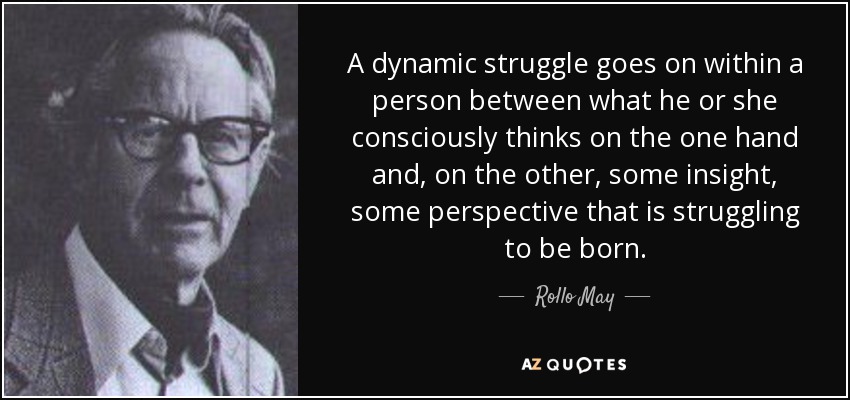
A dynamic struggle goes on within a person between what he or she consciously thinks on the one hand and, on the other, some insight, some perspective that is struggling to be born.
Poets often have a conscious awareness that they are struggling with the daimonic, and that the issue is their working something through from the depths which push the self to a new plane.
It may sound surprising when I say, on the basis of my own clinical practice as well as that of my psychological and psychiatric colleagues, that the chief problem of people in the middle decade of the twentieth century is emptiness.
Artistic symbols and myths speak out of the primordial, preconscious realm of the mind which is powerful and chaotic. Both symbol and myth are ways of bringing order and form into this chaos.
Neither Kierkegaard nor Nietzsche had the slightest interest in starting a movement – or a new system, a thought which would indeed have offended them. Both proclaimed, in Nietzsche's phrase, Follow not me, but you!
Existential psychotherapy is the movement which, although standing on one side on the scientific analysis owed chiefly to the genius of Freud , also brings back into the picture the understanding of man on the deeper and broader level man as the being who is human. It is based on the assumption that it is possible to have a science of man which does not fragmentize man and destroy his humanity at the same moment as it studies him. It unites science and ontology .
Physical courage in whatever scene ... seems to hinge on whether the individual can feel he is fighting for others as well as himself.
When inward life dries up, when feeling decreases and apathy increases, when one cannot affect or even genuinely touch another person, violence flares up as a daimonic necessity for contact, a mad drive forcing touch in the most direct way possible.
Man is the "ethical animal" ethical in potentiality even if, unfortunately, not in actuality. His capacity for ethical judgment like freedom, reason and the other unique characteristics of the human being is based upon his consciousness of himself.
Tenderness emerges from the fact that the two persons, longing, as all individuals do, to overcome the separateness and isolation to which we are all heir because we are individuals, can participate in a relationship that, for the moment, is not of two isolated selves but a union
Now, I believe in life, and I believe in the joy of human existence, but these things cannot be experienced except as we also face the despair, also face the anxiety that every human being has to face if he lives with any creativity at all.
The essence of being human is that, in the brief moment we exist on this spinning planet, we can love some persons and some things, in spite of the fact that time and death will ultimately claim us all.
Inner sense of worth that comes with being in love does not seem to depend essentially on whether the love is returned or not.
Professors will lecture with more inspiration if they occasionally alternate the classroom with the beach: authors will write better when, as Macaulay used to do, they write for two hours, then pitch quoits, and then go back to their writing. But certainly more than the mere mechanical alternation is involved.
Symbols are specific acts or figures, while myths develop and elaborate these symbols into a story which contains characters and several episodes. The myth is thus more inclusive. But both symbol and myth have the same function psychologically; they are man's way of expressing the quintessence of his experience - his way of seeing his life, his self-image and his relations to the world of his fellow men and of nature - in a total figure which at the same moment carries the vital meaning of this experience.
If we admit our depression openly and freely, those around us get from it an experience of freedom rather than the depression itself.
Artists do not run away from non-being, but by encountering and wrestling with it, force it to produce being.
Reason works better when emotions are present; the person sees sharper and more accurately when his emotions are engaged.
Tools and techniques ought to be an extension of consciousness, but they can just as easily be a protection from consciousness. Then the tools become defence mechanisms... against the unconscious.
That because of this interplay of conscious and unconscious factors in guilt and the impossibility of legalistic blame, we are forced into an attitude of acceptance of the universal human situation and a recognition of the participation of every one of us in man's inhumanity to man.
Humans have a habit of running faster when they have lost their way.
One longs for the presence of a leader like Lincoln, who openly admitted his doubts and as openly preserved his commitment.
The schizoid man is the natural product of the technological man. It is one way to live and is increasingly utilized and it may explode into violence.
It is necessary for the birthing process to begin to move in its own organic time. It is necessary that the artist have this sense of timing, that he or she respect... periods of receptivity as part of the mystery of creativity and creation.
The individual human is still the creature who can wonder, who can be enchanted by a sonata, who can place symbols together to make poetry to gladden our heart, who can view a sunrise with a sense of majesty and awe.
Follow AzQuotes on Facebook, Twitter and Google+. Every day we present the best quotes! Improve yourself, find your inspiration, share with friends
or simply: