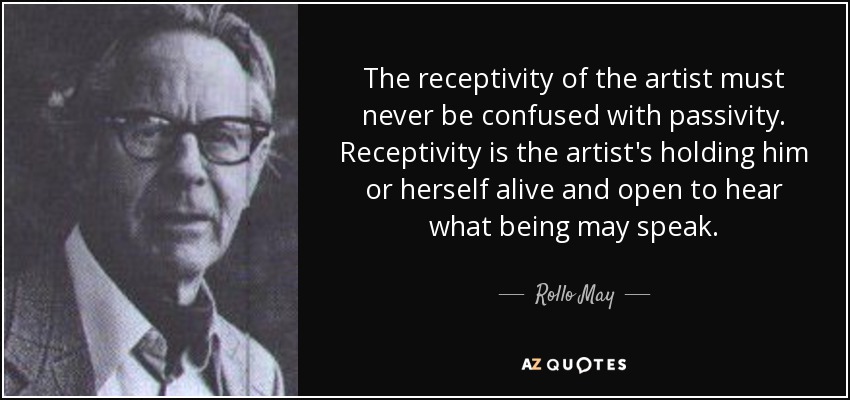
The receptivity of the artist must never be confused with passivity. Receptivity is the artist's holding him or herself alive and open to hear what being may speak.
In religion, it is not the sycophants or those who cling most faithfully to the status quo who are ultimately praised. It is the insurgents.
If the will remains in protest, it stays dependent on that which it is protesting against.
We must be fully committed, but we must also be aware at the same time that we might possibly be wrong. People who claim to be absolutely convinced that their stand is the only right one...is a dead giveaway of unconscious doubt. Commitment is healthiest when it is not without doubt, but in spite of doubt.
There is a curiously sharp sense of joy - or perhaps better expressed, a sense of mild ecstasy - that comes when you find the particular form required by your creation.
In any age courage is the simple virtue needed for a human being to traverse the rocky road from infancy to maturity of personality. But in an age of anxiety, an age of herd morality and personal isolation, courage is a sine qua non. In periods when the mores of the society were more consistent guides, the individual was more firmly cushioned in his crises of development; but in times of transition like ours, the individual is thrown on his own at an earlier age and for a longer period.
Lacking positive myths to guide him, many a sensitive contemporary man finds only the model of the machine beckoning him from every side to make himself over into its image.
Insight comes at a moment of transition between work and relaxation.
Our age is one of transition, in which the normal channels for utilizing the daimonic are denied; and such ages tend to be times when the daimonic is expressed in its most destructive form.
To say a person is a coward has no more meaning than to say he is lazy: It simply tells us that some vital potentiality is unrealized or blocked.
It requires greater courage to preserve inner freedom, to move on in one's inward journey into new realms, than to stand defiantly for outer freedom. It is often easier to play the martyr, as it is to be rash in battle. Strange as it sounds, steady, patient growth in freedom is probably the most difficult task of all, requiring the greatest courage. Thus if the term "hero" is used in this discussion at all, it must refer not to the special acts of outstanding persons, but to the heroic element potentially in every man.
They pursue meaninglessness until they can force it to mean.
A myth is a way of making sense in a senseless world. Myths are narrative patterns that give significance to our existence. Whether the meaning of existence is only what we put into life by our own individual fortitude, as Sartre would hold, or whether there is a meaning we need to discover, as Kierkegaard would state, the result is the same: myths are our way of finding this meaning and significance.
Those we call saints rebelled against an outmoded and inadequate form of God on the basis of their new insights into divinity.
We cannot will to have insights. We cannot will to have creativity, but we can will to give ourselves to the creative experience with intensity of dedication and commitment.
The insight is born with anxiety, guilt and the joy and gratification that is inseparable from the actualizing of a new idea or vision.
I became a psychotherapist because that's where people will unburden themselves, where they will show what is in their hearts.
The value of dreams, like ... divinations, is not that they give a specific answer, but that they open up new areas of psychic reality, shake us out of our customary ruts, and throw light on a new segment of our lives. Thus the sayings of the shrine, like dreams, were not to be received passively; the recipients had to "live" themselves into the message.
When one read's Kierkegaard's profound analyses of anxiety and despair or Nietzsche's amazingly acute insights into the dynamics of resentment and the guilt and hostility which accompany repressed emotional powers, one might pinch oneself to realize that one is reading works written in the last century and not some new contemporary psychological analysis.
The ancient Greeks, as Plato reports, believed that we discover truth through "reminiscence," that is by "remembering," by intuitively searching into our own experience.
Poets may be delightful creatures in the meadow or the garret, but they are menaces on the assembly line.
In any discussion of religion and personality integration the question is not whether religion itself makes for health or neurosis, but what kind of religion and how is it used? Freud was in error when he held that religion is per se a compulsion neurosis. Some religion is and some is not.
Generally, the shaking is consciously felt in its positive aspects — as the wonderful new heaven and earth which love with its miracle and mystery has suddenly produced. Love is the answer, we sing. Our Western culture seems to be engaged in a romantic - albeit desperate - conspiracy to enforce the illusion that that is all there is to eros.
Our thesis is that symbols and myths are an expression of man's unique self-consciousness, his capacity to transcend the immediate concrete situation and see his life in terms of 'the possible,' and that this capacity is one aspect of his experiencing himself as a being having a world.
One must have at least a readiness to love the other person, broadly speaking, if one is to be able to understand him.
Follow AzQuotes on Facebook, Twitter and Google+. Every day we present the best quotes! Improve yourself, find your inspiration, share with friends
or simply: