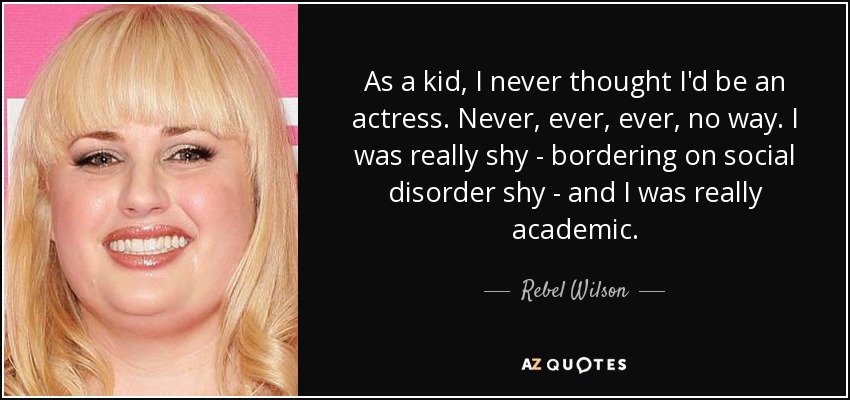
As a kid, I never thought I'd be an actress. Never, ever, ever, no way. I was really shy - bordering on social disorder shy - and I was really academic.
I published only in academic journals in philosophy until I was in my 40s, but I had been writing fiction and poetry my whole adult life - without ever once trying to publish it, and rarely letting anyone read it.
But I would much prefer students going to college to learn and be prepared for the rigors of the new economic order, rather than dumping fees on them to subsidize football programs that, far from enhancing the academic mission instead make a mockery of it.
I'm an academic. It's publish or perish.
I was quite straight-laced. I was quite academic until I was about 14 and then I went to boarding school where I had the opportunity to continue to be very academic, but got less interested in it and became more involved in acting. And then when I was applying for universities I used a couple of places on my UCAS form to apply for drama school without telling anyone... but didn't get into drama school. But that was the most rebellious thing I did.
I am not built for academic writings. Action is my domain.
I'm a vague, conjunctured personality, more made up of opinions and academic prepossessions than of human traits and red corpuscles.
To some of us, hunger was more academic than real, but we must try to develop the ability to feel the urgency of such a situation.
Academic training in beauty is a sham. We have been so deceived, but so well deceived that we can scarcely get back even a shadow of the truth.
Feminism, in all fields, has yet to produce a single scholar of the intellectual rank of scores of these learned men [e.g., Bruno Snell, Albin Lesky, Denys Page] in the German and British academic tradition.
Lacan , Derrida and Foucault are the perfect prophets for the weak, anxious academic personality, trapped in verbal formulas and perennially defeated by circumstances. They offer a self-exculpating cosmic explanation for the normal professorial state of resentment, alienation, dithering passivity and inaction.
Academic Marxism is a fantasy world, and unctuous compassion-sweepstakes, into which real workers or peasants never penetrate.
Academic Marxists, with their elitist sense of superiority to popular taste, are the biggest snobs in America.
In 1974 I nearly got into a fistfight with some early academic feminists in a restaurant when I casually alluded to a hormonal element in sex differences. It was utterly unacceptable at that time to think or say such a thing... If you have any doubts about the effect of hormones on emotion, libido and aggression, have a chat with a transexual, who must take hormones medically. He or she will set you straight.
Women's studies is a comfy, chummy morass of unchallenged groupthink . It is, with rare exception, totally unscholarly. Academic feminists have silenced men and dissenting women.
Yes, I spent two long years, traveling all over the United States, all over Europe, interviewing many, many, many people who had been thrown out of their academic jobs because they taught that there was a possibility of life coming from something other than Darwinism, who thought that possibly random selection and mutations didn't account for the universe, didn't account for gravity, didn't account for why nobody had ever seen an individual species evolve - no one's ever seen an individual species evolve!
How I understand the philosopher - as a terrible explosive, endangering everthing... my concept of the philosopher is worlds removed from any concept that would include even a Kant, not to speak of academic "ruminants" and other professors of philosophy.
When I [first] went to university, I was doing foreign languages, because I had done them since I was 13 years old. I had done French and German. I picked up Italian, just sort of blasted through the exams, [and then] took off overseas, because I wanted to be an actor. I thought, "I'm just not academic." I'm not very competitive, in terms of acting. But since going back to university, I've realized, I am highly competitive.
Anarcho-capitalism, in my opinion, is a doctrinal system which, if ever implemented, would lead to forms of tyranny and oppression that have few counterparts in human history. There isn't the slightest possibility that its (in my view, horrendous) ideas would be implemented, because they would quickly destroy any society that made this colossal error. The idea of 'free contract' between the potentate and his starving subject is a sick joke, perhaps worth some moments in an academic seminar exploring the consequences of (in my view, absurd) ideas, but nowhere else.
To a degree which is difficult to determine, the esoteric impulse in twentieth-century music, literature and the arts reflects calculation. It looks to the flattery of academic and hermeneutic notice. Reciprocally, the academy turns towards that which appears to require its exegetic, cryptographic skills.
The clerical work is par for the course. "Keep on file in numerical order" means throw in wastebasket. You'll soon learn the language. "Let it be a challenge to you" means you're stuck with it; "interpersonal relationships" is a fight between kids; "ancillary civic agencies for supportive discipline" means call the cops; "Language Arts Dept." is the English office; "literature based on child's reading level and experiential background" means that's all they've got in the Book Room; "non-academic-minded" is a delinquent; and "It has come to my attention" means you're in trouble.
I do not know whether to be delighted or outraged by the fact that Literary Theory: An Introduction was the subject of a study by a well known U.S. business school, which was intrigued to discover how an academic text could become a best-seller.
The academic mind, as we know, is sometimes capable of assuming an aggressive attitude. The official mind, on the contrary, is and has to be, expert in the art of self-defence.
What initially attracted me to The Seventh Seal was that it had values and characteristics which I was familiar with in other art forms, most notably, the European novel and certain forms on English drama, and indeed, in relation to my rather academic interest in history -- not "history" in the normal sense, but history as a form of entertainment . It might be a very unfashionable view but I believe that history is an amazing bank or reserve area of plots, characterisations, extraordinary events, etc.
The Internet is a big boon to academic research. Gone are the days spent in dusty library stacks digging for journal articles. Many articles are available free to the public in open-access journal or as preprints on the authors' website.
Follow AzQuotes on Facebook, Twitter and Google+. Every day we present the best quotes! Improve yourself, find your inspiration, share with friends
or simply: