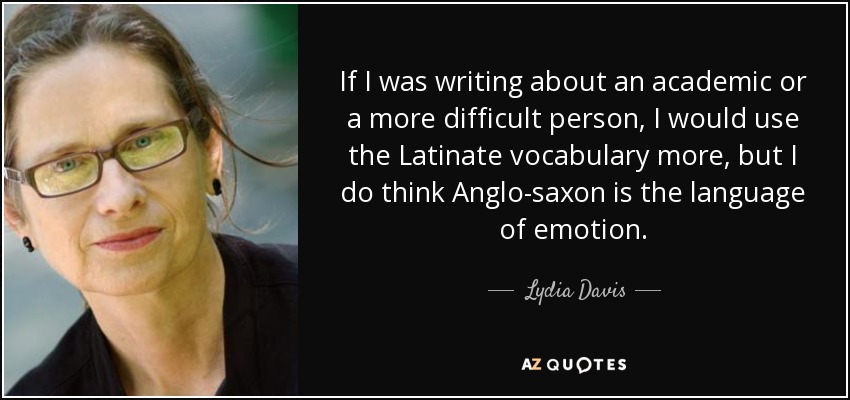
If I was writing about an academic or a more difficult person, I would use the Latinate vocabulary more, but I do think Anglo-saxon is the language of emotion.
I have read all of Daniel Aaron's books, and admired them, but in The Americanist I believe he has composed an intellectual and social memoir for which he will be remembered. His self-portrait is marked by personal tact and admirable restraint: he is and is not its subject. The Americanist is a vision of otherness: literary and academic friends and acquaintances, here and abroad. Eloquently phrased and free of nostalgia, it catches a lost world that yet engendered much of our own.
I had to run away from home in order to be a musician. Because I came from a family of... my father was a health inspector; my mother was a social worker. And I was pretty smart in school. So they expected me to be some kind of academic - schoolteacher, or doctor, lawyer - and they were very disappointed when I told them I wanted to be a musician.
I did not come from an academic background. My father was a smart man, but he had a fifth-grade education. He and all his friends were plumbers. They were all born around 1905 in great poverty in New York City and had to go to work when they were 12 or 13 years old.
I was so naive about writing, I went to the public library and checked out the only volume they had on the topic - an academic treatise about publishing from the WWII era.
It was the usual sort of academic battle: footnotes at ten paces, bolstered by snide articles in academic journals and lots of sniping about methodology, a thrust and parry of source and countersource. My sources had to be better.
Homicide is the major leagues, the center ring, the show. It always has been ... It goes beyond academic degrees, specialized training or book learning, because all the theory in the world means nothing if you can't read the street.
I had learned of Gertrude Steins bon mot that medicine opened all doors. This prompted me, in different moods, to view my future life as literary psychiatrist, globe-trotting tropical disease specialist, or academic internist.
Writing on the blog, you want to get attention and make strong claims. In academic work, that often doesn't pay, so sometimes it's a little bit difficult going back and forth to navigate these differences.
My career in academic research has not been involved with active management of securities. I've tried to understand risk-and-return relationships; also the pricing of derivative securities.
A hilarious academic novel that'll send you laughing (albeit ruefully) back into the trenches of the classroom. . . . [A] mordant minor masterpiece. . . . Like the best works of farce, academic or otherwise, Dear Committee Members deftly mixes comedy with social criticism and righteous outrage. By the end, you may well find yourself laughing so hard it hurts.
Pastoureau combines a charming, conversational tone with a haughtiness I found entirely endearing. A director of studies at the Ecole Pratique des Hautes Etudes at the Sorbonne in Paris, he writes from a position of professorial confidence. He has conducted extensive research into the history of colour for a quarter century and his aim is to correct misapprehensions and banish ignorance. His style is not to inquire, explore or interrogate, in the fashion of academic studies today. It is to impart knowledge.
I had no intention of becoming an academic. How could a person who was having trouble reading become an academic?
By academic freedom I understand the right to search for truth and to publish and teach what one holds to be true. This right implies also a duty: one must not conceal any part of what on has recognized to be true. It is evident that any restriction on academic freedom acts in such a way as to hamper the dissemination of knowledge among the people and thereby impedes national judgment and action.
Human affairs are so obscure and various that nothing can be clearly known. This was the sound conclusion of the Academic sceptics, who were the least surly of philosophers.
The difference between prose logic and poetic thought is simple. The logician uses words as a builder uses bricks, for the unemotional deadness of his academic prose; and is always coining newer, deader words with a natural preference for Greek formations. The poet avoids the entire vocabulary of logic unless for satiric purposes, and treats words as living creatures with a preference for those with long emotional histories dating from mediaeval times. Poetry at its purest is, indeed, a defiance of logic.
The academic mind can eat away the very basis of its own assurance ... produce contortions when it tries to bend over backward ... allow itself to be dismayed by the picture it has created of relentless historical process.
I have found that meditation has helped me with my academic career and has given me insights into musical composition and software design.
Follow AzQuotes on Facebook, Twitter and Google+. Every day we present the best quotes! Improve yourself, find your inspiration, share with friends
or simply: