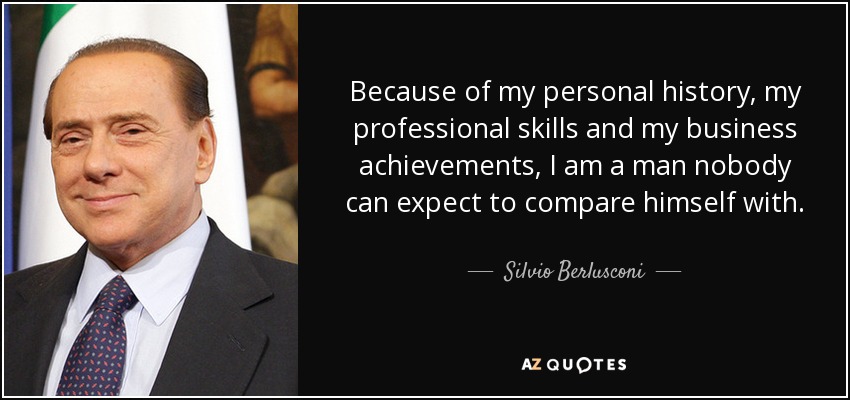
Because of my personal history, my professional skills and my business achievements, I am a man nobody can expect to compare himself with.
My contention is, first, that we should want more from our educational efforts than adequate academic achievement and, second, that we will not achieve even that meager success unless our children believe that they themselves are cared for and learn to care for others.
Angry contradiction of the patriarch is not creativity; it's delinquency calling for attention. Difference for the sake of difference is as empty an achievement as slavishly following the commercial imperative.
Who you are should not be defined by your achievements.
Within the model minority rhetoric, Asian Americans are represented as “good” minorities and African Americans are represented as “bad” minorities. Here, the achievements of Asian Americans are used to discipline African Americans. As model minorities, Asian Americans achieved the status of “honorary Whites”. Again it is important to point out that the honorary whiteness of Asian Americans was granted at the expense of Blacks. It is also significant that as “honorary Whites,” Asian Americans do not have the actual privileges associated with “real” whiteness.
Every successful man or great genius has three particular qualities in common. The most conspicuous of these is that they all produce a prodigious amount of work. The second is that they never know fatigue. And the third is that their minds grow more brilliant as they grow older, instead of less brilliant. Great men's lives begin at forty, where the mediocre man's life ends. The genius remains an ever-flowing fountain of creative achievement until the very last breath he draws.
If people ask me for the ingredients of success, I say one is talent, two is stubbornness or determination, and third is sheer luck. You have to have two out of the three. Any two will probably do.
We achieve more than we know. We know more than we understand. We understand more than we can explain.
"Normal science" means research firmly based upon one or more past scientific achievements, achievements that some particular scientific community acknowledges for a time as supplying the foundation for its further practice.
In science the successors stand upon the shoulders of their predecessors; where one man of supreme genius has invented a method, a thousand lesser men can apply it. ... In art nothing worth doing can be done without genius; in science even a very moderate capacity can contribute to a supreme achievement.
Science, by itself, cannot supply us with an ethic. It can show us how to achieve a given end, and it may show us that some ends cannot be achieved. But among ends that can be achieved our choice must be decided by other than purely scientific considerations. If a man were to say, "I hate the human race, and I think it would be a good thing if it were exterminated," we could say, "Well, my dear sir, let us begin the process with you." But this is hardly argument, and no amount of science could prove such a man mistaken.
The aim of science is, on the one hand, as complete a comprehension as possible of the connection between perceptible experiences in their totality, and, on the other hand, the achievement of this aim by employing a minimum of primary concepts and relations.
The greatest achievements in the science of this [twentieth] century are themselves the sources of more puzzlement than human beings have ever experienced. Indeed, it is likely that the twentieth century will be looked back at as the time when science provided the first close glimpse of the profundity of human ignorance. We have not reached solutions; we have only begun to discover how to ask questions.
The reproaches against science for not having yet solved the problems of the universe are exaggerated in an unjust and malicious manner; it has truly not had time enough yet for these great achievements. Science is very young--a human activity which developed late.
That is the way of the scientist. He will spend thirty years in building up a mountain range of facts with the intent to prove a certain theory; then he is so happy with his achievement that as a rule he overlooks the main chief fact of all-that all his accumulation proves an entirely different thing.
The experimental investigation by which Ampere established the law of the mechanical action between electric currents is one of the most brilliant achievements in science. The whole, theory and experiment, seems as if it had leaped, full grown and full armed, from the brain of the 'Newton of Electricity'. It is perfect in form, and unassailable in accuracy, and it is summed up in a formula from which all the phenomena may be deduced, and which must always remain the cardinal formula of electro-dynamics.
It strikes me as unfair, and even in bad taste, to select a few of them for boundless admiration, attributing superhuman powers of mind and character to them. This has been my fate, and the contrast between the popular estimate of my powers and achievements and the reality is simply grotesque.
The real achievement in discoveries... is seeing an analogy where no one saw one before... The essence of discovery is that unlikely marriage of cabbages and kings — of previously unrelated frames of reference or universes of discourse — whose union will solve the previously insoluble problem.
As history proves abundantly, mathematical achievement, whatever its intrinsic worth, is the most enduring of all.
I am busy just now again on Electro-Magnetism and think I have got hold of a good thing but can't say; it may be a weed instead of a fish that after all my labour I may at last pull up.
We should misjudge this scientist [Fritz Haber] seriously if we were to judge him only by his harvest. The stimulation of research and the advancement of younger scholars become ever more important to him than his own achievements.
Unless a man has been taught what to do with success after getting it, the achievement of it must inevitably leave him a prey to boredom.
It's true that there's no such thing as free will. We can't help what we are or what we do. It's not our fault. Nobody's to blame for anything. It's all in your background ... and your glands. If you're good, that's no achievement of yours - you were lucky in your glands. If you're rotten, nobody should punish you - you were unlucky, that's all.
Not the maker of plans and promises, but rather the one who offers faithful service in small matters. This is the person who is most likely to achieve what is good and lasting.
What cannot be achieved in one lifetime will happen when one lifetime is joined to another.
Follow AzQuotes on Facebook, Twitter and Google+. Every day we present the best quotes! Improve yourself, find your inspiration, share with friends
or simply: