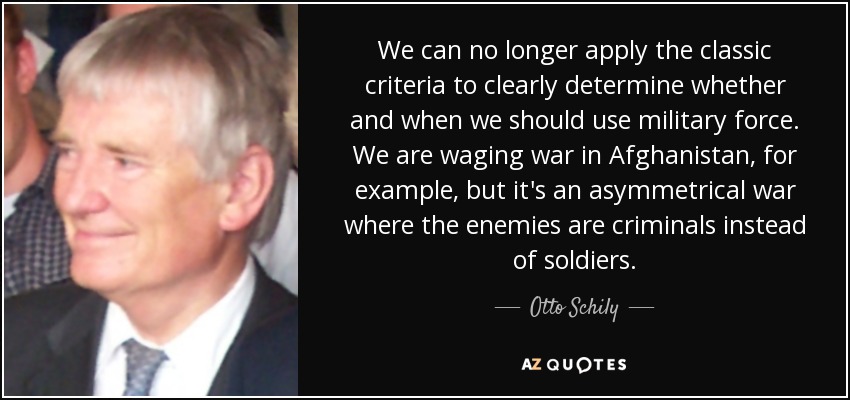
We can no longer apply the classic criteria to clearly determine whether and when we should use military force. We are waging war in Afghanistan, for example, but it's an asymmetrical war where the enemies are criminals instead of soldiers.
In Afghanistan, there have been a lot of teachers assassinated, schools are being blown up, girls are harassed and in some cases, attacked on their way to school. Even if the girls are able to get an education, they can dream big, they can think about how they want to become a member of parliament because they are now women members of parliament in Afghanistan, nobody is really sure how long everything is going to last.
When girls in Canada dream about becoming members of parliament, they have a pretty good expectation that parliament is going to be around for them when they graduate. There is no such expectation in Afghanistan. It's all still hope and wanting it but not really sure if it's going to be around.
Toughest decision was early in my presidency when I ordered 30,000 more troops into Afghanistan. As somebody who had run to end a large troop presence overseas.
I had said from the start that I thought Iraq was a mistake, that we should have stayed focused on Afghanistan. I think it was the right decision because the Taliban at that point had gotten a lot of momentum before I'd gotten into office, partly because we hadn't been paying attention as much as we needed to to Afghanistan.
[When I ordered 30,000 more troops into Afghanistan] that was the first time in which I looked out at a crowd of West Point graduates and knew that some of those might not come back because of that decision.
What we have done, I think, is build a model from a lot of hard lessons in Afghanistan and Iraq but in other places around the world, where we are working with them in an advisory capacity.
[Afghanistan and Iraq] are still countries that are fragile enough that we're gonna have to partner with them in some way.
It still puts burden on some troops of ours who are there [in Afghanistan and Iraq] as advisors and facilitators.
We don't have this huge footprint, we are less likely to be targeted as, you know, occupiers [in Afghanistan and Iraq].
If the United States had not intervened in Afghanistan, then obviously, we would have then allowed the attacks of 9/11 to go unanswered. I don't think most of Americans wanted that to happen.
If it is bin Laden, he's a very intelligent guy. He's been planning his war for a long time. I remember the last time I met him in 1997 in Afghanistan. And bin Laden said to me "From this mountain, Mr. Robert, upon which you are sitting, we beat the Russian army and helped break the Soviet Union. And I pray to God that he allows us to turn America into a shadow of itself." When I saw the pictures of New York without the World Trade Center, New York looked like a shadow of itself.
Osama Bin Laden is not well read and he's not sophisticated, but he will have worked out very coldly what America would do in response to this attack 9/11. I'm sure he wanted America to attack Afghanistan. Once you do what your enemy wants, you are walking into a trap, whether you think it's the right thing to do or not.
When George W.Bush attacked Afghanistan, it was widely hailed, and the failure of our war there wasn't understood. Within a few months of attacking Afghanistan, Bush clearly moved on to get ready for Iraq, long before Osama bin Laden or Al Qaeda were dispensed with. There was never any serious debate in the press about whether even the notion that every Taliban was our enemy was valid. A lot of assumptions about that war were never challenged.
If you polled the military in Afghanistan as to how many think we should be there or not, the numbers would probably be similar to what the U.S. population believes. That's not because they're watching the news. But, hey, they are out there risking their lives. No one likes to be criticized and it really sucks to be criticized when you're risking your life.
One of their major initiatives was getting all officers on Facebook. So the question is, why are these people who are there to train the Afghans being pressured to be on Facebook? Again, it sounds benign until you realize that the military's concern isn't the Afghans, it's convincing the American people that we should be in Afghanistan.Soldiers can put up pictures and say "See how happy the Afghans are because of our presence here." It's a way to directly influence the American people using propaganda.
Afghanistan would have been difficult enough without Iraq. Iraq made it impossible. The argument that had we just focused on Afghanistan we'd now be okay is persuasive, but it omits the fact that we weren't supposed to get involved in nation-building in Afghanistan.In my new book, I open with a quote from Donald Rumsfeld. In October 2001, he said of Afghanistan: "It's not a quagmire." Ten years later there are 150,000 Western troops there.
Johnny Apple, a New York Times correspondent, wrote a front-page story saying Afghanistan could be a quagmire and he was mocked and derided. What is certainly true is that all sorts of resources that would have been used in Afghanistan were diverted to Iraq. Would those resources have helped? Almost undoubtedly. Whether or not Afghanistan would be a peaceful nation-state had we not gone into Iraq I doubt. Afghanistan is going to be Afghanistan, no matter how hard we try to make it something else.
The day that the Soviets officially crossed the border of Afghanistan, I wrote to President Jimmy Carter: We now have the opportunity of giving to the USSR its Vietnam war.
Indeed, for almost 10 years, Moscow had to carry on a war in Afghanistan, unsupportable by the government, a conflict that brought about the demoralization and finally the breakup of the Soviet empire.
We got the Iran sanctions done. We got an agreement by Russia to allow us to use Afghanistan to transit supplies for our forces. We got a Security Council resolution on Libya. We got Russia into the WTO to bring in to it a rules-based trading system. All of those things were in our interest. The point is not whether we should work with Russia. The point is whether we should sacrifice other important interests to do so.
The whole world has become a crowded theater. You could say something here in New York and have it be heard in Afghanistan and potentially trigger riots and it may be something that to you was innocent or was in jest or was satirical and it's taken out of context. I mean, a joke, a tweet or a blog post can make it halfway around the world before the context gets its boots on.
But we have achieved at least two important things. Afghanistan is no longer a safe haven for international terrorists. We have a strong Afghan army, which is fighting the terrorists and Taliban. And the second thing is that they are able to do that without us being there to conduct the combat operations.
What NATO troops are doing in Afghanistan is to train, assist and advise Afghans, but they are actually doing the fighting. They are actually taking the responsibility for the security in their own country. And that is a great achievement, compared to what we saw just a few years ago, when NATO troops had to conduct the combat operations fighting the Taliban.
I think it is a very important step in the right direction that the Afghans have taken over responsibility for the security in their own country, and NATO being able to end its combat presence in Afghanistan.
Follow AzQuotes on Facebook, Twitter and Google+. Every day we present the best quotes! Improve yourself, find your inspiration, share with friends
or simply: