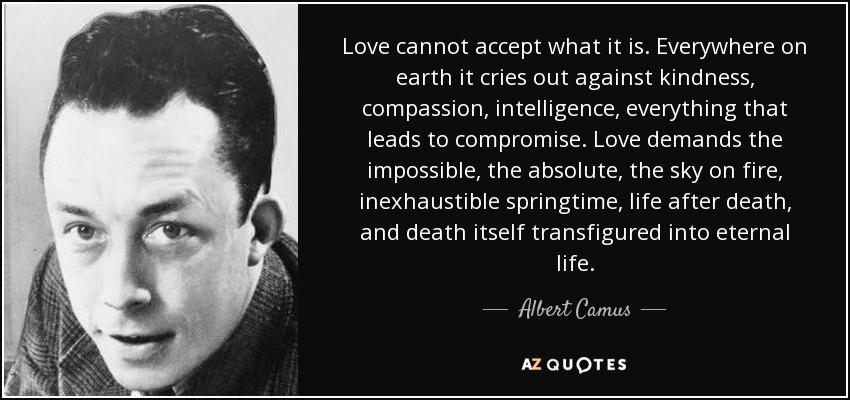
Love cannot accept what it is. Everywhere on earth it cries out against kindness, compassion, intelligence, everything that leads to compromise. Love demands the impossible, the absolute, the sky on fire, inexhaustible springtime, life after death, and death itself transfigured into eternal life.
You're a religious man, ... You believe in God and life after death. I also believe. When we come to the other world and meet the millions of Jews who died in the camps and they ask us, 'What have you done?' there will be many answers. You will say, 'I became a jeweler.' Another will say, 'I smuggled coffee and American cigarettes.' Another will say, 'I built houses.' But I will say, 'I didn't forget you.'
With all this extra stressin The question I wonder is after death, after my last breath When will I finaly get to rest? Through this supression they punish the people that's askin questions And those that possess, steal from the ones without possesions The message I stress: to make it stop study your lessons Don't settle for less - even the genius asks-es questions Be grateful for blessings Don't ever change, keep your essence The power is in the people and politics we address.
I think retirement beats the heck out of life after death, that's for sure.
Each holy temple stands as a symbol of our membership in the Church, as a sign of our faith in life after death, and as a sacred step toward eternal glory for us and our families.
The resurrection is not an isolated supernatural oddity proving how powerful, if apparently arbitrary, God can be when he wants to. Nor is it at all a way of showing that there is indeed a heaven awaiting us after death. It is the decisive event demonstrating that God’s kingdom really has been launched on earth as it is in heaven.
Mythology is the study of whatever religious or heroic legends are so foreign to a student's experience that he cannot believe them to be true. . . . Myth has two main functions. The first is to answer the sort of awkward questions that children ask, such as: 'Who made the world? How will it end? Who was the first man? Where do souls go after death?'. . . . The second function of myth is to justify an existing social system and account for traditional rites and customs.
I'm asked so often whether I believe in life after death. I do believe in the sanctity of life, the continuity of life and of energy. I know the anonymity of death has no appeal for me. It is the now that I must face and want to face.
The question of Heaven, the question of what happens after death, is one which a lot of people in our culture try to put off as long as they can, but sooner or later it suddenly swings round and looks them in the eye.
I'm not big on the after-death experience. If you've done a very good job in your current lifetime, then your next lifetime will be set up for you.
The "kingdom of heaven" to which he referred was the state of God-consciousness, not the beautiful astral heavens that most people visualize, where virtuous souls go after death.
I care little in the existence of a heaven or hell; self respect does not allow me to guide my acts with an eye toward heavenly salvation or hellish punishment. I pursue the good in life because it is beautiful and attracts me; and shun the bad because it is ugly and repulsive. All our acts should originate from the spring of unselfish love, whether there be a continuation after death or not.
The question whether our conscious personality survives after death has been answered by almost all races of men in the affirmative.
The estate tax punishes years of hard work and robs families of part of their heritage by imposing a huge penalty on inheritance after death - a tax on money that has already been taxed.
I want people to emphasize life before death as opposed to life after death.
Marble statues, engraved with public inscriptions, by which the life and soul return after death to noble leaders.
A thousand goodbyes come after death - the first six months of bereavement.
Someone who claims to know what happens after death is probably someone we should be suspicious of -- they might be a ghost.
[You write out of the] desire to seem clever, to be talked about, to be remembered after death, etc., etc., etc. It is humbug to pretend this is not a motive and a strong one.
When we see the many grave-stones which have fallen in, which have been defaced by the footsteps of the congregation, which lie buried under the ruins of the churches, that have themselves crumbled together over them; we may fancy the life after death to be as a second life, into which man enters in the figure, or the picture or the inscription, and lives longer there than when he was really alive. But this figure also, this second existence, dies out too, sooner or later. Time will not allow himself to be cheated of his rights with the monuments of men or with themselves.
If fame comes after death, I'm in no hurry for it. [Lat., Si post fata venit gloria non propero.]
It is the "where I am" that makes heaven. The life after death might become through its very endlessness a burden to our spirits, if it were not to be filled with the infinite variety and freshness of God's love. Some have shrunk from its very infinitude, because they have not realized what God's love can make of it. Human love helps us to understand this. When we have come to love any one with all our power of affection, then there is no monotony or weariness in the days and hours we spend with them.
It is not without reason that fame is awarded only after death. The cloud-dust of notoriety which follows and envelops the men who drive with the wind bewilders contemporary judgment.
Do I think there's life after death? No, I think my books are my life after death.
I know that we live after death and again and again, not in the memory of our children, or as a mulch for trees and flowers, however poetic that may be, but looking passionately and egocentrically out of our eyes.
Follow AzQuotes on Facebook, Twitter and Google+. Every day we present the best quotes! Improve yourself, find your inspiration, share with friends
or simply: