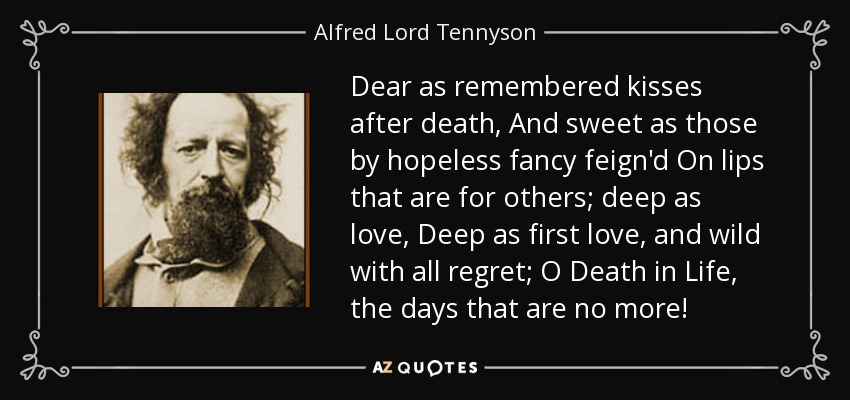
Dear as remembered kisses after death, And sweet as those by hopeless fancy feign'd On lips that are for others; deep as love, Deep as first love, and wild with all regret; O Death in Life, the days that are no more!
The more they lack material things, the more they indulge themselves when they can, but the less is their satisfaction with this world and they hunger for life after death(on Russian slave laborers.)
Death and what came after death was no great mystery to Sabriel. She just wished it was.
Our lives are about development, mutation and the possibility of change; that is almost a definition of what life is: change... If you disable change, if you effectively stop time, if you prevent the possibility of the alteration of an individual's circumstances — and that must include at least the possibility that they alter for the worse — then you don't have life after death; you just have death.
There is a moment after death when things can go one of several ways, when souls can mingle and reunite-or be forever parted. Fate throws the bones, and hearts are mended, or shattered. What tips the balance in one's favor? Is it Mercy, or Grace, or Justice-the names of the three brightest angels? Or is it Love, the name of the One True Being?
The nonexistent is whatever we have not sufficiently desired. Only after death, only in solitude, does a man’s true nature emerge. In death, as on the chimney sweep’s Saturday night, the soot gets washed from his body.
The question of what we are can only be answered by ourselves. We each decide what we are by the life choices we make. How we were made, who are parents are, where we are from, the color of our skin, who we choose to love, all those things do not define us. Our actions define us, and will keep defining us until even after death.
If some good evidence for life after death were announced, I'd be eager to examine it; but it would have to be real scientific data, not mere anecdote. As with the face on Mars and alien abductions, better the hard truth, I say, than the comforting fantasy.
In the past our glorious visions of the future - heaven, paradise, nirvana - were thought to happen after death. The newer thought is that we do not have to die to get there. We are not speaking here of life after death in some mythical heaven, but life more abundant in real time in history. We are speaking of the next stage of our social evolution.
Our German forefathers had a very kind religion. They believed that, after death, they would meet again all the good dogs that had been their companions in life. I wish I could believe that too.
There will be no major solution to the suffering of humanity until we reach some understanding of who we are, what the purpose of creation was, what happens after death. Until those questions are resolved we are caught.
Indeed, so deep is my pleasure in the work of the garden that, if there be a dimension after death in which grieving for the loss of the world of senses is possible, I shall grieve for no person however once agonisingly desired and passionately beloved, for no emotional adventure however uplifting, for no success however warming, no infamy however exhilarating, for nothing half so much as I shall grieve to the loss of the earth itself, the soil, the seeds, the plants, the very weeds... It is a love almost overriding my love the words that could express that love.
The Celts were fearless warriors because they wish to inculcate this as one of their leading tenets, that souls do not become extinct, but pass after death from one body to another.
Some people believe that we go on living in another body after death, that we lived before. They call it reincarnation. That we all lived before on the earth thousands of years ago or on some other planet. They say we have forgotten it. Some say they remember their past lives.
Not only is there no guarantee of the temporal immortality of the human soul, that is to say of its eternal survival after death; but, in any case, this assumption completely fails to accomplish the purpose for which it has always been intended. Or is some riddle solved by my surviving forever? Is not this eternal life itself as much of a riddle as our present life?
Due to his own original special nature, the Jew cannot possess a religious institution, if for no other reason because he lacks idealism in any form, and hence belief in a hereafter is absolutely foreign to him. And a religion in the Aryan sense cannot be imagined which lacks the conviction of survival after death in some form. Indeed, the Talmud is not a book to prepare a man for the hereafter, but only for a practical and profitable life in this world.
It is for all Men that come into the World once to Die, and after Death the Judgment; and since Death is a Debt that all of us must pay, it is but a matter of small moment what way it be done.
It isn't easy to live after death. It takes a lifetime.
With all this extra stressin The question I wonder is after death, after my last breath When will I finaly get to rest? Through this supression they punish the people that's askin questions And those that possess, steal from the ones without possesions The message I stress: to make it stop study your lessons Don't settle for less - even the genius asks-es questions Be grateful for blessings Don't ever change, keep your essence The power is in the people and politics we address.
I think retirement beats the heck out of life after death, that's for sure.
Each holy temple stands as a symbol of our membership in the Church, as a sign of our faith in life after death, and as a sacred step toward eternal glory for us and our families.
The resurrection is not an isolated supernatural oddity proving how powerful, if apparently arbitrary, God can be when he wants to. Nor is it at all a way of showing that there is indeed a heaven awaiting us after death. It is the decisive event demonstrating that God’s kingdom really has been launched on earth as it is in heaven.
Mythology is the study of whatever religious or heroic legends are so foreign to a student's experience that he cannot believe them to be true. . . . Myth has two main functions. The first is to answer the sort of awkward questions that children ask, such as: 'Who made the world? How will it end? Who was the first man? Where do souls go after death?'. . . . The second function of myth is to justify an existing social system and account for traditional rites and customs.
I'm asked so often whether I believe in life after death. I do believe in the sanctity of life, the continuity of life and of energy. I know the anonymity of death has no appeal for me. It is the now that I must face and want to face.
The question of Heaven, the question of what happens after death, is one which a lot of people in our culture try to put off as long as they can, but sooner or later it suddenly swings round and looks them in the eye.
Follow AzQuotes on Facebook, Twitter and Google+. Every day we present the best quotes! Improve yourself, find your inspiration, share with friends
or simply: