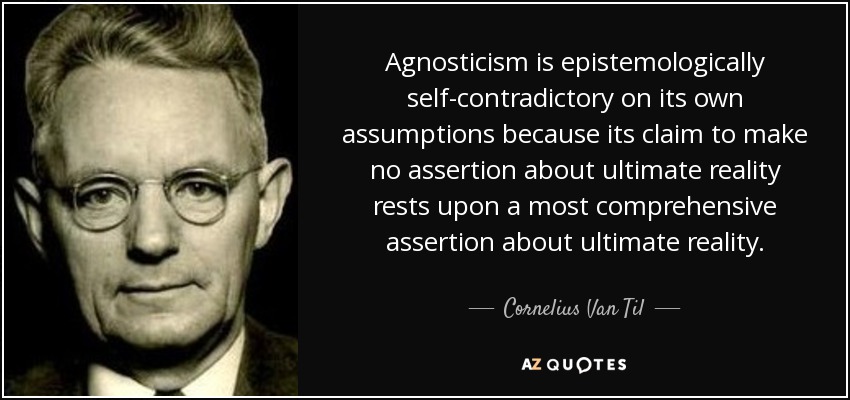
Agnosticism is epistemologically self-contradictory on its own assumptions because its claim to make no assertion about ultimate reality rests upon a most comprehensive assertion about ultimate reality.
It is the best book ever written on the subject. There is nothing like it!
We are enabled to apprehend at all what is sublime and noble only by the perpetual instilling and drenching of the reality that surrounds us. We can never have enough of nature.
I believe in the cosmos. All of us are linked to the cosmos. So nature is my god. To me, nature is sacred. Trees are my temples and forests are my cathedrals. Being at one with nature.
The impression forces itself upon one that men measure by false standards, that everyone seeks power, success, riches for himself, and admires others who attain them, while undervaluing the truly precious thing in life.
As for a future life, every man must judge for himself between conflicting vague probabilities.
Believing as I do that man in the distant future will be a far more perfect creature than he now is, it is an intolerable thought that he and all other sentient beings are doomed to complete annihilation after such long-continued slow progress.
There is nothing more necessary than truth, and in comparison with it everything else has only secondary value. This absolute will to truth: what is it? Is it the will to not allow ourselves to be deceived? Is it the will not to deceive? One does not want to be deceived, under the supposition that it is injurious, dangerous, or fatal to be deceived.
With the strength of his spiritual sight and insight the distance, and as it were the space, around man continually expands: his world grows deeper, ever new stars, ever new images and enigmas come into view.
The transition from Religion to Scientific contemplation is a violent, dangerous leap, which is not to be recommended. In order to make this transition, art is far rather to be employed to relieve the mind overburdened with emotions. Out of the illogical comes much good. It is so firmly rooted in the passions, in language, in art, in religion, and generally in everything which gives value to life. It is only the naive people who can believe that the nature of man can be changed into a purely logical one. We have yet to learn that others can suffer, and this can never be completely learned.
For such is man: a Theological Dogma might be refuted to him a thousand times - provided however, that he had need of it, he would again and again accept it as true. Belief is always most desired, most pressingly needed where there is a lack of will. Fanaticism is the sole "volitional strength" to which the weak and irresolute can be excited, as a sort of hypnotising of the entire sensory-intellectual system.
... superstitions, which, being unable to defend themselves on fair ground, raise these intangling brambles to cover and protect their weakness. Chased from the open country, these robbers fly into the forest, and lie in wait to break in upon every unguarded avenue of the mind, and overwhelm it with religious fears and prejudices. ... The idea of God, as meaning an infinitely intelligent, wise and good Being, arises from reflecting on the operations of our own mind, and augmenting, without limit, those qualities of goodness and wisdom.
And whoever is moved by Faith to assent to it, is conscious of a continued miracle in his own person, which subverts all the principles of his understanding, and gives him a determination to believe what is most contrary to custom and experience.
..when, in my philosophical disquisitions, I deny a providence and a future state, I undermine not the foundations of society, but advance principles, which they themselves, upon their own topics, if they argue consistently, must allow to be solid and satisfactory.
The religious hypothesis, therefore, must be considered only as a particular method of accounting for the visible phenomena of the universe: but no just reasoner will ever presume to infer from it any single fact, and alter or add to the phenomena, in any single particular.
Atheism, which people have tried to for hundreds of years as 'the ways of reason and science,' is proving to be mere irrationality and ignorance.
One reason education undoes belief is its teaching of evolution; Darwin's own drift from orthodoxy to agnosticism was symptomatic. Martin Lings is probably right in saying that more cases of loss of religious faith are to be traced to the theory of evolution ... than to anything else.
Writer Somerset Maugham, after his parents deaths, spent a few stultifying years in his uncle's vicarage. Later, in his teens at a boarding-school, having lost his belief in the existence of God said: "The whole horrible structure, based not on the love of God, but on the fear of hell, tumbled down like a house of cards."
Science is agnostic when it comes to god; not atheistic, as some people prefer to read that laden word wrongly; just agnostic.
Why do we need faith when we have the technology to move mountains?
The evolutionary vision is agnostic in regard to systems in the universe of greater complexity than those of which human beings have clear knowledge.
Anyone who feels that they're in some way plugged into a meaningful, cosmic system is given a greater psychological balance as a result-whether or not they believe it contains a god-like figure at the control panels. Lots of people have this beneficial sense of being plugged into something bigger, even if they're not religious in the going-to-church-regularly sense.
When students of other sciences ask us what is now currently believed about the origin of species, we have no clear answer to give. Faith has given way to agnosticism. Meanwhile, though our faith in evolution stands unshaken we have no acceptable account of the origin of species.
This deep agnosticism is more than the refusal of conventional agnosticism to take a stand on whether God exists or whether the mind survives bodily death. It is the willingness to embrace the fundamental bewilderment of a finite, fallible creature as the basis for leading a life that no longer clings to the superficial consolations of certainty.
Agnosticism is no excuse for indecision. If anything, it is a catalyst for action; for in shifting concern away from a future life and back to the present, it demands an ethics of empathy rather than a metaphysics of fear and hope.
Follow AzQuotes on Facebook, Twitter and Google+. Every day we present the best quotes! Improve yourself, find your inspiration, share with friends
or simply: