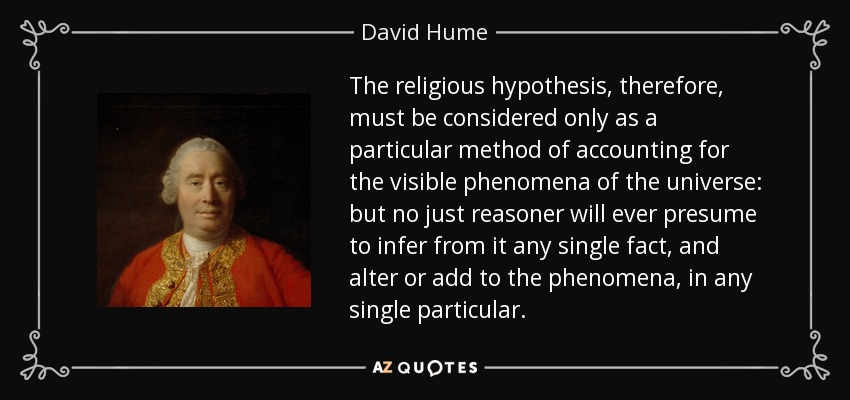
The religious hypothesis, therefore, must be considered only as a particular method of accounting for the visible phenomena of the universe: but no just reasoner will ever presume to infer from it any single fact, and alter or add to the phenomena, in any single particular.
Atheism, which people have tried to for hundreds of years as 'the ways of reason and science,' is proving to be mere irrationality and ignorance.
One reason education undoes belief is its teaching of evolution; Darwin's own drift from orthodoxy to agnosticism was symptomatic. Martin Lings is probably right in saying that more cases of loss of religious faith are to be traced to the theory of evolution ... than to anything else.
Writer Somerset Maugham, after his parents deaths, spent a few stultifying years in his uncle's vicarage. Later, in his teens at a boarding-school, having lost his belief in the existence of God said: "The whole horrible structure, based not on the love of God, but on the fear of hell, tumbled down like a house of cards."
Science is agnostic when it comes to god; not atheistic, as some people prefer to read that laden word wrongly; just agnostic.
Why do we need faith when we have the technology to move mountains?
The evolutionary vision is agnostic in regard to systems in the universe of greater complexity than those of which human beings have clear knowledge.
Anyone who feels that they're in some way plugged into a meaningful, cosmic system is given a greater psychological balance as a result-whether or not they believe it contains a god-like figure at the control panels. Lots of people have this beneficial sense of being plugged into something bigger, even if they're not religious in the going-to-church-regularly sense.
When students of other sciences ask us what is now currently believed about the origin of species, we have no clear answer to give. Faith has given way to agnosticism. Meanwhile, though our faith in evolution stands unshaken we have no acceptable account of the origin of species.
This deep agnosticism is more than the refusal of conventional agnosticism to take a stand on whether God exists or whether the mind survives bodily death. It is the willingness to embrace the fundamental bewilderment of a finite, fallible creature as the basis for leading a life that no longer clings to the superficial consolations of certainty.
Agnosticism is no excuse for indecision. If anything, it is a catalyst for action; for in shifting concern away from a future life and back to the present, it demands an ethics of empathy rather than a metaphysics of fear and hope.
The world is continuous flux and is impermanent.
I've sworn off agnosticism, which I now call cowardly atheism. I've come to the position that in the complete absence of any supporting data whatsover for the persistence of the individual in some spiritual form, it is necessary to operate under the provisional conclusion that there is no afterlife and then be ready to amend that if I find out otherwise.
My mind is incapable of conceiving such a thing as a soul. I may be in error, and man may have a soul; but I simply do not believe it.
Incurably religious, that is the best way to describe the mental condition of so many people.
Death makes me realize how deeply I have internalized the agnosticism I preach in all my books. I consider dogmatic belief and dogmatic denial very childish forms of conceit in a world of infinitely whirling complexity. None of us can see enough from one corner of space-time to know "all" about the rest of space-time.
Our ignorance of the cosmos is too vast to commit to atheism, and yet we know too much to commit to a particular religion. A third position, agnosticism, is often an uninteresting stance in which a person simply questions whether his traditional religious story (say, a man with a beard on a cloud) is true or not true. But with Possibilianism I’m hoping to define a new position - one that emphasizes the exploration of new, unconsidered possibilities. Possibilianism is comfortable holding multiple ideas in mind; it is not interested in committing to any particular story.
Now if the religious skeptic is right, we can know nothing about God. And if we can know nothing about God, how can we know God so well that we can know that he cannot be known? How can we know that God cannot and did not reveal himself—and perhaps even through human reason?
Skepticism is my nature, freethought is my methodology, agnosticism is my conclusion after 25 years of being in the ministry, and atheism is my opinion.
For a time it seemed inevitable that the surging tide of agnosticism and materialism would sweep all before it. There were those who did not dare utter what they thought. Many thought the case hopeless and the cause of religion lost once and for ever. But the tide has turned and to the rescue has come - what? The study of comparative religions. By the study of different religions we find that in essence they are one.
In one of his last appearances, Mitterrand, the agnostic president, was asked what the real God might say to him if he went to heaven. God would say: "At last, you know." And I would hope that He would add, "Welcome."
To say that we cannot know anything about God is to say something about God; it is to say that if there is a God, he is unknowable. But in that case, he is not entirely unknowable, for the agnostic certainly thinks that we can know one thing about him: That nothing else can be known about him.
Agnosticism is epistemologically self-contradictory on its own assumptions because its claim to make no assertion about ultimate reality rests upon a most comprehensive assertion about ultimate reality.
The great trouble is that the preachers get the children from six to seven years of age and then it is almost impossible to do anything with them.
It is the best book ever written on the subject. There is nothing like it!
Follow AzQuotes on Facebook, Twitter and Google+. Every day we present the best quotes! Improve yourself, find your inspiration, share with friends
or simply: