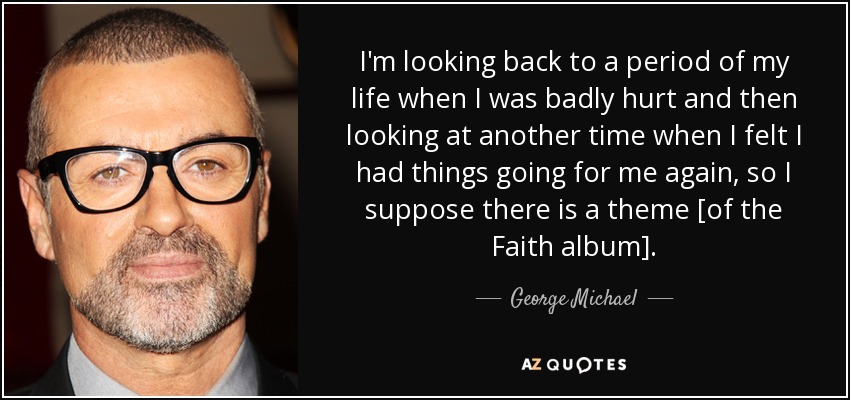
I'm looking back to a period of my life when I was badly hurt and then looking at another time when I felt I had things going for me again, so I suppose there is a theme [of the Faith album].
[Music From the Edge of Heaven] wasn't really an album at all. The band had made the decision to release an LP and then split up. We wanted to go out with a bang in Britain and the rest of the world by having a single that was four songs, not just one song. But we couldn't do that over here because we couldn't release a single without an album.
My contract with mercury PolyGram Nashville was about to expire. And I never had really been happy. The company, the record company, just didn't put any promotion behind me. I think one album, maybe the last one I did, they pressed 500 copies. And I was just disgusted with it. And about that time that I got to feeling that way, Lou Robin, my manager, came to me and talked to me about a man called Rick Rubin that he had been talking to that wanted me to sign with his record company.
When I finally stopped [singing], he had been saying, like, the last day or so, he'd been saying, now, I think we should put this one in the album. So without him saying I want to record you and release an album, he kept - he started saying, let's put this one in the album. So the album, this big question, you know, began to take form, take shape. And Rick [Rubin] and I would weed out the songs.
I got really excited about it. But then we went into the studio and tried to record some with different musicians, and it didn't sound good. It didn't work. So we put together the album [Unchained] with just a guitar and myself.
When I first knew Bob Dylan, he lived in the Village. And for a man who, years after, would disdain publicity or any attempts at interviews, whenever I'd write something about him, he'd be on the street corner saying, `When's it going to run? When's it going to run?' But I must say that album that was - it was the second album he did, and though I've never been a fan of his guitar-playing, he did - I have to admit, he did catch the Zeitgeist of the time.
Basically I made her [ Sara Pocock] listen to funk music for a good month, a nonstop stream of George Clinton. I was talking about the art from...if you look at the art from George Clinton albums there are two or three artists he worked with...I made her listen to my album too so all the images are from jokes I made. I wanted it to look like the thoughts that are coming out of my brain which is what comedy is anyway.
The album ['A Seat at the Table'] really feels like storytelling for us all and our family and our lineage.
I just feel so much joy and gratitude that people have connected to it in this way. The biggest reward that I could ever get is seeing women, especially black women, talk about what this album ['A Seat at the Table'] has done, the solace it has given them.
Mixtapes, it's for everyone and you throw them in the trash quickly. While an album is an object that only your real fans take the trouble to buy and know you have prepared something special.
Just because you can make an album on a laptop computer in your back bedroom doesn't mean it's going to be any good. Like any 'product', it has to come from a good original idea. There are no shortcuts!
I'm pretty much always planning two albums ahead.
I've sort of realized there's a definite pattern to my output at this point: there's an album that everybody sort of loves, that's a real balance between the old and new, like The Dreamer or No Beginning No End, like a blend of jazz and hip-hop, or r&b and soul and hip-hop.
I know I'm a very dynamic performer. Once you come to the show, you're gonna want to have the album. I think it's more about showing people that it's OK to share similarities, but it's more important to embrace your individuality.
When I start working on a new album, I kind of stop listening to a lot of outside stuff just so I can kind of focus.
I think, when all bands start, when you're on your first album you have the benefit of hoovering up people who genuinely come across the music and really like it, but also those sort of 'floating voters' who just like pop music when they're young. And I think that when you get to your fourth album, those floating voters have dissipated and you're left with a core audience, and at that point you've really got to get your act together and move on to something else to keep afloat, or you'll just shrink with your core audience.
I did LSD and peyote in the late Sixties, before I got into cocaine. That was concurrent with my change from a straight comic to the album and counterculture period, and those drugs served their purpose. They helped open me up.
The Class Clown album was done totally sober. I'd realized what a hell I'd made for myself and I cleaned up completely for three months. You can hear the clarity of my thinking and of my speech on that album.
When you start out as a band, you stake your claim and you go for it. And there's a part of you that dreams it and imagines it and does everything to get there, but you can't ever expect to sell 8, 10, 12, 20 million albums. It becomes this thing that you really have to figure out as you go.
I suspect by the time the Beatles were writing the White Album, they didn't go, "'I Wanna Hold Your Hand!' I wanna play that!" It's like if somebody asked you to put on the clothes you wore in high school. Well, no. No!
We have to be very clear about what we're doing to our music. We're giving away free albums. Now think about the psyche of the ordinary man, we don't respect anything that's free. Anything that we get easy has no validity.
I realized, "Gee, you're making the same film over and over here." I just kept making them for my own amusement, but also with this thought in my head that I could collect enough songs to make an album out of it. I am attracted to non-dramatic moments in life. The idea of a coffee break is not something you'd think of as being an important part of your day, so these shorts were like little free zones in which we could just play around.
I can write songs, but I'm not gonna really feel good about the song unless it feels like me, and I'm not gonna release a song or put it on an album or play it in concert unless it really feels like me.
A brilliant 1989 album, Oh Mercy; some career retrospectives; and two albums of American folk songs, with just Bob Dylan and his guitar and harmonica. All that culminated in the Grammy-winning comeback album, Time Out of Mind (1997). Once again, just as Dylan seemed to be out of it, he was back at the top of his game.
After putting out quite a few albums, there's a feeling of why make another? I was trying to make something that was an album experience.
Follow AzQuotes on Facebook, Twitter and Google+. Every day we present the best quotes! Improve yourself, find your inspiration, share with friends
or simply: