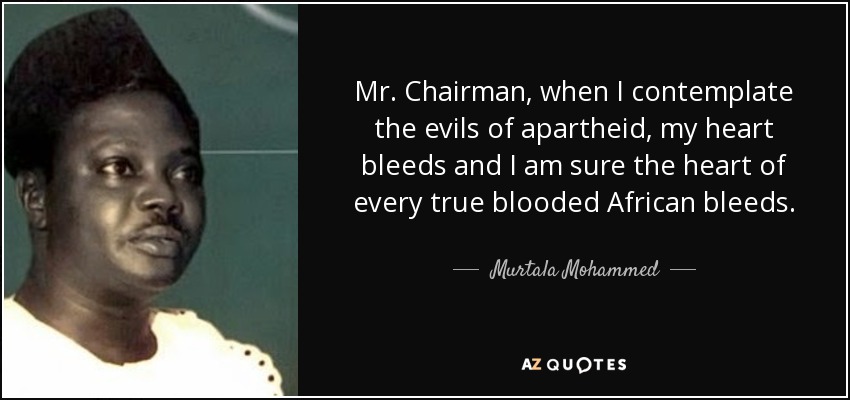
Mr. Chairman, when I contemplate the evils of apartheid, my heart bleeds and I am sure the heart of every true blooded African bleeds.
Jews and Muslims 'dialoguing' has nothing to do with Palestine. The problem is settler colonialism, apartheid and occupation, not religion.
South Africans have no concept of time and this is also why we can't solve poverty and social problems… It's now 10 years since the fall of the Apartheid government and we cannot blame Apartheid for being tardy.
I remember my emotions the day we watched Nelson Mandela walk out of prison Writing & literature in South Africa during the anti-apartheid years, became a 'cultural weapon.' You had to use it to fight apartheid & some of us resisted that in the end, you recognize that you are facing a government that has no scruples about using culture & art to oppress you.
In Western Australia, minerals are being dug up from Aboriginal land and shipped to China for a profit of a billion dollars a week. In this, the richest, 'booming' state, the prisons bulge with stricken Aboriginal people, including juveniles whose mothers stand at the prison gates, pleading for their release. The incarceration of black Australians here is eight times that of black South Africans during the last decade of apartheid.
The veil deliberately marks women as private and restricted property, nonpersons. The veil sets women apart from men and apart from the world; it restrains them, confines them, grooms them for docility. A mind can be cramped just as a body may be, and a Muslim veil blinkers both your vision and your destiny. It is the mark of a kind of apartheid, not the domination of a race but of a sex.
We are in a strange kind of time, where the kind of liberation movements such as anti-apartheid movements and freedom struggles in India need to be reinvented. We need to retool them so that all the gains that our generation has made can be passed on to future generations.
I refused this evening at Oxford University to debate with an Israeli, a supporter of the apartheid state of Israel. The reason is simple: no recognition, no normalisation. Just boycott, divestment and sanctions, until the apartheid state is defeated. I never debate with Israelis nor speak to their media. If they want to speak about Palestine – the address is the PLO.
Women have always struggled with their men-folk for the abolition of slavery, the liberation of countries from colonialism, the dismantling of apartheid and the attainment of peace. It is now the turn of men to join women in their struggle for equality.
Disengagement is a response to certain demographic realities, .. Within a few years, due to the higher Arab birth rate, Jews will become a minority in the area between the Jordan River and the Mediterranean Sea. I don't want [Israel] to be South Africa because we don't believe in apartheid. We simply have to separate from the Palestinians so that we can control our own destinies.
With the Cuban presence in Namibia it was possible to achieve the security and real freedom of that country and the end of Apartheid in South Africa, with the modest contribution of the international military presence in Africa.
He [Belafonte] was a good teacher and looked after me. He said, 'You have such great talent, you must try not to be a tornado - be like a submarine. It was good advice when I found myself speaking at the UN Committee Against Apartheid and then the UN General Assembly.
I myself am a very, very peaceful person. Throughout our history, from our own American revolution to the resistance against apartheid in South Africa, to labor strikes in the US, people have resorted to violence to achieve a more progressive society, from time to time.
The Reformed Church was identified with the old all-white government of South Africa and its apartheid policy. The Roman Catholic Church was closely identified with the Franco and Salazar dictatorships in Spain and Portugal. . . . More recently, . . . the Serbian Orthodox Church has come to be identified with the policies of Serbia (Yugoslavia).
I am deeply moved by the warmth and courage of the Canadian people which I felt so strongly during my recent visit to your country. Your support of the struggle against apartheid restored me in my journey home and reassured me that many just people around the world are with us.
I'm not a pacifist at all; I think there is a notion of "just war" that can be persuasively argued. I think in the face of Nazis, in the face of apartheid, that I would have joined those armies. But that's the last, last resort.
In my many trips to South Africa, I have met and spoken to a lot of people there, and they all seem to find apartheid as repellent as you would.
Mumbling obeisance to abhorrence of apartheid is like those lapsed believers who cross themselves when entering a church.
South Africa, with US support, after the fall of the Portuguese empire, invaded Angola and Mozambique to establish their own puppet regime there. They were trying to protect Namibia, to protect apartheid, and nobody did much about it; but the Cubans sent forces, and furthermore they sent black soldiers and they defeated a white mercenary army, which not only rescued Angola but it sent a shock throughout the continent-it was a psychic shock-white mercenaries were purported to be invincible, and a black army defeated them and sent them back fleeing into South Africa.
I listen a lot to the incredible young artists who are coming through, which is something that just wasn't possible during Apartheid. That's the way I learn.
My maternal family are South African and when I was small and my parents separated my mother and I went back to South Africa. So for me the emergence of my own childhood consciousness was in the context of 1970s and 1980s apartheid South Africa and the movement there.
In general, Iranians believe that all Palestinians have the right to return home and that there is no chosen people on this earth, whether Jewish, Muslim, Christian. Iran had the same policy towards apartheid South Africa and at the time when it was supporting and funding the ANC [African National Congress] among other groups in South Africa, these groups were also considered to be terrorist organizations by many western governments.
When I was growing up, it was still during Apartheid, so the country was very shielded from the outside artistic world. Anything that was too subversive was basically banned. All the music that we got from outside of South Africa was the poppiest, least subversive music that you could get.
When I think back, I felt like I had the life that a lot of white American kids grew up with in the suburbs in the States. I started noticing, as Apartheid's grip weakened, that we had more and more black kids at school; I had more and more black friends. But I never really saw a separation between myself and the black kids at school.
I remember being very affected by what was going on there towards the end of Apartheid. And the subject is still very pertinent, politically, to what's happening around the world today, in terms of negotiating peace talks. I had always been interested in this period of change in South Africa, generally, for a variety of reasons.
Follow AzQuotes on Facebook, Twitter and Google+. Every day we present the best quotes! Improve yourself, find your inspiration, share with friends
or simply: