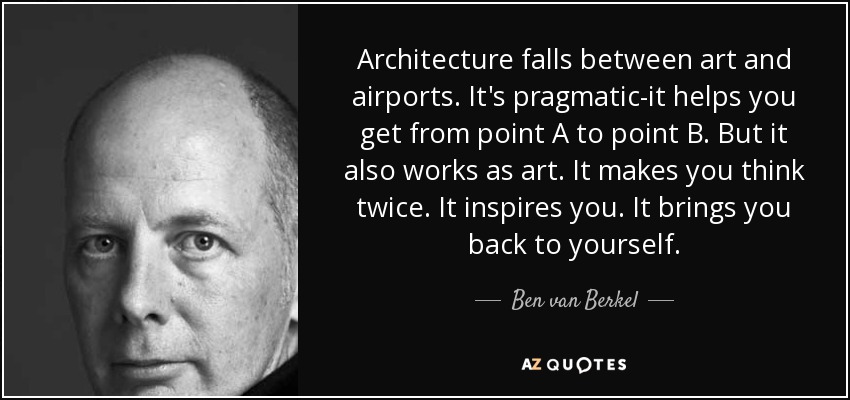
Architecture falls between art and airports. It's pragmatic-it helps you get from point A to point B. But it also works as art. It makes you think twice. It inspires you. It brings you back to yourself.
I got into architecture because I was searching for a way to produce in the world. I went to art school and thought I would do it through art, but I realized very quickly that I was interested in the social ramifications of form making. So buildings became the vehicle and fulfilled that thing. That satisfied me when I produced them. I decided this is what I wanted to do with the rest of my life.
Cartoons are perhaps a bigger part of art than is generally realized, and they influence people in ways that are not always recognized. But creating a monumental work of architecture, or writing a great symphony, is something else. It's a higher order of creation.
I'm trying to create flesh architecture. I aim to get a sculptural feel for groups of bodies, as well as create performance art.
My mother took me to Venice one time and showed me all the houses where famous composers used to live. It gave me a fascination for music and the city, but also for architecture. It was a valuable lesson.
I think it modern society as a whole, but definitively in Brazil, spaces are so well divided and there are so many barriers, and so many divisions, so many lines and so many borderlines, basically telling you that you should be here but not here. This is my space and this is your space, and this is expressed very dramatically in architecture, we have a very kind of aggressive, almost medieval concept for architecture, which is basically keeping people out. So you get high walls, fences, and electric fences, and divisions like that.
Architecture must make connections
The US ... cultivates no origin or mythical authenticity; it has no past and no founding truth ... it lives in a perpetual present. in the US everything human is artificial. The country is without hope. What is arresting here is ... both the absence of architecture in the cities and the dizzying absence of emotion and character in the faces and bodies.
The thing about architecture is that it's an art [you] simply learn more by doing more. It's one of those things that is really not an art about thinking, but doing. So in a way, what it has done is greatly intensify the way that I build.
When I was in architecture school at Princeton, the worst thing you could say about someone was that they were eclectic.
People who build their own home tend to be very courageous. These people are curious about life. They're thinking about what it means to live in a house, rather than just buying a commodity and making it work.
Very often the opinion of the clients must be disregarded in their own interest.
The greatest architectural illusion is not Baroque fancy or Victorian flamboyant, but minimalism.
Architects spend an entire life with this unreasonable idea that you can fight against gravity.
There are 360 degrees, so why stick to one?
The sun never knew how great it was until it hit the side of a building.
Architects today tend to depreciate themselves, to regard themselves as no more than just ordinary citizens without the power to reform the future.
A bold architectural statement turns a public building into a landmark, but it is in the details where the architect becomes the real storyteller.
The future of architecture is culture.
Chandeliers are marvels of drop-dead showiness, the jewellery of architecture.
When the old way of seeing was displaced, a hollowness came into architecture. Our buildings show a constant effort to fill that void, to recapture that sense of life which was once to be found in any house or shed. Yet the sense of place is not to be recovered through any attitude, device, or style, but through the principles of pattern, spirit, and context.
My ambition has always been to reduce a building's support to a minimum. The more we diminish supporting structures, the more audacious and important the architecture is. That has been my life's work.
Chicago is known for good steaks, expensive stores and beautiful architecture. Unfortunately, the Windy City also enjoys a reputation for corrupt politics, violent crime, and some of the strictest gun control laws anywhere in the country.
And when an architect has designed a house with large windows, which is a necessity today in order to pull the daylight into these very deep houses, then curtains come to play a big role in architecture.
Painting, sculpture and architecture are finished, but the art habit continues.
Follow AzQuotes on Facebook, Twitter and Google+. Every day we present the best quotes! Improve yourself, find your inspiration, share with friends
or simply: