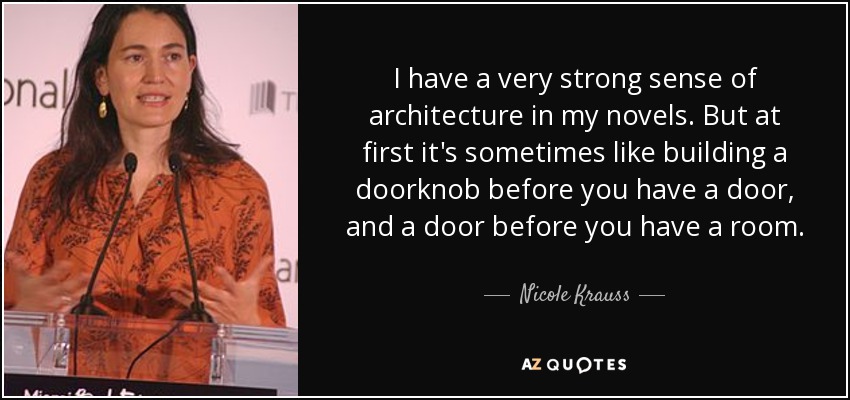
I have a very strong sense of architecture in my novels. But at first it's sometimes like building a doorknob before you have a door, and a door before you have a room.
Architecture is measured against the past, you build in the present, and try to imagine the future.
It was very definitely architectural. I was using the words on the page as some kind of equivalent of a physical model. But I never thought at that point that I wanted to move toward architecture. I wanted to move toward real space. Sure, that's probably another way of saying, I want to move toward architecture. But I didn't define real space in terms of architecture, then.
Cartoons are perhaps a bigger part of art than is generally realized, and they influence people in ways that are not always recognized. But creating a monumental work of architecture, or writing a great symphony, is something else. It's a higher order of creation.
What's your story? It's all in the telling. Stories are compasses and architecture; we navigate by them, and to be without a story is to be lost in the vastness of world that spreads in all directions like arctic tundra or sea ice. To love someone is to put yourself in their place, we say, which is to put yourself in their story, or figure out how to tell yourself their story. Which means that a place is a story, and stories are geography, and empathy is first of all an act of imagination, a storyteller's art, and then a way of traveling from here to there.
It seems that the brain has a "small world" architecture - or at least the cortex does. Everything can connect to everything else in a few synaptic steps.
It is a gift, and you realize as soon as you cross the border into Paraguay, as I did, the first time in '82, that you are in a sort of wonderland. Nothing is quite right: the buildings, they've got their own architecture, their own language; and everything is just a little bit off key.
What's interesting in archaeology is that we always understand other cultures by digging up their cities; architecture is almost always a way for us to formulate a diagram of how people used to live.
I see architecture as a form of communication over time.
I just think structure can make a book feel so much bigger. It's the architecture. You could use flimsy materials if you wanted to, even, but it could still feel big.
One of the things that's amazing about reading the private writing of these folks is that they enthusiastically describe things which we have now seen, and which are widely regarded as unappealing. They'll write, "It's going to be beautiful, we're going to have a town of 1,000 stone buildings that are all identical." And we as modern readers think, we've seen that; that's bad Soviet architecture or a public housing project. Nobody fantasizes about living there.
In my head, my business is architecture and furniture; it's 70 percent Prouvé, and Corbusier, Royer, Jeanneret - they all passed away. So it's retrospective, I'm looking back.
In one point of view, Gothic is not only the best, but the only rational architecture, as being that which can fit itself most easily to all services, vulgar or noble.
As for your high towers and monuments, there was a crazy fellow once in this town who undertook to dig through to China, and he got so far that, as he said, he heard the Chinese pots and kettles rattle; but I think that I shall not go out of my way to admire the hole which he made.
Churches have given us great treasures such as music and architecture. Whether that pays for the harm they have done is another matter.
Poor minorities live in a new age of Jim Crow, one in which the ravages of segregation, racism, poverty and dashed hopes are amplified by the forces of privatization, financialization, militarization and criminalization, fashioning a new architecture of punishment, massive human suffering and authoritarianism.
In order for architecture to experience its ongoing evolution as a language, there has to be a lot of adjusted copies between how architects draw, think, engage bylaws and constraints.
Chicago is known for good steaks, expensive stores and beautiful architecture. Unfortunately, the Windy City also enjoys a reputation for corrupt politics, violent crime, and some of the strictest gun control laws anywhere in the country.
And when an architect has designed a house with large windows, which is a necessity today in order to pull the daylight into these very deep houses, then curtains come to play a big role in architecture.
Painting, sculpture and architecture are finished, but the art habit continues.
A bold architectural statement turns a public building into a landmark, but it is in the details where the architect becomes the real storyteller.
The future of architecture is culture.
Chandeliers are marvels of drop-dead showiness, the jewellery of architecture.
When the old way of seeing was displaced, a hollowness came into architecture. Our buildings show a constant effort to fill that void, to recapture that sense of life which was once to be found in any house or shed. Yet the sense of place is not to be recovered through any attitude, device, or style, but through the principles of pattern, spirit, and context.
The difference between good and bad architecture is the time you spend on it.
Follow AzQuotes on Facebook, Twitter and Google+. Every day we present the best quotes! Improve yourself, find your inspiration, share with friends
or simply: