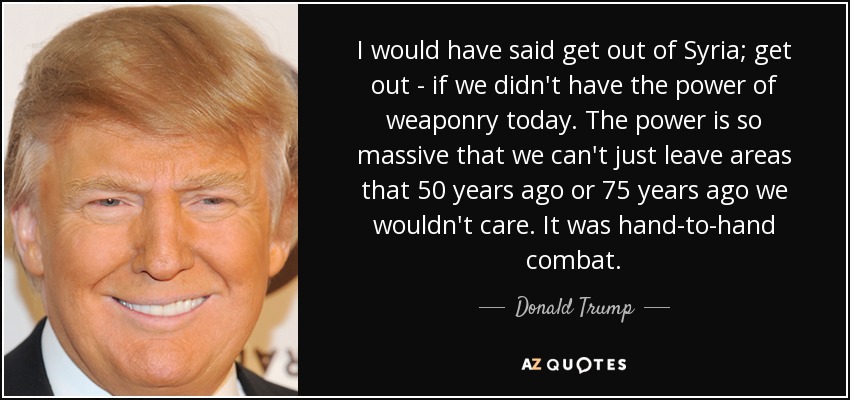
I would have said get out of Syria; get out - if we didn't have the power of weaponry today. The power is so massive that we can't just leave areas that 50 years ago or 75 years ago we wouldn't care. It was hand-to-hand combat.
You have to be able to differentiate between the different areas of life. It shows that we're all separate people, we're all different, but we're all the same.
You bomb ISIL. You're not trying to bomb innocent people. And that requires intelligence and confidence in our military to be able to develop the kinds of targets that we need. We're already doing Special Forces, who are going to help us gather that intelligence and help advise and assist and train local forces so that they can go after ISIL in areas like Raqqah and Mosul.
With more than 80 percent of Americans living in metropolitan areas, there are still demagogues who want to run down the idea of multiculturalism, of urbanity, being the only future we have. We either live or die based on how we live in cities, and our society is either going to be great or not based on how we perform as creatures of the city.
The most basic act of awareness or knowing that we can demonstrate in science. I postulate that that is the very basis of why we're conscious at all, that it is this relationship at the quantum level as matter evolves into more complex form, including plants and animals and living substance and ourselves, that this area of consciousness as an awareness becomes more and more complex.
I feel like it's me singing back to myself as a younger person and saying have confidence in being a bit different. I really felt I didn't fit in. My dad was from the Caribbean, my mum was English, we lived in quite a white area but we were quite poor, but also quite brainy, and I was a really, really skinny child so I felt a bit awkward about all these things.
As an actor, you're always in situations that can be compromising. But you can wipe away that gray area by making a choice.
It wasn't until I went to college and met different people from different areas of life - and then went to San Francisco and met people who really knew who the hell they were - that I kind of caught up in a hurry.
I began studying human emotions more than twenty years ago. At that time, almost every scientist working in this area was studying one of the negative emotions, like fear, anger, anxiety, or depression. I wondered why no scientists cared to explain why we humans sometimes feel upbeat and pleasant. I liked the idea of charting new terrain. It's been a fun intellectual puzzle. There's so much to discover!
I'm the youngest of five kids, and I wanted attention. And in Santa Barbara, there was lots of theater going on, so for that area, it was a little bit like playing Little League baseball. There were dance classes, theater classes, and I just loved it.
We may not always recognize it, but government plays a bigger role in our lives than any other single person or institution. We spend nearly half of our lives working to pay for it. Children spend more time in government schools than they do with their parents. Birth, death, marriage, every area of our lives feels the influence of government.
When I was a young fellow, I used to learn the dialogue backwards. The point is that in a conversation between two people, you can't have already made the decisions about what you're gonna do. You gotta be very light on your feet. That leads you into areas where conversations can have a much bigger, grander meaning.
Do we pour $40 billion into grandiose Louisiana engineering projects or do we instead put up no trespassing- signs in the areas below sea level? All are hard choices with various merits and pains. The important thing, however, is for America to decide whether the current policy of inaction is really the way we want to deal with the worst natural disaster in our history.
In a world where people are hungry for quick fixes and sound bites, for instant gratification, there is not patience for the long. Slow rebuilding process: implementing after school programs, hiring more community workers to act as mentors, adding more job training programs in marginalized areas
Where you are is what you eat. When I'm in London I'll have beans on toast for lunch. On holiday - what? Tapas? Go on then I'll have a bit. You eat whatevers in that area.
I have compromised down the line. I've disliked it intensely in the old days when you were trying to talk race relations and they would not allow you to talk about the legitimacies of race relations. In the old days, you didn't talk about black, you talked about Eskimo or American Indian, and the American Indian was assumed not to be a problem area.
I had a hole in my voice. It's an area in the voice where it's air. It's just - there's no - it's just very airy. And my classical teachers were just so frustrated with me because I would have these deep, low notes that were really strong, and the higher register was strong, but right in that middle area, it was really hard. It was like a passage. And many singers go through this and work it out. But I realized in jazz, I could just take advantage of that and take advantage of having a voice that was very different in different areas.
My father was a doctor. He was just a great guy, a gentle humanist, and an old-fashioned GP. He'd get up at three in the morning to see patients in different areas if they needed him.
A level of anxiety and tension and outright fear that so many people have felt, not only during the recession but during this slow economic recovery since. This made me very much want to up the conversation about how miracle-minded thinking applies to that area of life.
By clarity I don't mean that we're always in kind of a simple area where everything is clear and comforting and understood. Clarity is certainly a way toward disorientation because if you don't start out - if the reader isn't grounded, if the reader is disoriented in the beginning of the poem, then the reader can't be led astray or disoriented later.
Oh, I usually don't know a whole lot about a subject when I begin; the process itself teaches me a lot as I go along. Usually I know enough about one narrow area of the subject to start myself going, and then everything - including a lot more research - follows from that.
Especially in urban areas, nobody cares so much [about castes], because you are forced to live in the same buildings. There is so, so little space. You can't be thinking about whether you are living in a street that has only Brahmins, or in a building that has been touched only by Muslims or Christians. You just live there, because that's the only place that you can find. So such distinctions just crumble away. There are people who maintain them, at all costs. But for the most part, it doesn't matter.
We used to watch executions. I mentioned that in one of my stories. There was a piece of open ground near the area where we lived and we used to play soccer there. That was where they used to hold public executions for soldiers who deserted the army and members of the Kurdish resistance.
Peacekeeping there is still just totally ineffective. The UN is now saying they are sending reinforcements in the area, but I have no particular reason to believe that they will be any stronger than the force there. In Southern Kordofan, it's mostly an Egyptian battalion, and that's really problematic because the population already doesn't trust the Egyptians; they think they're on payroll of the north. So we already have a force that is seen as compromised.
There is less gray area there, less doubt. There is a security in being some thing all the way. Our culture, too, encourages this way of being - exaggeration, for example, is the key to advertising success in the United States. But hyperbole also seems a big part of Iranian culture, as well.
Follow AzQuotes on Facebook, Twitter and Google+. Every day we present the best quotes! Improve yourself, find your inspiration, share with friends
or simply: