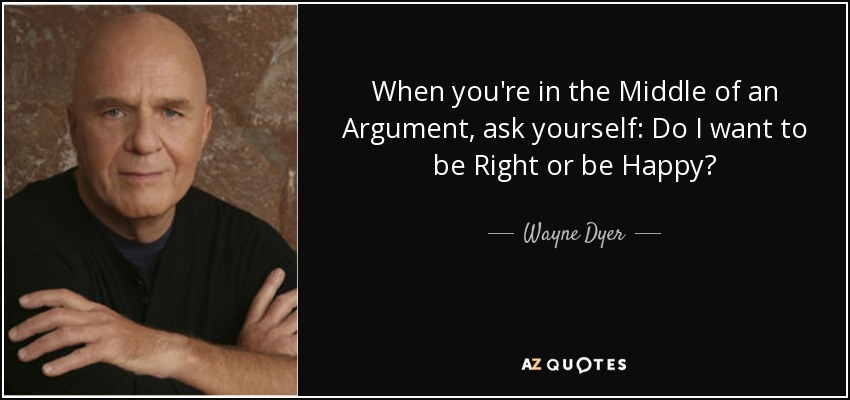
When you're in the Middle of an Argument, ask yourself: Do I want to be Right or be Happy?
An ounce of algebra is worth a ton of verbal argument.
That Francis Bacon retains his reputation gained, is not strange to any that knows him. The unusual words wherewith he had spangled his speech, were rather gracious for their propriety than strange for their novelty, and like to serve both for occasions to report and means to remember his argument. Certain sentences of his , somewhat obscure, and as it were presuming upon their capacities will, I fear, make some of them rather admire than commend him. In sum, all is as well as words can make it, and if it please Her Majesty to add deeds, the Bacon may be too hard for the Cook.
Closing one's ears to the complaints of partisans would also entail closing one's mind to the substance of their arguments.
I believe that President Clinton considered the legal merits of the arguments for the pardon as he understood them, and he rendered his judgment, wise or unwise, on the merits.
The argument now that the spread of pop culture and consumer goods around the world represents the triumph of Western civilization trivializes Western culture. The essence of Western civilization is the Magna Carta, not the Magna Mac. The fact that non-Westerners may bite into the latter has no implications for their accepting the former.
I cannot understand antiabortion arguments that center on the sanctity of life. As a species, we’ve fairly comprehensively demonstrated that we don’t believe in the sanctity of life. The shrugging acceptance of war, famine, epidemic, pain, and lifelong, grinding poverty show us that, whatever we tell ourselves, we’ve made only the most feeble of efforts to really treat human life as sacred.
I do not propose to criticize the fatuous argument I have just outlined; here, to expound is to expose.
I have no influence with the rising generation. All my arguments have failed to induce them to set bounds to their wants.
I now add, farther, that the apostles argument is so far from proving it to be the duty of people to obey, and submit to, such rulers as act in contradiction to the public good, and so to the design of their office, that it proves the direct contrary.
One could drive a prairie schooner through any part of his argument and never scrape against a fact.
Silence is an argument in favor of the status quo. A refusal to address an inequity is a strategy for maintaining that inequity.
A man with an experience of God is never at the mercy of a man with an argument.
But the indeterminate future is somehow one in which probability and statistics are the dominant modality for making sense of the world. Bell curves and random walks define what the future is going to look like. The standard pedagogical argument is that high schools should get rid of calculus and replace it with statistics, which is really important and actually useful. There has been a powerful shift toward the idea that statistical ways of thinking are going to drive the future.
I suppose it's unfair, tricks of argument that leave wounds, but with this sort of thing that (C.S.) Lewis does, what I feel is a craftsman's joy at the sight of a superior performance.
I have advocated postal reform for many years. The parliament said it was an absurd argument. The people have said it was the right thing.
Yes, I share your concern: how to program well -though a teachable topic- is hardly taught. The situation is similar to that in mathematics, where the explicit curriculum is confined to mathematical results; how to do mathematics is something the student must absorb by osmosis, so to speak. One reason for preferring symbol-manipulating, calculating arguments is that their design is much better teachable than the design of verbal/pictorial arguments. Large-scale introduction of courses on such calculational methodology, however, would encounter unsurmoutable political problems.
... if you insist that the inference is made by a chain of reasoning, I desire you to produce that reasoning. The connection between the two is not intuitive. There is required a medium, which may enable the mind to draw such an inference, if indeed it be drawn by reasoning and argument. What that medium is, I must confess, passes my comprehension; and it is incumbent on those to produce it, who assert that it really exists, and is the origin of all our conclusions concerning matter of fact.
We are in fact convinced that if we are ever to have pure knowledge of anything, we must get rid of the body and contemplate things by themselves with the soul by itself. It seems, to judge from the argument, that the wisdom which we desire and upon which we profess to have set our hearts will be attainable only when we are dead and not in our lifetime.
A man who is furnished with arguments from the mint, will convince his antagonist much sooner than one who draws them from reason and philosophy. - Gold is a wonderful clearer of the understanding; it dissipates every doubt and scruple in an instant; accommodates itself to the meanest capacities; silences the loud and clamorous, and cringes over the most obstinate and inflexible. - Philip of Macedon was a man of most invincible reason this way. He refuted by it all the wisdom of Athens; confounded their statesmen; struck their orators dumb; and at length argued them out of all their liberties.
Whether or not you agree that trimming and cooking are likely to lead on to downright forgery, there is little to support the argument that trimming and cooking are less reprehensible and more forgivable. Whatever the rationalization is, in the last analysis one can no more than be a bit dishonest than one can be a little bit pregnant. Commit any of these three sins and your scientific career is in jeopardy and deserves to be.
But you now, you wear your soul on your sleeve, exhausting your energy, propping yourself up on a tree, mumbling, or bent over your desk, asleep. Heaven gives you a form and you wear it out by pointless argument.
We argue with our biology, and the result of that argument is civilization.
History is the art of making an argument about the past by telling a story accountable to evidence. In the writing of history, a story without an argument fades into antiquarianism; an argument without a story risks pedantry. Writing history requires empathy, inquiry, and debate. It requires forswearing condescension, cant, and nostalgia. The past isn’t quaint. Much of it, in fact, is bleak.
An argument frequently used by believers [is] to force unbelievers to soften their terms by accepting their opponents' definition; "Atheist" means without a concept of God that is logically convincing, not with proof that God does not exist.
Follow AzQuotes on Facebook, Twitter and Google+. Every day we present the best quotes! Improve yourself, find your inspiration, share with friends
or simply: