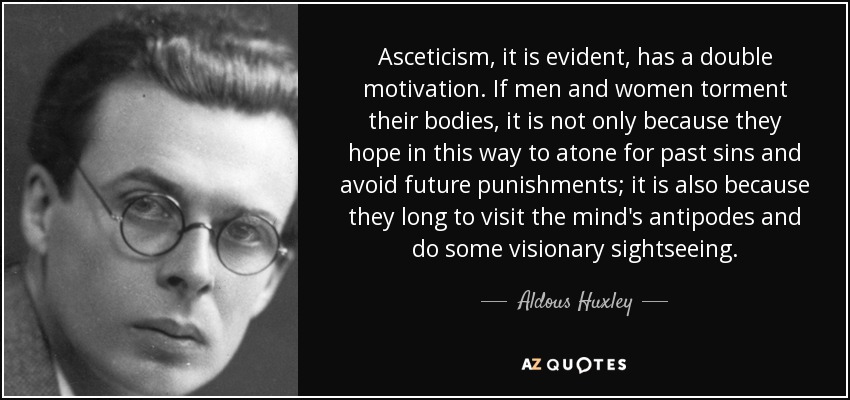
Asceticism, it is evident, has a double motivation. If men and women torment their bodies, it is not only because they hope in this way to atone for past sins and avoid future punishments; it is also because they long to visit the mind's antipodes and do some visionary sightseeing.
Asceticism may be a mere expression of organic hardihood, disgusted with too much ease.
Nothing is easier than to give Christian asceticism a Socialist tinge.
The most intelligent men, like the strongest, find their happiness where others would find only disaster: in the labyrinth, in being hard with themselves and with others, in effort; their delight is self-mastery; in them asceticism becomes second nature, a necessity, as instinct.
Faith comes not through pondering but through action.
The saints' deep secret is this: do not seek freedom, and freedom will be given you.
We notice the person who is for ever bowing and fussily servile, and perhaps say, How humble he is! But the truly humble person escapes notice: the world does not know him.
Everybody who does not live in a prostitute's bed and on a diet of cocaine snow is called an ascetic nowadays.
The less you eat, drink and read books; the less you go to the theatre, the dance hall, the public house; the less you think, love, theorize, sing, paint, fence, etc., the more you save-the greater becomes your treasure which neither moths nor dust will devour-your capital. The less you are, the more you have; the less you express your own life, the greater is your alienated life-the greater is the store of your estranged being.
It is precisely our egoism, our self-centeredness and self-love that cause all our difficulties, our lack of freedom in suffering, our disappointments and our anguish of soul and body.
There are three kinds of nature in man, as Nicetas Stethatos further explains: the carnal man, who wants to live for his own pleasure, even if it harms others; the natural man, who wants to please both himself and others; and the spiritual man, who wants to please only God, even if it harms himself. The first is lower than human nature, the second is normal, the third is above nature; it is life in Christ.
The beauty of a cuckoo is in its notes, that of a woman in her unalloyed devotion to her husband, that of an ugly person in his scholarship, and that of an ascetic in his forgiveness.
The dunyâ distracts and preoccupies the heart and body, but al-zuhd (asceticism, not giving importance to worldly things) gives rest to the heart and body. Verily, Allâh will ask us about the halâl things we enjoyed, so what about the harâm!
Cast off the burden of sin and you will find within you the upward path that will make your ascent possible.
We find nothing easier than being wise, patient, superior. We drip with the oil of forbearance and sympathy, we are absurdly just, we forgive everything. For that very reason we ought to discipline ourselves a little; for that very reason we ought to cultivate a little emotion, a little emotional vice, from time to time. It may be hard for us; and among ourselves we may perhaps laugh at the appearance we thus present. But what of that! We no longer have any other mode of self-overcoming available to us: this is our asceticism, our penance.
The ascetic remembrance of death is opposed to akedia, to anxiety, to depression, and becomes a powerful reminder of eternity, its joyful nostalgia.
It is true, we shall be monsters, cut off from all the world; but on that account we shall be more attached to one another.
Some have paid me an undeserved compliment by supposing that my Letters were the ripe fruit of many years' study in moral and ascetic theology. They forgot that there is an equally reliable, though less creditable, way of learning how temptation works.
Give up a member to save a family, a family to save a village, a village to save a country, and the country to save yourself.
The essence of being human is that one does not seek perfection, that one is sometimes willing to commit sins for the sake of loyalty, that one does not push asceticism to the point where it makes friendly intercourse impossible, and that one is prepared in the end to be defeated and broken up by life, which is the inevitable price of fastening one's love upon other human individuals.
Renounce and give up. What did Christ say? "He that loseth his life for my sake shall find it." Again and again did he preach renunciation as the only way to perfection. There comes a time when the mind awakes from this long and dreary dream-the child gives up its play and wants to go back to its mother. Renunciation is not asceticism. Are all beggars Christ? Poverty is not a synonym for holiness; often the reverse.
It begins here, and has no end, and no earthly power can coerce it; and it is to be found in the human heart.
However weighed down and entangled in earthly fetters you may be, it can never be too late.
Thus you are led from moment to moment in your halter of preoccupation with self, and kindled instantly to displeasure, impatience or anger if an obstacle intervenes.
Catholicism is not ritualism; it may in the future be fighting some sort of superstitious and idolatrous exaggeration of ritual. Catholicism is not asceticism; it has again and again in the past repressed fanatical and cruel exaggerations of asceticism. Catholicism is not mere mysticism; it is even now defending human reason against the mere mysticism of the Pragmatists.
Follow AzQuotes on Facebook, Twitter and Google+. Every day we present the best quotes! Improve yourself, find your inspiration, share with friends
or simply: