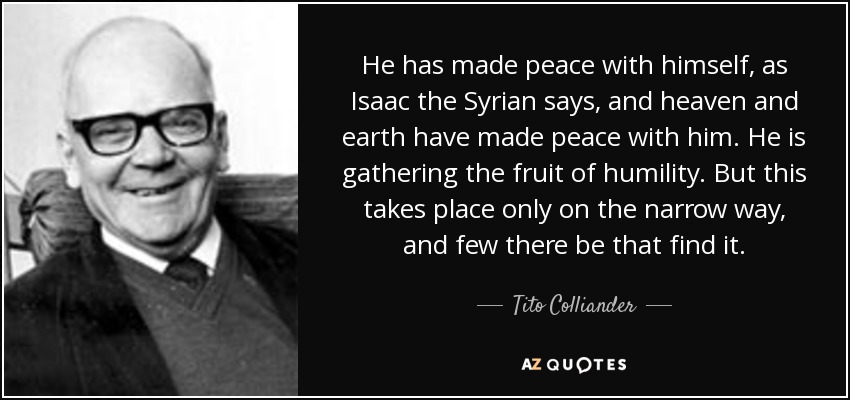
He has made peace with himself, as Isaac the Syrian says, and heaven and earth have made peace with him. He is gathering the fruit of humility. But this takes place only on the narrow way, and few there be that find it.
Through practice he has accustomed himself to wish for nothing, and for a person with no wishes, everything goes just as he wishes, explains the Abbot Dorotheus. His will has coincided with God's will, and whatever he asks, he will receive.
I never did calligraphy... But handwriting is an entirely different kind of thing. It's part of the syndrome of modernism... It's part of that asceticism.
Fasting, as some people speculate, is not a bodily torture, martyrdom, or a cross, but it is a way to elevate the body to reach the level of cooperation with the soul. When we fast, our intention is not to torture the body but to shun its behaviour. Thus, one who fasts becomes a spiritual and not a physical person. Fasting is an ascetic soul which takes the body with it as its partner in asceticism.
Without asceticism, self-indulgence would be insignificant.
Remember: there is no place, no community, no external circumstance that is not serviceable for the battle you have chosen. The exception is only such work as directly serves your vices.
This obstinate will to personal happiness is the cause of unrest and division in your soul. Give it up and work against it: the rest will be given you without effort.
Thus you are led from moment to moment in your halter of preoccupation with self, and kindled instantly to displeasure, impatience or anger if an obstacle intervenes.
As soon as you direct such a question outward to your fellow man and not inward to yourself, you have set yourself on a judgment seat and thereby judged yourself. You have robbed yourself of what you had won by your own continence; you have taken one step forward but ten backward: and then you have reason to weep over your obstinacy, your failure to improve, and your pride.
The origin of the stupid ideal of womanhood against which men as well as women to-day are still fighting was the asceticism of the Christian religion; and, unless St. Paul was a woman in disguise, I fail to see how woman is to be blamed for a conception of her place and duty from which she has suffered more than anybody else.
Fie on the eloquence that leaves us craving itself, not things!
Out of the doctrine of original sin grew the crimes and miseries of asceticism, celibacy and witchcraft; woman becoming the helpless victim of all these delusions.
The religion of art, like the religion of politics, was born from the ruins of Christianity. Art inherited from the old religion the power of consecrating things and endowing them with a sort of eternity; museums are our temples, and the objects displayed in them are beyond history. Politics--or more precisely, Revolution--co-opted the other function of religion: changing human beings and society. Art was an asceticism, a spiritual heroism; Revolution was the construction of a universal church.
Asceticism is the right way of thinking for those who have to extirpate their sensual drives because they are ravening beasts of prey. But only for those!
Christian morality (so called) has all the characters of a reaction.... In its horror of sensuality, it made an idol of asceticism, which has been gradually compromised away into one of legality. It holds out the hope of heaven and the threat of hell, as the appointed and appropriate motives to a virtuous life - in this falling far below the best of the ancients, and doing what lies in it to give to human morality an essentially selfish character.... It is essentially a doctrine of passive obedience; it inculcates submission to all authorities found established.
Asceticism without religion is just another way of cultivating peculiar sensations.
Catholicism is not ritualism; it may in the future be fighting some sort of superstitious and idolatrous exaggeration of ritual. Catholicism is not asceticism; it has again and again in the past repressed fanatical and cruel exaggerations of asceticism. Catholicism is not mere mysticism; it is even now defending human reason against the mere mysticism of the Pragmatists.
However weighed down and entangled in earthly fetters you may be, it can never be too late.
Mastering our emotions has nothing to do with asceticism or repression, for the purpose is not to break the emotions or deny them but to "break in" the emotions, making them teachable because they are tamed.
PRACTICE OF THE Art of Peace is an act of faith, a belief in the ultimate power of nonviolence. It is faith in the power of purification and faith in the power of life itself. It is not a type of rigid discipline or empty asceticism. It is a path that follows natural principles, principles, that must be applied to daily living. The Art of Peace should be practiced from the time you rise to greet the morning to the time you retire at night.
The cacophony of contemporary popular culture makes it hard to discern the call of truth and wisdom. There is no area in which practicing asceticism is more important.
The strongest argument for the un-materialistic character of American life is the fact that we tolerate conditions that are, from a materialistic point of view, intolerable. ... No nation with any sense of material well-being would endure the food we eat, the cramped apartments we live in, the noise, the traffic, the crowded subways and buses. American life, in large cities, at any rate, is a perpetual assault on the senses and the nerves.
For when asceticism was carried out of monastic cells into everyday life, and began to dominate worldly morality, it did its part in building the tremendous cosmos of the modern economic order. This order is now bound to the technical and economic conditions of machine production which to-day determine the lives of all the individuals who are born into this mechanism, not only those directly concerned with economic acquisition, with irresistible force. Perhaps it will so determine them until the last ton of fossilized coal is burnt.
Yet in a kingdom containing seven constituent parts, which is upheld like the triple staff ,of an ascetic , there is no ,single part more important ,than the others , by reason of the importance of the qualities of each for the others.
Mirthfulness is in the mind, and you cannot get it out. It is the blessed spirit that God has set in the mind to dust it, to enliven its dark places, and to drive asceticism, like a foul fiend, out at the back door. It is just as good, in its place, as conscience or veneration. Praying can no more be made a substitute for smiling than smiling can for praying.
Follow AzQuotes on Facebook, Twitter and Google+. Every day we present the best quotes! Improve yourself, find your inspiration, share with friends
or simply: