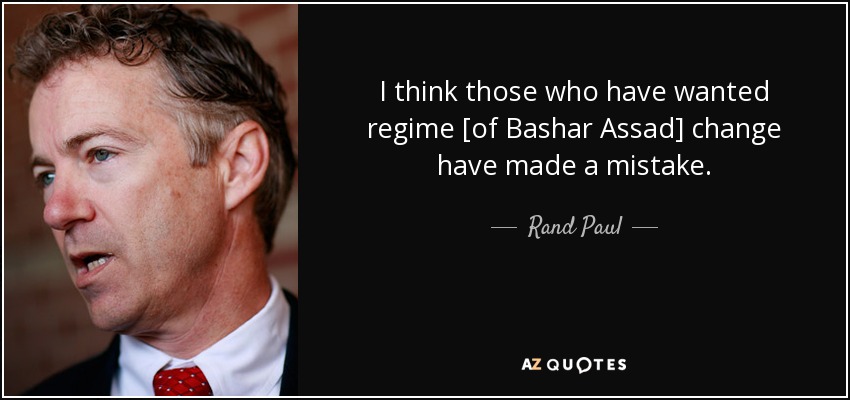
I think those who have wanted regime [of Bashar Assad] change have made a mistake.
I think that by arming the allies of ISIS, the Islamic rebels against [Bashar] Assad, that we created a safe space or made that space bigger for ISIS to grow.
If you can resolve this transition of [Bashar] Assad, that is absolutely possible, but you have to have a clarity for everybody about the way forward.
If [Bashar] Assad himself could save this whole process by saying, "I will engage in a managed transition where we all work together to stabilize the government, save the institutions of government, and turn on ISIL and preserve Syria." That could happen. It all depends on one man, and Russia and Iran should not be so stubborn here that they tie this whole thing up simply because of one person.
Three-quarters of [Bashar Assad] country is displaced. It's in Jordan, it's in Lebanon, it's in Turkey, and in the desert. The threat is that those people in the desert and others could become the next acolytes of ISIL if we don't find a way to join together to go after ISIL.
I mean, all of these things that [Bashar Assad] has done, there's no way even if President Obama wanted to just play along that you could actually achieve peace, because there are 65 million Sunni in between Baghdad and the border of Turkey, Syria, and Iraq, who will never, ever again accept Assad as a member - as a legitimate leader.
There seems to be a passive alliance between Vladimir Putin and Donald Trump and that's unprecedented in its form and dangerous in its content, because Russia is our most dangerous geopolitical opponent because of the desires that they have in the Middle East and because of their desire to break up Europe. And in the United States, we spent a lot of blood and a lot of treasure trying to keep Europe intact and democratic, and trying to keep the Middle East from being only influenced by people who are massive fans of [Syrian President] Assad and massive fans of the Iranians.
The Russians appear to be - appear to be in conjunction with the Turks, as well as the Iranians, appear to be at a point where they are realizing for their interests as well, Assad being in power indefinitely is not in their interests.
If Russia is there [in Syria] alone fighting them [ISIL], guess what? Russia becomes the target and Russia starts seeing - who knows - MANPADs will find their way in there, airplanes will fall out of the sky. They will become vilified. They'll become the new magnet, together with Assad, for the jihadis.
[Bashar] Assad himself has said on several occasions recently that if the people of Syria don't believe I should be there in the future, then I would step - I would leave. He has said it. He has, on occasion, hinted that he wants a political settlement of one kind or another. I think it's up to his supporters, his strongest supporters, to make it clear to him that if you're going to save Syria, Assad has made a set of choices - barrel bombing children, gassing his people, torturing his people, engaging in starvation as a tactic of war.
I believe that Assad must go. I believe he will go. But I believe - we want to make sure that America has the relationships of friendship with the people that take his place, steps that in the years to come we see Syria as a friend, and Syria as a responsible party in the Middle East.
People talk about [Bashar] Assad running Syria. He doesn't control his own country. He's down to about 20, 25 percent of the country. What is this fiction that he is somehow the only person who can save Syria? There's - with Assad there, there is no Syria. So that's what the Iranians and the Russians need to really begin to focus in on.
Bashar Assad clearly doesn't want to hear anything that impugns his government.
Seeing Syria remove Assad is a very high priority for America.
I don't regret at all saying that if I saw Bashar al-Assad using chemical weapons on his people that that would change my assessments in terms of what we were or were not willing to do in Syria.
I think we are making an assumption that that is the outcome of the negotiations. I think President Assad will be prepared to accept whatever the outcome of the intra-Syrian dialogue and the decision of the Syrian people is. But people are trying to decide and determine the outcome of the negotiation before even we agree to start the negotiations.
This comes from a group of people who`ve been wrong about every foreign policy issue over the last two decades. They supported Hillary Clinton`s war in Libya. They supported President [Barack] Obama`s bombing of Assad.
Russia went into Syria basically to support President Bashar al-Assad. And the Western allies have said Russia's really done very little against ISIS. For his part, Putin said Russia's open to stronger cooperation, and he supports Frances's effort to build a strong anti-terror coalition.
Part of the problem that we have currently in the Middle East is that[Bashar] Assad has hung on to power with the very strong support of Russia and Iran and with the proxy of Hezbollah being there basically fighting his battles.
I don't think that the United States has the bulk of the responsibility. I really put that on Bashar Assad and on the Iraqis and on the region itself.
I invite President Assad to come to Jerusalem and to speak with me, with our parliament, with whomever he wants to speak in Israel and in the territories among the Palestinians.
[Vladimir] Putin wants to keep [Bashar] Assad in power and expand his own military base in Syria, whatever the cost. I even believe he has an interest in more and more people fleeing the country. The flow of refugees improves his negotiating position toward the West, including the German chancellor.
We could have made peace with Syrian dictator Bashar Assad a long time ago. It didn't happen, because Prime Minister Benjamin Netanyahu doesn't want to give up the Golan (Heights).
[Bashar] Assad has made a series of choices ever since then that is literally destroying his country.
Sunni are the majority of the [Syria], 60 to 65 percent. They've been ruled by [Bashar] Assad, who represents a minority Alawite element, which is about 12, 13 percent. And because of the choices Assad made, it's very difficult to see how you resolve this without buy-in from the Sunni world.
Follow AzQuotes on Facebook, Twitter and Google+. Every day we present the best quotes! Improve yourself, find your inspiration, share with friends
or simply: