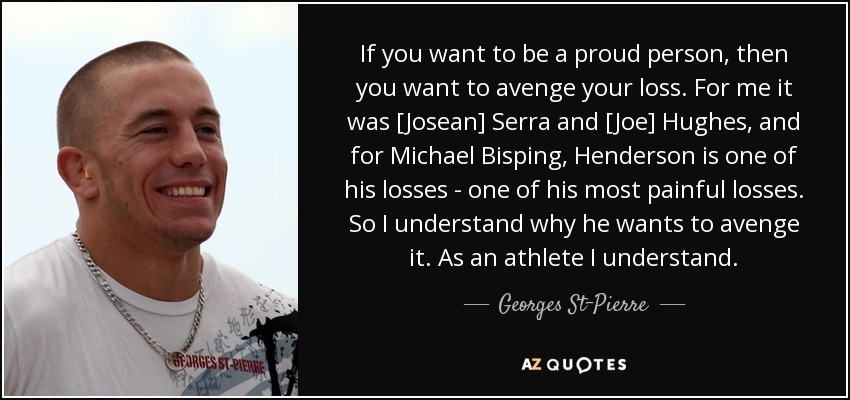
If you want to be a proud person, then you want to avenge your loss. For me it was [Josean] Serra and [Joe] Hughes, and for Michael Bisping, Henderson is one of his losses - one of his most painful losses. So I understand why he wants to avenge it. As an athlete I understand.
I'm an athlete, my job is not negotiating, it's not my field of expertise. I'm an emotional guy - it's normal, a lot of athletes are, and we're very susceptible to get our ego cut because of that.
I'm the biggest sports fan there is, I love sports, but I'm still convinced that it's teachers who deserve the big salaries, not athletes.
I was just starting out acting [doing "Airplane"] and wanted to be taken as a professional, not as an athlete doing a cameo.
The lifespan of most professional athletes is relatively short, and most have no preparation for doing anything after their career ends, which it could in an instant.
Common decency demands that [NCAA athletes] should be paid, but the only way it will happen is the same way workers got paid throughout American history, through a strong union.
A lot of the athletes moved away from boxing, into UFC - which I think is really crazy, where they elbow to the head and knee to the jaw. I think that's really a barbaric sport - but boxing is coming back.
Tony [Walters] was one of the first international world-class athlete I had ever dealt with and I was lucky enough to have him as a coach and he taught me a lot about the mental aspects of training and competition.
I had some very fit people. I worked with a lot of athletes helping them, especially combat athletes, MMA fighters,[Dennis] Bermudez, [Chris] Weidman, and guys on the lower levels - boxers and MMA fighters.
People no longer know how to apologize, which is particularly noticeable among athletes, politicians, and entertainment figures.
Being an artist is like being an athlete. You have to be in there every day, keeping in shape. You have to be fearless. You have to be confident, and if you start getting thrown by criticism or esthetic terminology, you're going to fall off the balance beam and hit your head and do some injury.
Colleges seem to want candidates that are so well-rounded they'd have to be two different people use together with mutually exclusive characteristics! They have to be gung ho athletes and sensitive artists, studious nerds and gregarious social networkers, future rulers of the universe and selfless altruists.
I still think that there's some kind of psychological investment in black athletes carrying the flag for "us" at times. So, sports [remains a] metaphor for struggle and triumph and flair.
Sport is cultural. What the star athlete does helps to define the culture. What the star athlete does on a Canadian team, especially if he or she is Canadian, helps define Canadian-ness.
I suppose the "dilemma" might come up if I see a black athlete from the U.S. squaring off against a white Canadian athlete. Who do I want to identify with? I certainly will not and cannot say that race determines how I see competition. I'm certainly aware of how race plays into the way others see and portray competition some times, but I don't have to invest in it that way myself. Unless it's boxing.
I think that a huge positive that's come out of me having successful competitions as an athlete has been that, through the years it's become less and less about personal victory and more about strengthening a platform for me to have a voice in the world and I could really talk about anything I wanted to and I've chosen to make my voice be heard and be recognized for some of the charities that I really care about and work very closely with.
I think it's interesting that a lot of times people want celebrities to give back in the way that they want them to give back. They want them to give money to the cause they think is important and when that doesn't happen they say, "Oh, they're not doing anything." People think celebrities are going to solve their problems. People think because someone is famous or an athlete or a politician that the solution begins with them. All they're there to do is sell you a product.
When I finished the Boston race in 1967, there were two things I wanted to do. I wanted to become a better athlete because my first marathon was 4:20. In those days, that was considered a jogging time and I knew people were going to tease me. But I was more fascinated with what women could do if they only had the chance.
I do identify with Olympic athletes quite a lot because they have to push to reach a certain plateau and some of them go on and some of them give up and some art - you know, some people are very talented in art and do a few amazing things and then give it up and go on and do other things, and others are in it for the long haul, more or less long-distance runners.
I feel like every woman, and actually any guy who hasn't played that many sports, you secretly wonder, like, 'Would I be a pro athlete?'
It's not enough to just test athletes. The athletes themselves need to fight for their right to compete against clean athletes.
It was good to see an athlete that emotional in the aftermath of defeat, to show that losing isn't good enough. Fighting hard and trying your best isn't good enough. It showed that the only thing good enough in his eyes was winning. It caused a tremendous amount of emotion from him when he didn't achieve that.
I want to be one of the greatest athletes ever to live, not only in track and field, but in all of general sport.
I don't think that the Olympic games are a good place to bring up any political issues because it should be about the athletes and about coming together. This year's motto was One World, One Dream and to take that away it's just not a good time.
I was always more of a film guy than an athlete guy. I had an art scholarship at Western.
Follow AzQuotes on Facebook, Twitter and Google+. Every day we present the best quotes! Improve yourself, find your inspiration, share with friends
or simply: