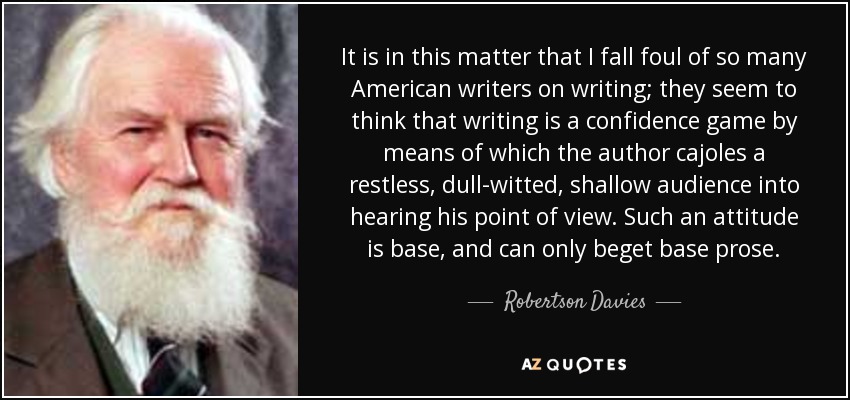
It is in this matter that I fall foul of so many American writers on writing; they seem to think that writing is a confidence game by means of which the author cajoles a restless, dull-witted, shallow audience into hearing his point of view. Such an attitude is base, and can only beget base prose.
The air of fashion, which many young people are so eager to attain, always strikes me like the studied attitudes of some modern prints, copied with tasteless servility after the antigue; the soul is left out, and none of the parts are tied together by what may properly be termed character.
The Theatre of the Absurd ... can be seen as the reflection of what seems to be the attitude most genuinely representative of our own time.  The hallmark of this attitude is its sense that the certitudes and unshakable basic assumptions of former ages have been swept away, that they have been tested and found wanting, that they have been discredited as cheap and somewhat childish illusions.
Days when you just don't have it, you don't mail it in, you don't pack it in, you give it everything you've got. You grind it out, I don't care what kind of game you have, you somehow try and find a way to get it done ... That's part of my attitude and belief, that you should always have the switch on. You can't turn it on and off.
Designing is not a profession but an attitude... Thinking in relationships.
We atheists can argue that, with the modern revolution in attitudes toward homosexuals, we have become the only group that may not reveal itself in normal social discourse.
Style is an attitude; a trend is just another thing to follow.
Too much self-centered attitude, you see, brings, you see, isolation. Result: loneliness, fear, anger. The extreme self-centered attitude is the source of suffering.
I did exhibitions with the Surrealists (in Paris, in 1929) because their attitude revolted against 'art' and their attitude toward life itself was wise, as was Dada's.
There is a popular superstition that "realism" asserts itself in the cataloguing of a great number of material objects, in explaining mechanical processes, the methods of operating manufactories and trades, and in minutely and unsparingly describing physical sensations. But is not realism, more than it is anything else, an attitude of mind on the part of the writer toward his material, a vague indication of the sympathy and candour with which he accepts, rather than chooses, his theme?
The "sayings" of a community, its proverbs, are its characteristic comment upon life; they imply its history, suggest its attitude toward the world and its way of accepting life. Such an idiom makes the finest language any writer can have; and he can never get it with a notebook. He himself must be able to think and feel in that speech - it is a gift from heart to heart.
The variety of minds served the economy of nature in many ways. The Creator, who designed the human brain for activity, had insured the restlessness of all minds by enabling no single one to envisage all the qualities of the creation. Since no one by himself could aspire to a serene knowledge of the whole truth, all men had been drawn into an active, exploratory and cooperative attitude.
I have been, or seemed, hard with everyone because I was carried away by a sort of brutality born of my distrust in myself and my ill-humor. I have felt so badly equipped, so soft, in spite of the fact that my attitude towards art seemed to me so just. I was disgusted with everyone, and especially myself.
Most English speakers do not have the writer's short fuse about seeing or hearing their language brutalized. This is the main reason, I suspect, that English is becoming the world's universal tongue: English-speaking natives don't care how badly others speak English as long as they speak it. French, once considered likely to become the world's lingua franca, has lost popularity because those who are born speaking it reject this liberal attitude and become depressed, insulted or insufferable when their language is ill used.
I'm often asked, Which is more important--attitude or skill? The answer is that it's somewhat like asking which leg of a three-legged stool is most important. It is my complete conviction, based on a considerable amount of research, that if you have the right attitude, combined with the right skills, and build your attitude and your skills on a solid character base, you can enjoy long-lasting success.
It would be foolish to assert that there is no power above mine. Only the attitude that I take toward it will be quite another than that of the religious age: I shall be the enemy of every higher power, while religion teaches us to make it our friend and be humble toward it.
Facilitative attitudes (and skills) can help a therapist gain entry into the group Freedom from a desire to control the outcome, and respect for the capacity of the group, and skills in releasing individual expression Openness to all attitudes no matter how extreme or unrealistic they may seem Acceptance of the problems experienced by the group where they are clearly defined as issues Allowance of the freedom of choices in direction, either for the group or individuals particularly in the near future
The new and most powerful union of all will be a union of one one man, one woman, one worker with special skills, an inquiring mind, and an independent attitude, his creativity intact, his love of life blooming. The union of one will be peopled by one man or one woman who is alive. Such a person is always sought by the intelligent manager.
I felt exactly like the man in the advertisement who has not devoted fifteen minutes a day to the study of the classics. If only (I thought) I had devoted fifteen minutes a day to the cultivation of the aesthetic attitude! I could bound Afghanistan.
Change the attitude toward errors. Think of an object's user as attempting to do a task, getting there by imperfect approximations. Don't think of the user as making errors; think of the actions as approximations of what is desired.
I am interested in the creativity of the criminal attitude because I recognize in it the existence of a special condition of crazy creativity. A creativity without morals fired only by the energy of freedom and the rejection of all codes and laws. For freedom rejects the dictated roles of the law and of the imposed order and for this reason is isolated.
Since the Greeks the predominant attitude of thinkers towards intellectual activity was to glorify it insofar as (like aesthetic activity) it finds its satisfaction in itself, apart from any attention to the advantages it may procure. Most thinkers would have agreed with Renan's verdict that the man who loves science for its fruits commits the worst of blasphemies against that divinity. The modern clercs have violently torn up this charter. They proclaim the intellectual functions are only respectable to the extent that they are bound up with the pursuit of concrete advantage.
Faith is something that comes out of the soul. It is not an information that is absorbed but an attitude, existing prior to the formulation of any creed.
Daughters of the attitude that produced them, certain women will not appeal to us without the double bed in which we find peace by their side, while others, to be caressed with a more secret intention, require leaves blown by the wind, water rippling in the dark, things as light and fleeting as they are.
Socrates was the chief saint of the Stoics throughout their history ; his attitude at the time of his trial, his refusal to escape, his calmness in the face of death , and his contention that the perpetrator of injustice injures himself more than his victim, all fitted in perfectly with Stoic teaching. So did his indifference to heat and cold, his plainness in matters of food and dress, and his complete independence of all bodily comforts.
Follow AzQuotes on Facebook, Twitter and Google+. Every day we present the best quotes! Improve yourself, find your inspiration, share with friends
or simply: