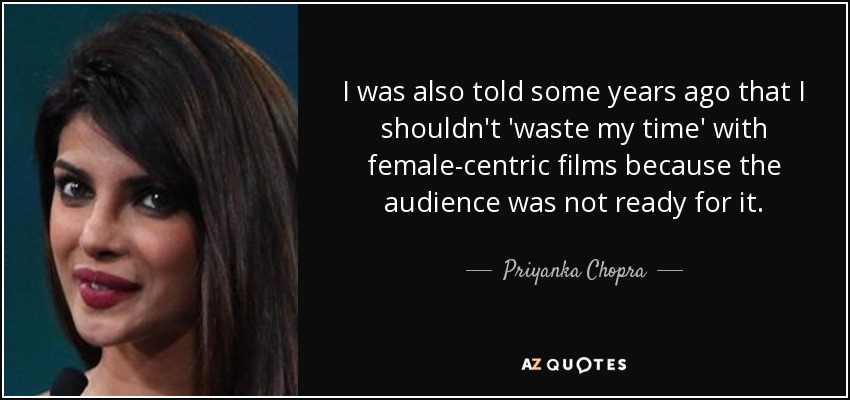
I was also told some years ago that I shouldn't 'waste my time' with female-centric films because the audience was not ready for it.
I like risky parts - abrasive characters the audience won't necessarily like.
Ratings experts say the best way to get people to watch during sweeps is to leave the audience with a question that won't be answered until the next time the show is on. You know, like Who shot J.R.? I like to think I do this every night - the question is, Is this show still on?
Nowadays, especially in big commercial films it's much easier for the audience, and they tend to get spoonfed. It's much more interesting to me, people leave the theater and they start asking themselves questions and find their own moral compass about what these characters have been doing.
Movies, over time, as they do or don't find their audience, or they find a different audience, they change in your memory and in the eyes of those who see it.
During childbirth and hospice I'll sing gospel songs that my grandma taught me when I was younger, or something I've made up, or I'll hum. I just play things that I think the audience will like.
If you ask me about music and how things should be played, I believe that music-making is the combination of having learned how to do something right, what one feels is right to do in the moment, and the way the audience is listening.
To be able to actually sit in a theater and watch people get off on anything that I had a part in, is just thrilling. When you work in television, it's an isolating experience. You rarely ever get to watch it with an audience.
In America, instead of making the audience come to the film, the idea seems to be for you to go to the audience. They come up with the demographics for the film and then the film is made and sold strictly to that audience.
There is a point you can definitely lose the audience and sometimes you don't know where it is.
I'm so lucky that I get to write my own music and write my own stories, so every single time I look down in the audience and I see somebody singing the words back to me, it makes it all worth it.
I think to put death on screen where it isn't that turns it into comic book time and there I think by desensitizing an audience, you really do open the possibility that someone is going to kill.
I think that, on the one hand, our audience, our culture is so savvy now to an assumption that teaser effects are not fully representative of the final product. But in the same breath, I would say there's no shot in the teaser that I'm not really happy with.
There's a very interesting article or symposium to be written on just the real difference between comedy filmmaking and non-comedy. Because, you know, when you work in comedy, you depend on audience screenings to tell you about your movie.
My mother, I want her to like my music, but she's not exactly my target audience. So I care more about the fans in general, just making sure they enjoy what I do.
I think American audiences like gangster movies. It's part of the culture.
People test movies within an inch of their life, so that the entire audience experience is a uniform one.
There is a danger, if you cast someone who is 18, 19 or 20 to play 14 or 15, that very subtly, almost unconsciously, the audience is, "Oh, this isn't so bad."
I had invited 50 or 60 peers and friends, most of whom were parents, to see the film [Trust], and I asked about the last scene. It was interesting because it was split right down the middle, 50/50. About half the audience wanted it to end with the very emotional scene between Clive and Liana, and that feeling of realization and catharsis. And, the other half were adamant about keeping that last scene.
And by the right thing, I mean that whatever step we take next, the first criteria we should consider is the people who have been loyal to us, thus far, which is primarily our audience.
I don't feel any obligation to make my intentions for a song accessible to a listener or an audience. I'm not interested in conveying anything to them so much as what's best for me.
Being in front of the audience, letting my audience see me in person - it is real intimate, you get to make them laugh and cry, they get to feel you. And then afterward, we go out and do a meet-and-greet session with the fans. It was just a wonderful experience. I really, really enjoyed it.
I hope that audiences respond really positively. I think it's a very intense, entertaining film [The Last King of Scotland], because you're brought in on a fun ride, and slowly you fall into it as James [actor James McAvoy's character, Dr. Nicholas Garrigan] does. Nicholas is like the audience. I think it's a good ride for people. And you learn something, as well.
Here's a tip for all you aspiring young comics: Don't beat up the customers. It is very difficult to get laughs from an audience when you've actually drawn blood from one of their number. It kills the mood.
If I had to fall in love with all the actresses I play with and live the situations I have to play, I would be lost ! I need to be solid and know who I really am to have fun in making something else. I noticed, while talking with other actors, that they often let ambiguity float. I don't like ambiguity, it's dangerous. I need distance. I also think that the result would prevent the audience from identifying to the characters. If you feel the things too strongly, you simply close the doors.
Follow AzQuotes on Facebook, Twitter and Google+. Every day we present the best quotes! Improve yourself, find your inspiration, share with friends
or simply: