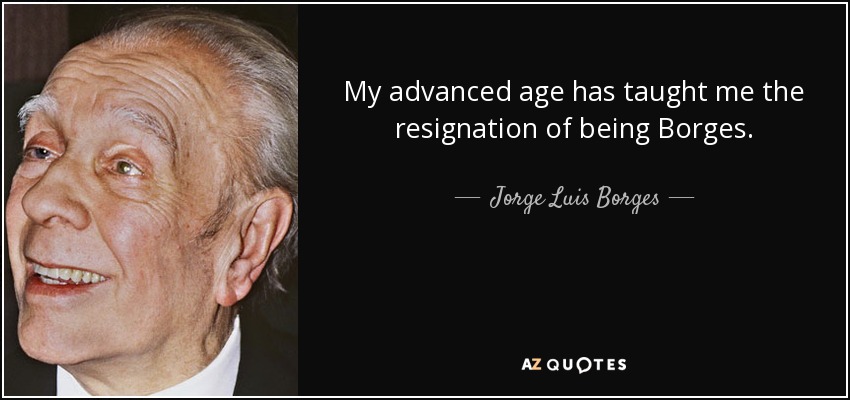
My advanced age has taught me the resignation of being Borges.
Borges said there are only four stories to tell: a love story between two people, a love story between three people, the struggle for power and the voyage. All of us writers rewrite these same stories ad infinitum.
He is no true reader who has not experienced the reproachful fascination of the great shelves of unread books, of the libraries at night of which Borges is the fabulist. He is no reader who has not heard, in his inward ear, the call of the hundreds of thousands, of the millions of volumes which stand in the stacks of the British Library asking to be read. For there is in each book a gamble against oblivion, a wager against silence, which can be won only when the book is opened again (but in contrast to man, the book can wait centuries for the hazard of resurrection.)
I would say that Edgar Allan Poe, [Georges] Perec, Thomas Pynchon, and [Jorge Luis] Borges are all boy-writers. These are writers who take... a kind of demonic joy in writing.
I always read the Latin American writers. I love so many of them: Gabriel García Márquez, José Donoso, Alejo Carpentier, Jorge Luis Borges, Clarice Lispector. I also love a lot of American experimental writers and surrealist European writers. But perhaps The Persian Book of Kings was the greatest influence - I encourage people to look at it. There is such a wealth of incredible stories.
There [DreamTigers by Jorge Luis Borges] were these little fablesque things, you know, dream tigers, beautiful, beautiful pieces that when you read them had the power of a long piece, but they were prose, and they had the power of poetry, in that the last line wasn't the end, it was a reverberation, like when you tap on a glass made of crystal, and it goes ping.
Jorge Luis Borges wrote a poem when he was in his 80s about one day writing the book that would justify him. This was long after he had become one of the great masters, a writer everyone looks up to and reveres. As artists, I don't think we ever see ourselves as done. We always think we're at the beginning . . .
I'm educating myself more about world poetry. I know a lot about contemporary American poetry, so I felt I needed to learn more about figures like Borges, Akhmatova, Neruda, etc. I felt I needed a bigger lens to see poetry through. It really helps to see poetry as a world language, and not just something American.
When I use a name or place, I want to leave the reader open to the waterfall of determinacy that it may provoke. And I don't know, but I must mention the name Borges. I try to mention it in every one of my works. It's a mark, a stamp, a sort of homage to Argentinidad. But it's an homage that works through pat phrases, those stock images that populate his work: the night, labyrinths, libraries. That is, I don't want simply to pay homage to Borges, but rather the contrary: to recall his commonplaces.
I never really liked "cool" books. I plowed through as much Borges and Joyce as possible, read the first half of V. and spent whole Bar Mitzvah checks on Beat poetry.
I was fascinated by quotations and lists. And then I noticed that other people were fascinated by quotations and lists: people as different as Borges and Walter Benjamin, Novalis and Godard.
Most of my influences from outside the commerical strange fiction genre came in with university, discovering James Joyce and Wallace Stevens, Blake and Yeats, Pinter and Borges. And meanwhile within those genres I was discovering Gibson and Shepard, Jeter and Powers, Lovecraft and Peake.
[Jorge Luis Borges] had short stories, and I was trying to learn how to write short stories, and then he had these things in the middle that were like fables, and I loved hearing fables.
I remember I was very taken with a book called DreamTigers by [Jorge Luis] Borges. He was at the University of Texas, Austin, and they collected some of his writings and put them in a little collection. It's called DreamTigers in English, but it doesn't exist in Spanish. It's a little sampler. But that collection in English is what struck me, because in there he has his poems, and I was a poet as well as a fiction writer.
Style: There is something in too much verbal felicity (as in Joyce or Nabokov or Borges) that can betray the writer into technique for the sake of technique.
The bacillus of efficiency has also attacked football, and some dare to ask what's the point in playing well. I feel tempted to tell about the time they dared to ask Borges what is poetry for, to which he answered: 'What is a sunrise for? What are caresses for? What is the smell of coffee for?'
Borges was unapologetically smart and equally sentimental; a proto-geek, blind to distinctions between low pulp fiction and high criticism, experimental but never arch, and always playful, with a humor as dry as dust.
I might accept immortality, if I had to do it. But I would prefer - if there is any afterlife - to know nothing whatever about Borges, about his experiences in this world.
One of my favorite writers is short story writer/essayist Jorge Luis Borges, who was blind. I'm not claiming to be anything remotely resembling a talent of Borges' caliber, but he is an inspiration and a proof that one can be a meaningful and successful writer while blind.
I really wouldn't call a lot of what's online "literature" since that word, to me, refers to a sub-genre of writing that belongs to the heavy-hitters, the canonical writers, Shakespeare, Dante, Milton, Dostoevsky, Kafka, and even Toni Morrison, George Saunders, Thomas Bernhard, Sebald, Borges, DFW, e.g.
We have inhabited both the actual and the imaginary realms for a long time. But we don't live in either place the way our parents or ancestors did. Enchantment alters with age, and with the age. We know a dozen Arthurs now, all of them true. The Shire changed irrevocably even in Bilbo's lifetime. Don Quixote went riding out to Argentina and met Jorge Luis Borges there. Plus c'est la même chose, plus ça change.
One should read Borges more.
This is how space begins, with words only, signs traced on the blank page. To describe space: to name it, to trace it, like those portolano-makers who saturated the coastlines with the names of harbours, the names of capes, the names of inlets, until in the end the land was only separated from the sea by a continuous ribbon of text. Is the aleph, that place in Borges from which the entire world is visible simultaneously, anything other than an alphabet?
For Borges, the core of reality lay in books; reading books, writing books, talking about books. In a visceral way, he was conscious of continuing a dialogue begun thousands of years before and which he believed would never end.
Nazi Literature in the Americas, a wicked invented encyclopedia of imaginary fascist writers and literary tastemakers, is Bolaño playing with sharp, twisting knives. As if he were Borges's wisecracking, sardonic son, Bolaño has meticulously created a tightly woven network of far-right litterateurs and purveyors of belles lettres for whom Hitler was beauty, truth, and the great lost hope.
Follow AzQuotes on Facebook, Twitter and Google+. Every day we present the best quotes! Improve yourself, find your inspiration, share with friends
or simply: