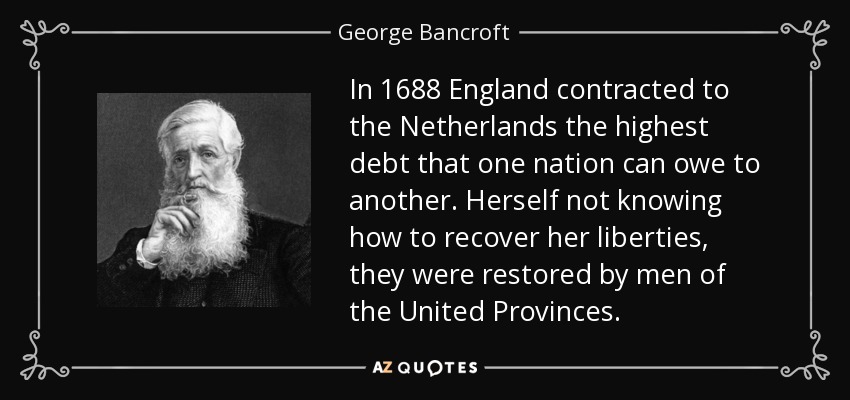
In 1688 England contracted to the Netherlands the highest debt that one nation can owe to another. Herself not knowing how to recover her liberties, they were restored by men of the United Provinces.
I knew a bit but we don't study a lot of British history at school in Australia. We have our own 50-year period to concentrate on.
Ever since the Reformation, the case of legislation confining Catholics had been constructed primarily to protect a nervously Protestant against what was assumed to be a fifth column in its midst... Ministers believedm with some justice, that Catholics retained an attachment to their exiled co-religionists, the princes of the House of Stuart. After the Battle of Culloden had confirmed Jacobitism's insignificance, however, government attitudes towards Catholicism began perceptibly and logically to relax.
Loyal and substansial Catholic service on the battlefield undermined one of the most longstanding objections to emancipation: namely, that since Catholics owed religious allegiance to a foreign authority in the person of the Pope, their political and patriotic allegiance must necessarily be suspect.
Most Britons still lived and died without encountering anyone whose skin colour was different from their own. Slaves, in short, did not threaten, at least as far as the British at home were concerned. Bestowing freedom upon them seemed therefore purely an act of humanity and will, an achievement that would be to Great Britain's economic detriment, perhaps, but would have few other domestic consequences.
It would be wrong to interpret the growth of British national consciousness in this period in terms of a new cultural and political uniformity being resolutely imposed on the peripheries of the island by its centre. For many poorer and less literate Britons, Scotland, Wales and England remained more potent rallying calls than Great Britain, except in times of danger from abroad. And even among the politically educated, it was common to think in terms of dual nationalities, not a single national identity.
In the early 21st century, it is easy to condemn the Bond books for being racist and imperialist, sexist and misogynist, elitist and sadistic. But this is merely another way of saying that we cannot understand the Bond books without reference to the personality, the outlook and the 'Tory imagination' of the man who wrote them, and to the time in which he wrote them; and that we cannot understand the 1950s and 1960s without some reference to them, and to him.
Royal relationships across the generations have often been strained and distant, rather than close and affectionate. Most eldest sons, interminably waiting to become king, have not been on the best of terms with the sovereign to whose death they look forward with a debilitating combination of guilt-ridden anxiety and eager anticipation. And younger sons (and daughters, too) have often found their lives empty of purpose: cut off by their royal statius, but unable to find anything rewarding with which to fill the time.
There are important arguments to be made about the relative merits of an hereditary or an elected head of state: but not at the level of the human frailties of particular monarchs or presidents. No one seriously contends that the American presidency should be abolished because Bill Clinton is a self-confessed adulterer. So why should the abolition of the British monarchy be contemplated because the same is true of Prince Charles?
Of all the memorable phrases that have been minted and mobilised to describe modern British royalty, 'constitutional monarchy' is virtually the only one which seemes to have neither been anticipated nor invented by Walter Bagehot. It was he who insisted that 'a princely marriage is the brilliant edition of a universal fact, and as such it rivets mankind'; and he who warned that the monarchy's 'mystery is its life. We must not let in daylight upon magic'.
Vernon Bogdanor's account The Monarchy and the Constitution is written as much in the shadow of Edmund Burke as it is of Walter Bagehot. He stresses the organic development of the British constitution, prefers evolution to revolution, and thinks stability is better than strife.
Charitable endeavour exalts the prestige and the status of the giver. This may sound unduly cynical but as with all philantrophic activity, it is not easy to unravel the mutually reinforcing motives of selflessness and self-interest. All that can safely be said is that most members of the royal family have difficulty distinguishing between concern about society, concern about the social order and concern about what best to do so they can remain at the top of it.
Great Britain has lost an Empire and has not yet found a role.
The great theme of modern British history is the fate of freedom. The 18th century inherits, after the Civil War, this very peculiar political animal. It's not a democracy, but it's not a tyranny. It's not like the rest of the world, the rest of Europe. There is a parliament, laws have to be made, elections are made.
There is no other Parliament like the English. For the ordinary man, elected to any senate, from Perisa to Peru, they may be a certain satisfaction in being elected... but the man who steps into the English Parliament takes his place in a pageant that has ever been filing by since the birth of English history... York or Lancaster, Protestant or Catholic, Court or Country, Roundhead or Cavalier, Whig or Tory, Liberal or Conservative, Labour or Unionist, they all fit into that long pageant that no other country in the world can show.
Armed Soldier, terrible as Death, relentless as Doom; doing God's judgement on the Enemies of God. It is a phenomenon not of joyful nature; no, but of awful, to be looked at with pious terror and awe.
He had done that which could never be forgiven; he was in the grasp of one who never forgave.
A bottomless pit of violence, a Tower of Babel where all are speakers and no hearers.
Today a Scot is leading a British army in France [Field Marshall Douglas Haig], another is commanding the British Grand Fleet at sea [Admiral David Beatty], while a third directs the Imperial General Staff at home [Sir William Roberton]. The Lord Chancellor is a Scot [Viscount Finlay]; so are the Chancellor of the Exchequer and the Foreign Secretary [Bonar Law and Arthur Balfour]. The Prime Minister is a Welshman [David Lloyd George], and the First Lord of the Admiralty is an Irishman [Lord Carson]. Yet no one has ever brought in a bill to give home rule to England!
In virtually every Continental state at this time, aristocracies had to live with the risk that their property might be pillaged or confiscated. Only in Great Britain did it prove possible to float the idea that aristocratic property was in some magical and strictly intangible way the people's property also. The fact that hundreds of thousands of men and women today are willing to accept that privately owned country houses and their contents are part of Britain's national heritage is one more proof of how successfully the British elite reconstructed its cultural image in an age of revolution.
Recognising that an ostentatious cult of heroism and state service served an important propaganda function for the British elite does not mean, of course, that we should dismiss it as artificial or insincere. All aristocracies have a strong military tradition, and for many British patricians the protracted warfare of the period was a godsend. It gave them a job, and, more important, a purpose, an opportunity to carry out what they had been trained to do since childhood: ride horses, fire guns, exercise their undoubted physical courage and tell other people what to do.
Girls must be thwarted early in life.
In Great Britain, woman was subordinate and confined. But at least she was also safe.
An unprecedented number of uniformed males, marching, parading and engaging in mock battles in every region of Great Britain brought a pleasant frisson of excitement into many normally quiet and deeply repetitive female lives.
For women to be supplying the soldiery with banners, flannel shirts and other material comforts was, superficially, all of a piece with their ministrations to their menfolk at home. Such contributions to the war effort were socially acceptable because they could be seen as an extension into the military sphere of the traditional female virtues of charity, nurture and needlework. Yet in reality what the women were doing represented the thin end of a far more radical wedge. Consciously or not, these female patriots were staking out a civic role for themselves. And many of them relished it.
Follow AzQuotes on Facebook, Twitter and Google+. Every day we present the best quotes! Improve yourself, find your inspiration, share with friends
or simply: