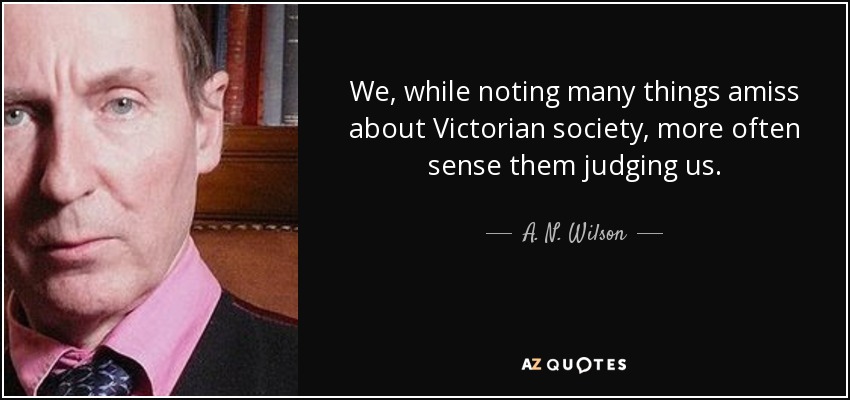
We, while noting many things amiss about Victorian society, more often sense them judging us.
The Victorians pioneered numbers of commercial rackets about which their descendants complain (the manufacturers of Bovril, it appears, were virtually official sponsors of the Boer War).
Compare the scale and magnifcence of Versailles with St James's - the brick-built hovel in which the 18th-century kings of England lived. What was then the most powerful monarchy in the world housed its sovereigns in a converted leper hospital, yet, at the same time, parliament provided the magnificent palaces of Chelsea and Greenwich as hospitals for retired soldiers and sailors.
Charitable endeavour exalts the prestige and the status of the giver. This may sound unduly cynical but as with all philantrophic activity, it is not easy to unravel the mutually reinforcing motives of selflessness and self-interest. All that can safely be said is that most members of the royal family have difficulty distinguishing between concern about society, concern about the social order and concern about what best to do so they can remain at the top of it.
The highest eulogy which can be pronounced on the Revolution of 1688 is this that this was our last Revolution.
Vernon Bogdanor's account The Monarchy and the Constitution is written as much in the shadow of Edmund Burke as it is of Walter Bagehot. He stresses the organic development of the British constitution, prefers evolution to revolution, and thinks stability is better than strife.
Let valour end my life!
For William Cecil and others in Elizabeth's Council, whose sense of Catholic conspiracy and threat governed their political thinking, England's security lay in the creation of a united and Protestant British Isles, which could stand alone, ready to resist invaders. Divine providence had set the islands apart from the rest of the world by encircling seas, 'a little world by itself'.
I knew a bit but we don't study a lot of British history at school in Australia. We have our own 50-year period to concentrate on.
Of all the memorable phrases that have been minted and mobilised to describe modern British royalty, 'constitutional monarchy' is virtually the only one which seemes to have neither been anticipated nor invented by Walter Bagehot. It was he who insisted that 'a princely marriage is the brilliant edition of a universal fact, and as such it rivets mankind'; and he who warned that the monarchy's 'mystery is its life. We must not let in daylight upon magic'.
Ever since the Reformation, the case of legislation confining Catholics had been constructed primarily to protect a nervously Protestant against what was assumed to be a fifth column in its midst... Ministers believedm with some justice, that Catholics retained an attachment to their exiled co-religionists, the princes of the House of Stuart. After the Battle of Culloden had confirmed Jacobitism's insignificance, however, government attitudes towards Catholicism began perceptibly and logically to relax.
No medieval monarch in the whole of British history ever had such power as every modern British Prime Minister has in his or her hands. Nor does any American President have power approaching this
Of the 664 men who rode into the Valley of Death about 540 eventually got out of it again. By far the highest casualty rate was among the horses. Compared with the Somme or an evening in the Blitz, the Valley of Death was a piece of cake.
Nine English traditions out of ten date from the latter half of the nineteenth century.
I am speaking to you from the Cabinet Room at 10 Downing Street. This morning the British Ambassador in Berlin handed the German Government an official note stating that unless we heard from them by eleven o'clock, that they were prepared at once to withdraw their troops from Poland, a state of war would exist between us. I have to tell you now that no such undertaking has been received, and consequently this country is at war with Germany.
Egyptologists, skilled in piecing together the papyri of lost civilisations, suddenly discovered that the same talent could be applied to working out the pattern of German radio traffic.
Thirty resolute men in your House of Commons could save the world.
England totally disarmed and an easy prey to hostile forces! Can you think of anything more likely to excite cupidity and hostile intention? We should sink to the level of a fifth rate Power, our Colonies would be stripped from us, our commerce would decline, famine and unemployment would stalk the land... I have yet to learn that the cause of peace can be served by rendering our country impotent.
I am a man of peace. I am longing and working and praying for peace, but I will not surrender the safety and security of the British constitution. You placed me in power eighteen months ago by the largest majority accorded to any party for many, many years. Have I done anything to forfeit that confidence? Cannot you trust me to ensure a square deal to secure even justice between man and man?
The male clerk with his quill pen and copper-plate handwriting had gone for good. The female short-hand typist took his place. It was a decisive moment in women's emancipation.
Yes, making mock o' uniforms that guard you while you sleep... For it's Tommy this, an' Tommy that an' Chuck him out, the brute! But it's Saviour of his country, when the guns begins to shoot!
The Germans could not get over the perfidy of it. It was unbelievable that the English, having degenerated to the stage where suffragettes heckled the Prime Minister and defied the police, were going to fight.
Jews show so near an affinity to you... Where is your Christianity if you do not believe in their Judaism?
There is little doubt that, until 1846 when he helped to engineer the resignation of Robert Peel, Disraeli was driven by an ambition to make his mark rather than by any consistent political purpose, and that his attacks on Peel would have not have been so mounted had he been given in 1841 the office for which he had asked.
Disraeli was now at the height of his fame and popularity. He still had his enemies... But the people as a whole now admired and respected him deeply... His unscrupulous past and cynical opportunism were being largely forgotten or forgiven. He was gradually becoming recognized not only as the prophet of a new Conservatism, at once compassionate at home and positive abroad, but as a great statesmen whom the Queen did well to honour. Power had brought responsibility. By 1878 the transformation in public attitudes towards Disraeli was complete.
Follow AzQuotes on Facebook, Twitter and Google+. Every day we present the best quotes! Improve yourself, find your inspiration, share with friends
or simply: