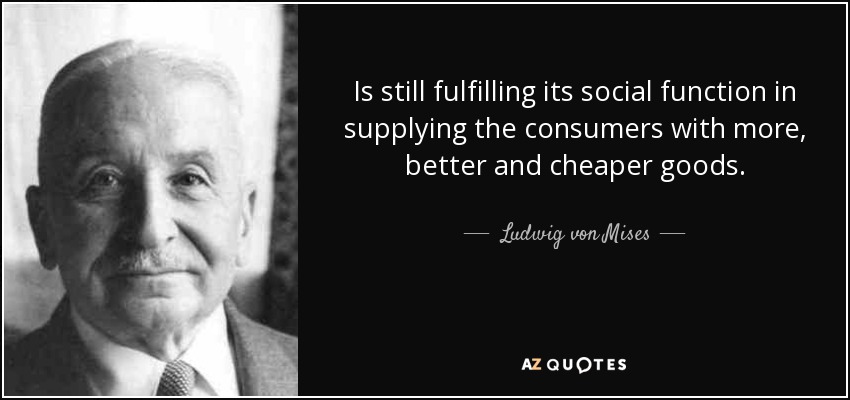
Is still fulfilling its social function in supplying the consumers with more, better and cheaper goods.
The spread of evil is the symptom of a vacuum. Whenever evil wins, it is only by default: by the moral failure of those who evade the fact that there can be no compromise on basic principles.
The desire for an increase of wealth can be satisfied through exchange, which is the only method possible in a capitalist economy, or by violence and petition as in a militarist society, where the strong acquire by force, the weak by petitioning.
The characteristic feature of capitalism that distinguishes it from pre-capitalist methods of production was its new principle of marketing. Capitalism is not simply mass production, but mass production to satisfy the needs of the masses.
A system of capitalism presumes sound money, not fiat money manipulated by a central bank. Capitalism cherishes voluntary contracts and interest rates that are determined by savings, not credit creation by a central bank.
I believe capitalism will eventually be replaced by a communitarian ethic where the rights and care of all beings will be taken into consideration, not just the greed of a corporate few.
It only stands to reason that where there's sacrifice, there's someone collecting the sacrificial offerings. Where there's service, there is someone being served. The man who speaks to you of sacrifice is speaking of slaves and masters, and intends to be the master.
I swear, by my life and my love of it, that I will never live for the sake of another man, nor ask another man to live for mine.
In spite of the anticapitalistic policies of all governments and of almost all political parties, the capitalist mode of production
The early industrialists were for the most part men who had their origin in the same social strata from which their workers came. They lived very modestly, spent only a fraction of their earnings for their households and put the rest back into the business.
From the smallest necessity to the highest religious abstraction, from the wheel to the skyscraper, everything we are and everything we have comes from one attribute of man - the function of his reasoning mind.
One of the biggest lies in capitalism is that companies like competition. They don't. Nobody likes competition.
Even if the crises that are looming up are overcome and a new run of prosperity lies ahead, deeper problems will still remain. Modern capitalism has no purpose except to keep the show going.
When the press writes scare stories about the global labor supply draining jobs from rich to poor places, the story is usually presented as a "race to the bottom" simply in terms of wages. Capitalism supposedly looks for labor wherever labor is cheapest. This story is half wrong. A kind of cultural selection is also at work, so that jobs leave high-wage countries like the United States and Germany, but migrate to low-wage economies with skilled, sometimes overqualified workers.
It seems that neither the Keynesian nor the Marxian prognosis of the future of capitalism is being fulfilled and we are left without any particular theory as to what will happen next.
Massive concentration of financial power, accompanied by the machinations of finance capital, can as easily de-stabilize as stabilize capitalism.
Neoliberalism is going to fail by being replaced. The system is entirely broken. Whenever you have a system that equates a market economy with a market society and claims that capitalism is democracy, you've not only got a massive lie being imposed on the people, but you've got the foundation for a form of authoritarianism and a much more intensive form of class warfare.
Voltaire remarked that it is possible to kill a flock of sheep by witchcraft if you give them plenty of arsenic at the same time. The sheep, in this figure, may well stand for the complacent apologists of capitalism; Marx's penetrating insight and bitter hatred of oppression supply the arsenic, while the labour theory of value provides the incantations.
Capitalism is of this material world; it provides us with the means to live; it empowers us within the known world of sense and human reason. If it is to be measured by a strict standard of holiness, by religious normativity alone, then there can never be a moral capitalism.
The invocation of social necessity should alert us. It contains the seeds for Marx's critique of political economy as well as for his dissection of capitalism.
Individual capitalists, in short, necessarily act in such a way as to de-stabilize capitalism.
The fundamental differences between Marxian and traditional orthodox economics are, first, that the orthodox economists accept the capitalist system as part of the eternal order of Nature, while Marx regards it as a passing phase in the transition from the feudal economy of the past to the socialist economy of the future.
Marx, however imperfectly he worked out the details, set himself the task of discovering the law of motion of capitalism, and if there is any hope of progress in economics at all, it must be in using academic methods to solve the problems posed by Marx.
Litmus test: If you can't describe Ricardo's Law of Comparative Advantage and explain why people find it counterintuitive, you don't know enough about economics to direct any criticism or praise at "capitalism" because you don't know what other people are referring to when they use that word.
Moral capitalism is possible; if not, its strictures are only a kind of misleading vanity, the rhetoric of a secular piety.
Follow AzQuotes on Facebook, Twitter and Google+. Every day we present the best quotes! Improve yourself, find your inspiration, share with friends
or simply: