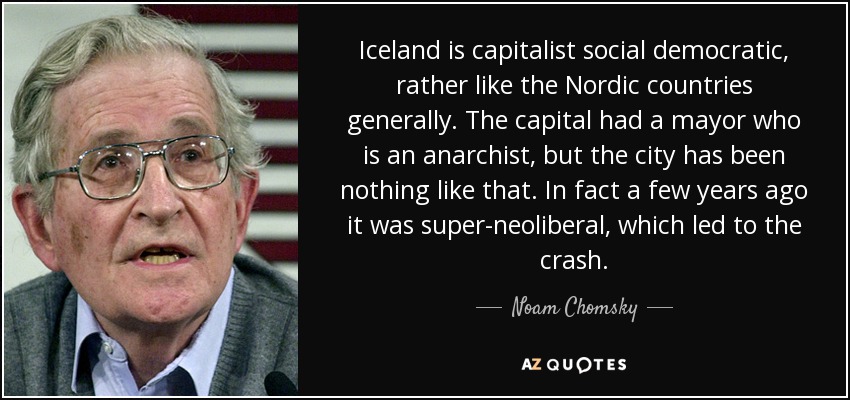
Iceland is capitalist social democratic, rather like the Nordic countries generally. The capital had a mayor who is an anarchist, but the city has been nothing like that. In fact a few years ago it was super-neoliberal, which led to the crash.
As someone from the working class I was always interested in Russia and China and everything that related to the working class, even though I was playing the capitalist game.
Of course it's difficult to know what the workers are really thinking because the capitalist press always only quotes mouthpieces like Vic Feather anyway.
I want a capital-earning democracy. Every man and woman a capitalist. Housing is the start. If you're a man or woman of property, you've got something. So every man a capitalist, and every man a man of property.
When I was young, I worked for a capitalist twelve hours a day and I was always tired. Now I work for myself twenty hours a day and I never get tired
In England, there are only two things to be, basically: You are either for the labor movement or for the capitalist movement. Either you become a right-wing Archie Bunker if you are in the class I am in, or you become an instinctive socialist, which I was.
There is no denying that we are still living in the capitalist world. I think that in order to survive and to change the world, you have to take care of yourself first. You have to survive yourself.
We do not have to get rid of consumer-capitalist society before we can begin to build the new way. The way to replace the old system is to ignore it to death.
In the major state capitalists economies, Europe and the US, it's low growth and stagnation and a very sharp income differentiation a shift - a striking shift - from production to financialization.
Worker ownership within a state capitalist, semi-market system is better than private ownership but it has inherent problems. Markets have well-known inherent inefficiencies. They're very destructive.
The main argument is that capitalism is constituted by a varied of different practices, and so challenging capitalism needs to be about a variety of struggles. I draw on the important work of J.K. Gibson-Graham, who argues that we should model anti-capitalist struggle on feminist struggles.
One of the problems with traditional anti-capitalist thought is that it defines capitalism as a totality, which encourages us to imagine another totality, socialism, which we can try to replace it with. This totalizing perspective has colonized the imagination of anti-capitalism and left us waiting for a revolution we can never have.
We see ourselves as inhabiting a complex social world that has some capitalist things going on in it as well as some socialist ones, some communist ones, and many where economics are not separated out of the broader fabric of life (such as sharing and gift giving, and mutual support).
The way we get past capitalism is by building on the healthy non-capitalist aspects of our world while we also do pitched battle with the capitalist ones that we have a fair chance of winning against. In that way we build a better world and shrink the destructive capitalist practices that are part of the social fabric.
I often refer to myself as a radical, reminding people that the word radical comes from the Latin word radix, meaning root. I think we need to get to the roots of problems as we try to solve them. I also like the word anti-capitalist.
You build movements and keep people in a struggle when it feels productive. Anti-capitalists have typically been the people in movements who have declared every gain to be a trick of the capitalist class to buy us off. That line isn't very inspiring, and it shows no sensitivity to how social movements actually succeed.
Yes it is true that pro-capitalist forces have a lot of power. But so did slave-holding racists. We give ourselves hope when we conceptualize capitalism as a set of practices that can be challenged by fighting the piece of the puzzle we feel most compelled to fight.
I believe profoundly in the possibilities of democracy, but democracy needs to be emancipated from capitalism. As long as we inhabit a capitalist democracy, a future of racial equality, gender equality, economic equality will elude us.
The crisis is the price for the capitalist system
By bourgeoisie is meant the class of modern capitalists, owners of the means of social production and employers of wage labor. By proletariat, the class of modern wage laborers who, having no means of production of their own, are reduced to selling their labor power in order to live.
In a capitalist world, the word capital has taken on more and more uses. . . . human capital, for instance, which is what labor accumulates through education and work experience. Human capital differs from the classic kind in that you can't inherit it, and it can only be rented, not bought or sold.
The essential point here is that all people with small, insecure incomes are in the same boat and ought to be fighting on the same side. Probably we could do with a little less talk about' capitalist' and 'proletarian' and a little more about the robbers and the robbed.
It has not been possible to build that society. It set very high standards, because not only would life in the Soviet Union or in any other country which adopted that system, have to be just as good as in the Capitalist world, it would have to be better. So that other peoples, other nations would want to join it, and obviously we have failed in that.
I am a capitalist and I believe in making a profit.
Imagine, capitalist America also divides the anarchists into two categories, philosophic and criminal. The first are accepted in highest circles; one of them is even high in the councils of the Wilson Administration. The second category, to which we have the honor of belonging, is persecuted and often imprisoned. Yours also seems to be a distinction without a difference. Don't you think so?
Follow AzQuotes on Facebook, Twitter and Google+. Every day we present the best quotes! Improve yourself, find your inspiration, share with friends
or simply: