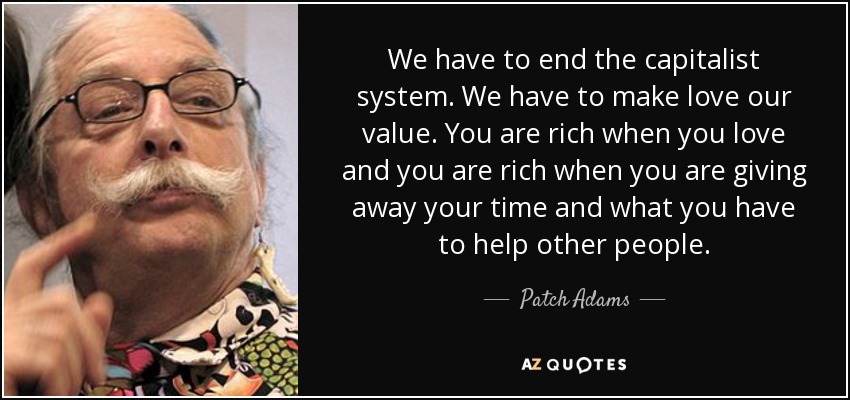
We have to end the capitalist system. We have to make love our value. You are rich when you love and you are rich when you are giving away your time and what you have to help other people.
We live in a predatory capitalist society in which everything is for sale. Everybody is for sale, so there is ubiquitous commodification - be it of music, food, people, or parking meters.
The barriers that renewables and efficiency face come less from our living in a capitalist market economy and more from not taking market economics seriously.
Obviously there are some organizations that go out on the street and say we want an end to the capitalist system. But obviously that is not going to happen as a result of just assuming that stance.
The capitalist workplace is one of the most profoundly undemocratic institutions on the face of the Earth. Workers have no say over decisions affecting them. If workers sat on the board of directors of democratically operated self-managed enterprises, they wouldn't vote for the wildly unequal distribution of profits to benefit a few and for cutbacks for the many.
The more successful capitalists are in cutting their wage costs, the less money workers will have to buy back what those same capitalists produce. It's a contradiction.
A cooperative enterprise is the key alternative to a traditional capitalist enterprise. All the workers, whatever they do inside an enterprise, have to be able to participate in collectively arriving at the decisions about what, how, where to produce, and what to do with the profits in a democratic way. One person, one vote should decide how these things are done.
What's interesting to me is that in the late twentieth century it seems that there's scarcely a part of the world that doesn't have some capitalist return that can be realized providing that this area's made accessible and resources can be extracted from it.
"Patents make our product defensible." The optimal number of times to use the P word in a presentation is one. Just once, say, "We have filed patents for what we are doing." Done. The second time you say it, venture capitalists begin to suspect that you are depending too much on patents for defensibility. The third time you say it, you are holding a sign above your head that says, "I am clueless."
It is a democratic uprising. I'd say a democratic revolution against imperialism and against capitalism. So the agreements between us, more than that, any cooperation means unconditional credit, while the US and some capitalist countries want to help us under conditions, under blackmail.
While I'm a venture capitalist who invests in early-stage tech companies, I often feel like a professional emailer and conference call maker. I try to spend most of my time doing whatever the companies we are investors in need me to do.
The world is a big place. There are lots of smart people in it. Entrepreneurs are kidding themselves if they think they have any kind of monopoly on knowledge. And, sure as I'm a Macintosh user, on the same day that an entrepreneur tells this lie, the venture capitalist will have met with another company that's doing the same thing.
Man is about to be deprived of a great pole - work routine. The nightmare of capitalist society is unemployment; the nightmare of cybernetic society will be employment.
Given the fact that we are in a capitalist society, we still do not want to overlook not only what a corporation produces and its profitability but also how it impacts the environment, touches human life and whether it protects or undermines the dignity of the human person.
Human beings were behaving as human beings and not as cogs in the capitalist machine.
If you're a capitalist and you have the best goods and they're free, you don't have to proselytize, you just have to wait.
The ideal of having a real job that you risk your soul in and make good or be damned, belongs to the heroic age of capitalist enterprise, imbued with self-righteous beliefs about hard work, thrift, and public morals. Such an ideal might still have been mentioned in public fifty years ago; in our era of risk-insured semimonopolies and advertised vices it would be met with a ghastly stillness.
The capitalist system is not delivering those decade-after-decade increases it promised. We're not where we should be in terms of our national economies. We don't know how to get out of this malaise and I think we now have to consider more radical policies.
I’m a capitalist, not a corporatist. I’m not someone who believes we should be bailing out corporations whether their auto industries, or banks.
The dominant, almost general, idea of revolution - particularly the Socialist idea - is that revolution is a violent change of social conditions through which one social class, the working class, becomes dominant over another class, the capitalist class. It is the conception of a purely physical change, and as such it involves only political scene shifting and institutional rearrangements
The capitalist system was termed "capitalism" not by a friend of the system, but by an individual who considered it to be the worst of all historical systems, the greatest evil that had ever befallen mankind. That man was Karl Marx.
Outsiders think of Silicon Valley as a success story, but in truth, it is a graveyard. Failure.. is Silicon Valley's greatest strength. Every failed product or enterprise is a lesson stored in the collective memory of the country. We not only don't stigmatize failure, sometime we even admire it. Venture Capitalists actually like to see a little failure in the resumes of entrepreneurs.
That first company I started made a lot of money for the venture capitalists - nearly $30 million - but next to nothing for the founders. The companies I started after that varied between failures and mediocre successes. But at no point did I ever consider getting a 'real job.' That felt like a black and white world, and I wanted Technicolor.
At a basic level venture capitalists are arbitrageurs: they have access to more information than those with the capital, and access to more capital than those with information, and they profit by exploiting the mismatch.
Generally speaking, experience counts for something. So you'd expect entrepreneurs who've been through the ups and downs of a tech startup to have an advantage over the newcomers. Or at least have an equal chance at success. But in fact the opposite may be true. A number of venture capitalists I've spoken with have said that too many "old guard" entrepreneurs are not being bold enough in their business decisions, and it's hurting their startups.
Follow AzQuotes on Facebook, Twitter and Google+. Every day we present the best quotes! Improve yourself, find your inspiration, share with friends
or simply: